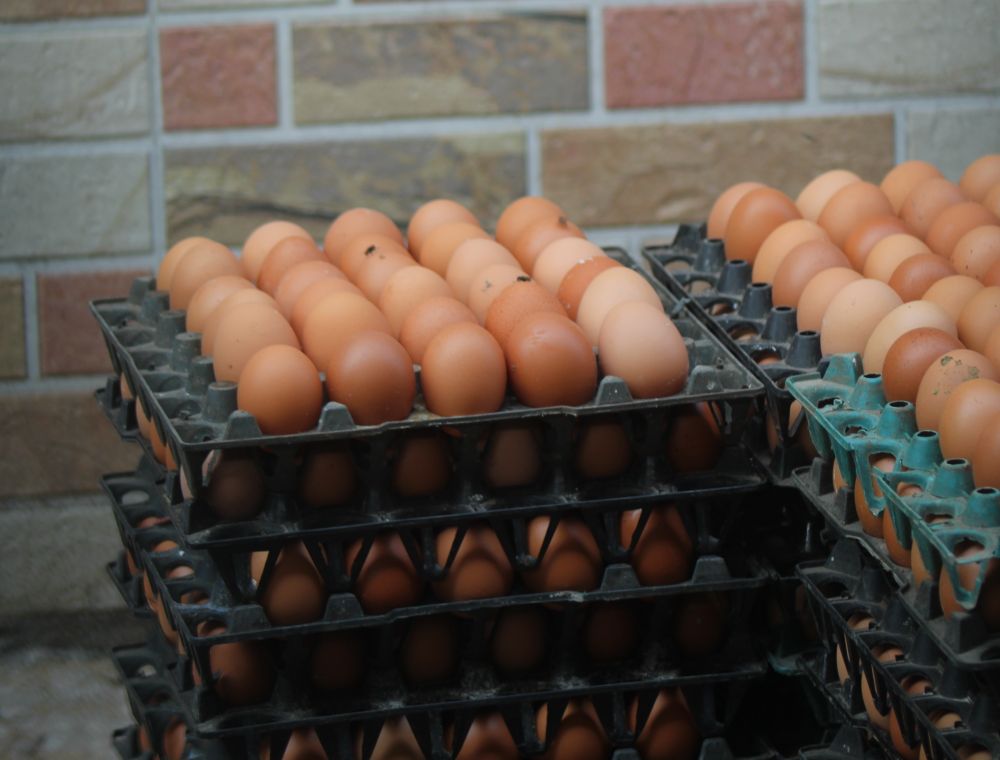
Short answer: Two collections a day is the floor, and three is the rule once the house heats up, because an egg left in a nest for hours picks up dirt, heat damage and cracks. Sort the eggs at the door, dry-rub them at the coop rather than soaking them, and keep a daily record of cracked and dirty eggs so one bad round shows up the same day. For a 240-hen house laying about 80 percent, a 2 percent crack rate costs about GH₵192 a month in lost crates.
Key takeaways
- Collect three times a day when the house is hot: early, late morning and mid-afternoon.
- Sort at the door into clean, dirty, cracked and floor eggs, and keep each tray separate.
- Dry-rub at the coop. Save washing for a batch you intend to sell straight away.
- Write the count of eggs, cracks and dirty eggs for each round in a record, not in your head.
- A 2 percent crack rate on 192 eggs a day is roughly GH₵192 a month in lost crates.
Three rounds a day once the heat arrives
Three collection rounds a day on a 240-hen house is not overkill once the afternoon heat reaches the nests. It is the cheapest insurance on the farm, because the hens do the laying and you only have to stop the eggs from spoiling while they wait.
Most of a flock's eggs are laid between early morning and early afternoon. A morning round at about seven or eight picks up what the hens laid overnight and at first light, while the house is still cool. A round at about eleven catches the middle of the laying window, and that is the one that goes wrong most often in the hot months. A late-afternoon round at about three or four clears the last layers of the day before the nests go into the evening cool and the hens start to roost.
If you only collect once, the eggs laid after breakfast sit in hot nests until evening. You will not see the damage straight away. You will see it in the crate, as dirty shells, a few cracks and the odd egg that is cold and tacky inside the tray. By then the problem is already in the batch. Our hot-season article on egg drop covers what the heat does to the hens themselves, which matters just as much as the eggs.
What the nest tells you before you touch an egg
Before you lift an egg, look at the nest. A hen that laid in a dry, clean nest left an egg that is clean and easy to collect. A nest with droppings, wet litter or a broken straw base tells you that the nest is wrong, and the eggs in it will be dirtier than they need to be.
Count the eggs as you take them, and count the empty nests too. If three nests in ten are empty while the others hold eggs, two or three hens are probably laying on the floor or fighting for the same box. Note the empty nests on the record. You will use that number later when you ask why the crate was short.
Check the nest for a broken egg before you move on. A cracked shell that has leaked into the litter draws flies, makes the nest sticky, and can lead a hen to peck at the next egg. Remove the broken egg, take out the soiled litter, and put in a handful of clean dry material before the next round. Our nest box guide covers how many nests a flock needs and what size they should be.

Sorting at the door: clean, dirty, cracked and floor eggs
Sort the eggs at the door, not later at the sales table. Once an egg has gone into the main crate with a cracked shell or a smear of droppings, the only way to remove it is to open every crate, and by then you have already paid for the labour twice.
Use four trays. The clean tray takes eggs that are whole, dry and free of dirt. The dirty tray takes eggs with droppings, litter or a dull, dusty shell. The cracked tray takes anything with a visible crack, including the hairline ones you find only when you tilt the egg to the light. The floor tray takes any egg that was laid on the litter, the floor or a ledge, because those eggs have usually picked up more than the nests put on them.
Keep the trays separate all the way to the sale. A buyer who finds a single dirty egg in a crate of clean ones will remember it. A buyer who finds a cracked egg in a crate of sound ones will often refuse the whole crate. Sorting is slow for the first week and quick after that, and the sorting itself teaches you which hens and which nests are causing the trouble.
A dry rub at the coop, and when to leave the washing for later
At collection, the job is to remove loose dirt and nothing more. Take a dry cloth, or a soft brush, and rub the shell gently until the dust and litter come off. A fine sandpaper block takes off stubborn dried droppings without wetting the egg. Do not soak eggs in a bucket at the coop, and do not use a hose on a tray of eggs.
Washing is a separate decision, and it belongs at the store, not at the nest. A washed egg loses its protective bloom, so it keeps for a shorter time, and a wash in cold water can pull contamination into the egg. Our washing guide for table eggs covers when to wash, how warm the water should be, and what to sell first. The short version for collection is this: dry-rub every egg, and only wash the batch you are about to sell that day.
In the rainy season, the nests and the eggs both get wetter, and dry-rubbing takes longer. Do not be tempted to rinse the whole crate in a bucket to speed things up. Put the wet eggs in a separate tray, let them dry in the shade with the tray uncovered for an hour, and then grade them. Eggs that are still wet when they go into the crate are a recipe for mould.
Hour by hour: why eleven o'clock is the danger time
The three rounds are not equal. Each one meets a different state of the eggs, and each needs a different response. The table shows what we would expect to find, and what to do about it, on a hot dry day with a flock that is laying well.
| Round | What is in the nests | Main risk | What to do |
|---|---|---|---|
| About 7 to 8 am | Eggs laid overnight and at first light, cool and mostly clean | Dew and litter on the shells | Dry-rub, sort, and move the trays to shade |
| About 11 am | Eggs laid since the last round, warm from the hen and the house | Heat damage, sweating, cracks in the tray | Collect fast, keep trays out of direct sun, and check the house temperature |
| About 3 to 4 pm | The last layers of the day, in nests that have been hot for hours | Dirty shells and eggs that roll to the floor | Collect, sort the floor eggs out, and clear the litter before roosting |
The eleven o'clock round is the one most farmers skip when they are busy. It is also the round that takes the most damage in a hot spell. If the house is hot enough that the hens are panting, the eggs in the nests are hotter too. Collect them quickly, and if your shed has a fan or a shaded side, move the trays there rather than leaving them by the open door. Our storage guide covers the temperatures that matter once the trays are in the store.

Carrying eggs in trays, never in buckets or loose handfuls
Carry eggs in flat trays from the nest to the store. A bucket is the commonest way to crack a batch, because eggs knock together as the bucket moves and the bottom layer takes the weight of everything above it. A loose handful is worse. Both cause breakage that you will only notice when the crate is opened at the buyer's door.
Walk the collection route once without carrying anything, and note the steps where the trays might tip, the doorways that are too narrow, and the ramp or step that makes you run. Fix those before the first round. A tray that is carried flat and set down on a hard, flat surface breaks far fewer eggs than one that is swung along a path.
The trays also need to be clean. A tray that has held cracked eggs and was never scrubbed will spread the same crack and the same dirt to the next batch. Keep one set of trays for clean eggs and another for dirty ones, and wash the dirty set at the end of each day. Our guide to packing and transporting eggs covers what happens once the crates leave the farm, including the bus-station handover.
The collection record that catches a problem in a day
A record is what tells you whether a bad crate was bad luck or a sign that something has changed. Keep one sheet per week, with a line for each round. Write down the date, the time, the number of eggs collected, and how many were cracked, dirty and on the floor. Add a note for anything unusual, such as rain, a sick bird or a broken nest.
Here is an example of three lines from a hot week. The numbers are an illustration, not a benchmark, but they show the kind of pattern a record makes visible.
| Date | Round | Eggs | Cracked | Dirty | Floor | Note |
|---|---|---|---|---|---|---|
| 11 Nov | 7:30 am | 58 | 0 | 2 | 0 | Cool night, nests dry |
| 11 Nov | 11:00 am | 61 | 2 | 6 | 1 | Hot, two hens in one nest |
| 11 Nov | 3:30 pm | 49 | 1 | 4 | 0 | Rain from 2 pm, floor eggs up |
The eleven o'clock line is the one to watch. Two cracks and six dirty eggs in one round is a signal, and the note tells you the cause. Two hens sharing one nest, a hot house and a rain shower all push the numbers the same way, and the record lets you separate them. Without the record, you will only remember that the crate was disappointing. For how buyers judge a crate once it reaches them, see our egg quality guide.
Hands, boots and who is allowed to touch the eggs
The person who collects the eggs should be the person who keeps the nests clean, and that person should not handle sick birds or dead birds in the same round. Wash hands before the first round, and again after handling the bins, the feed sacks or any bird that looks unwell. Salmonella can be found on the shell and on hands, and a clean routine does more than a pair of gloves that gets touched on the way in and out of the shed.
Boots matter too. Dust and droppings from the walkway end up on the tray, and a tray that is set down on the floor will pick up what the boots carry. Keep a pair of boots for the house only, or dip them in a footbath at the door. A separate set of collection trays that never leave the house is the simplest rule to follow.
In a shared household, the eggs also get touched by people who never work in the shed. Keep the collected trays in a cool room or a shaded store, not on a kitchen counter that is used for cooking, and label the crates that are for sale so nobody takes a dirty egg from the wrong tray at home.
Need chicks for your next batch?
Send breed, number and town. We reply with price, hatch date and delivery cost in writing.
Hairline cracks you cannot see, and what to do with them
Some eggs leave the nest with cracks you cannot see. The shell is intact to the eye, but a fine crack runs through the outer layer and lets air and bacteria in. You find these only by tilting the egg against a bright light in a dark room, or by listening to two eggs knocking together. A dull sound that does not ring is a warning.
Put any egg that you suspect into the cracked tray, not the clean one. Do not sell it as a whole egg. If you want to use it at home, crack it into a bowl first and check the smell and the colour of the white before you cook it. A bad smell, a green or pink tinge or a watery white means the egg goes in the bin.
Hairline cracks rise with age, heat and calcium shortfall. If the cracked share climbs over several weeks while the nests and the collection stay the same, look at the feed, the oyster shell and the house temperature before you change anything else. The cracked column on your record will tell you when the trend starts. Spots inside the egg are a separate problem, and our blood spots article covers them.
A worked routine for 240 hens, and what a 2 percent crack rate costs
Take a house of 240 hens laying at about 80 percent. That is roughly 192 eggs a day, or about 5,760 in a 30-day month. Our table-egg price is GH₵50 a crate of 30, which works out to roughly GH₵1.67 an egg, and every cracked or unsaleable egg costs about that much.
Now take a crack rate of 2 percent, which is not a catastrophe in most houses. That is about 115 eggs a month, or roughly GH₵192 of crates gone. If the rate doubles in the hot season to 4 percent, the loss doubles with it, and nobody has to do anything wrong for that to happen. A three-round routine cuts the time an egg sits in a hot nest, and it is usually the cheapest way to hold the rate near 2 percent. Once the crates are full, grading by size decides what each crate is worth.
A routine that fits this house runs like this. Collect at about 7:30, sort at the door, and move the clean trays to the store. Collect at about 11, dry-rub and sort, and move the trays out of direct sun. Collect at about 3:30, sort, clear the floor and the litter, and write the record before dinner. The whole round takes about twenty minutes a time once the crew knows the steps, and the record takes five minutes a day.
Mistakes that cost more than the eggs
- Collecting once a day in the hot months. The afternoon eggs sit all night in hot nests, and the crate shows it the next morning.
- Tipping eggs from the tray into a bucket. Eggs knock together, and the cracks show up at the buyer, not at the farm.
- Soaking dirty eggs in a bucket at the coop. The wet shell takes in dirt, and a wet tray is slow to dry.
- Mixing floor eggs into the clean tray. One dirty egg is the reason a buyer refuses the whole crate.
- Using the same tray for cracked and clean eggs. The crack spreads to the next batch on the tray's rim.
- Keeping no record. Without the numbers, every bad crate looks like bad luck.
A collection checklist to pin by the door
- Wash hands before the first round, and again after the bins, the feed sacks or any sick bird.
- Collect at about 7:30, 11 and 3:30, and tick each round on the record sheet.
- Look at each nest before lifting the egg, and note any empty nests or broken eggs.
- Dry-rub every egg at the coop, and sort it into clean, dirty, cracked or floor trays.
- Carry the trays flat, never in a bucket, and set them on a hard, level surface.
- Move the trays out of direct sun, and into the shade or the store, within minutes of collection.
- Write the count, the cracks, the dirty eggs and the floor eggs for each round on the sheet.
- Clean the dirty trays at the end of the day, and keep them apart from the clean set.
Questions farmers ask
How often should eggs be collected in the hot season?
At least twice, and three times in the hot season or when the house gets dusty or wet. Early morning, late morning and mid-afternoon suit most flocks. If you only collect once, the eggs laid after breakfast sit in hot nests until evening, and you will see the damage in the cracked and dirty counts the next morning.
Should I wash eggs as soon as I collect them?
Not as a routine. Dry-rub the dirt off and sort the eggs. Wash only the batch you will sell that day, in water warmer than the egg, with an approved sanitiser, and read the washing guide before you start. Washing removes the protective bloom, so a washed egg keeps for less time than an unwashed one.
What do I do with cracked eggs?
Keep them out of the saleable crates. Use them at home within a day or two after cracking them into a bowl and checking the smell, or sell them as cracked for cooking if your buyer accepts that. Never sell a cracked egg as a whole one. Log the cracks every day, because a rising number points to calcium, heat or handling, and each one has its own fix.
Can eggs stay in the nest overnight?
They should not be left in the nests overnight if you can avoid it. Eggs left out can be dirty and cold, and hens may peck at them. A final check in the evening is a good habit, but the main collections should happen while the eggs are still cool and clean, and the afternoon round should clear what the day laid.
How do I tell a floor egg from a nest egg?
A floor egg has sat on the litter or the floor, and it usually shows scratches, dirt or a dull shell. Log floor eggs separately. If they keep appearing, the nest boxes need attention, which is a separate job covered in our nest box guide, and the count of floor eggs is the first sign that a nest has gone wrong.
Do I need gloves to collect eggs?
Gloves are not essential, but clean hands are. Wash hands before you start and again after handling bins, dead birds or feed. Keep the collection trays off the floor. Salmonella can be found on the shell and on hands, so simple, repeated habits matter more than the equipment you wear.
How long can I keep collected eggs before I sell them?
Store them somewhere shaded and cool, and sell within about a week where you can. Our storage article covers room temperature and cool stores in more detail. Dirty or cracked eggs should not be kept with clean stock, because one bad egg can affect how the whole tray is judged.


