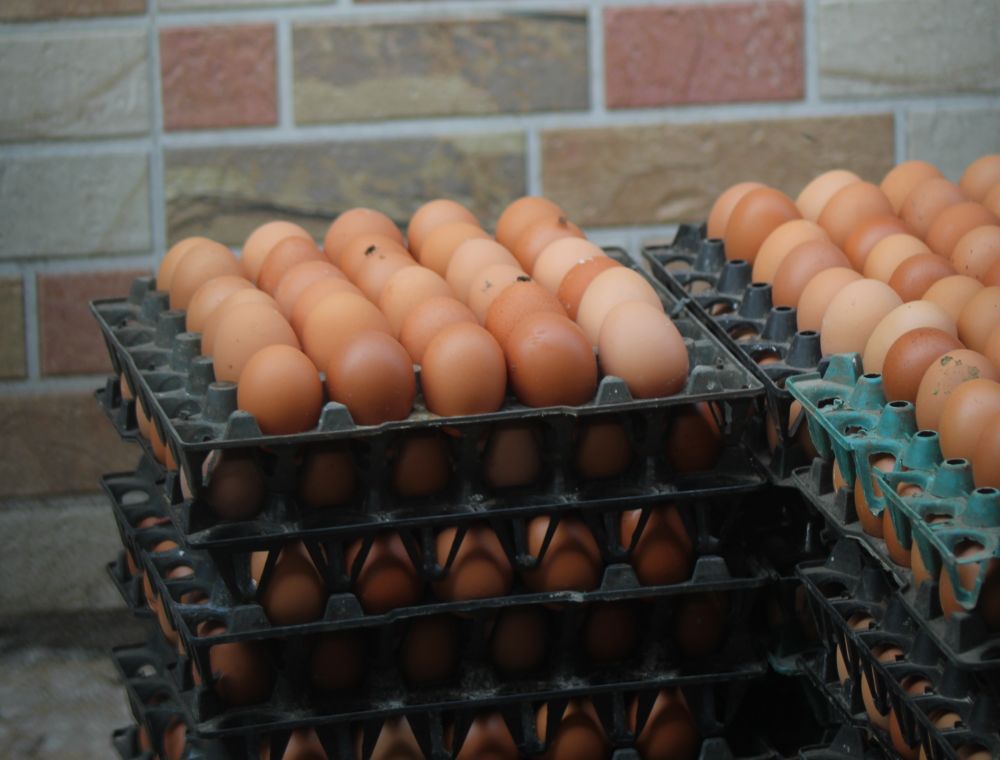
Short answer: Most buyers in Ghana judge table eggs by eye and by the crate rather than by a printed grade. A practical split is small under 53 g, medium 53 to 63 g, large 63 to 73 g and extra large over 73 g, the classes many international packers use. Weigh a sample each week, sort by size, and price a uniform crate higher than a mixed one.
Key takeaways
- Sort table eggs by weight, not by eye, and write the size on every crate.
- Medium and large eggs sell most easily in most local markets.
- Weigh a sample of ten eggs every week and keep the average for each flock.
- Take out cracks, marks and blood spots before the size sort, not after.
- A uniform crate of 30 earns more than a mixed one, even at the same average weight.
- Quote crate prices in writing before any money changes hands. Our starting price is GH₵50 for a crate of 30.
Why sorting eggs changes what you earn
Eggs look alike in a tray, but a buyer who runs a bakery or a chop bar notices a mixed crate within a few seconds. Large and small eggs in one crate mean uneven cooking, uneven portions and a buyer who has to sort them before use. A uniform crate says the farm is organised, and buyers reward that with repeat orders and fewer questions about price.
Grading also tells you what your flock is doing. If your medium eggs are slipping into small, or your large eggs are creeping up, you have an early warning about feed, age or water. Most farms only notice a problem when the crate count falls. A weekly weigh-in shows it sooner. The breed you keep sets the typical size range, and our breed pages set out how the common layers compare.
The size classes, with weights you can check at home
In most Ghanaian markets, buyers judge eggs by eye rather than by a printed grade. That leaves room for you to set a clear system and stick to it. The classes below follow the weight bands that many international packers use, which makes them easy to explain to a buyer who has seen a carton elsewhere.
| Size class | Weight per egg | Where it usually sells | Practical note |
|---|---|---|---|
| Small | Under 53 g | Household bundles, cheaper lines | Often the first eggs of young hens, so keep them in a separate tray |
| Medium | 53 to 63 g | Households, chop bars, bakeries | The easiest size to keep uniform across a flock |
| Large | 63 to 73 g | Bakeries, shops, restaurants | Usually the size buyers ask for by name |
| Extra large | Over 73 g | Premium orders, special requests | Only a few hens in a flock reach this regularly |
| Reject | Any weight | Not for sale as table eggs | Cracked, dirty, bloody or leaking eggs |

Use the table as a starting point and adjust it to what your buyers ask for. A chop bar that wants large eggs for omelettes will pay for them, while a household buyer may be happy with medium at a lower price. The point is to have named classes and to use them every time.
How to weigh a sample without a lab
You need a digital kitchen scale that reads to one gram, a clean bowl and a pencil. A cheap spring scale is not accurate enough to sort eggs that sit close to a class boundary. Pick ten eggs at random from different parts of the tray, not only the top layer, and weigh each one on its own. Write the weights down in a column.
Add the ten weights and divide by ten to get the average. A flock averaging 58 g is mostly medium, with some large and some small, and you can see that at a glance. If the average is well below the range you expected, sort a bigger sample before you decide anything, because one heavy tray can mislead you. Keep the figure on the same page as your daily tally, so you can compare this week with last.
- Pick ten eggs from across the tray, not just the top layer.
- Weigh each egg on its own on a scale that reads to one gram.
- Write each weight down, then add them and divide by ten.
- Record the average against the flock and the date.
- Repeat every week, and again after any feed or house change.
Grading by eye: what a trained hand can do in a morning
After a few weeks, most people can sort by eye with reasonable accuracy. Hold two eggs side by side, feel the weight in your palm and look at the length and the width. Large eggs are visibly longer, and their shells look fuller. Small eggs look narrow and light. Keep a set of plastic size gauges or a board with cut-out rings if you want a tool that does not depend on the sorter's mood.
Eye sorting drifts, though. A tired sorter at the end of a long collection will put a few large eggs into medium and a few medium into large. Weigh a sample of the sorted trays once a week to check the hand. If the medium tray averages well above 63 g, your sorter is generous, and you are giving away large eggs for the price of medium.
What the hen controls and what she cannot
Breed and age set the range of egg sizes a flock can produce. A young flock lays smaller eggs, and the average rises for several weeks after first lay. You cannot push a pullet's first eggs into the large class, and no ration will make that happen in a fortnight. Egg size is also tied to body weight at the start of lay, which is why reared pullets and bought point-of-lay birds can lay different sizes from the same hatch. Our point-of-lay pullet guide sets out how the start of lay shapes those first eggs.
Within that range you have some control, through feed, water, heat and the uniformity of the flock. Our guide to increasing egg size sets out the levers that move the average up, and what to expect from each one. The point here is simpler. Before you try to change the size of your eggs, find out where the flock sits in its own range, and sort according to that.
Defects that take an egg out of the top grade
Weight is only one part of grading. A large egg with a crack, a bloody spot or a dirty shell does not sell as a clean large, and it can spoil the crate next to it. Our guide to blood spots explains why spots happen and how to pull them out at collection. Double-yolk eggs are normal to eat, but most buyers do not expect them in a standard crate, so keep them out of sized packs or label them clearly.
Shell-less eggs, misshapen eggs and very thin shells all belong in the reject tray. Thin shells are a feed or heat signal, and they tend to crack in transport, so they should not travel. We cover the causes of those in our notes on soft-shelled eggs, and the odd-egg types in our double yolk and abnormal egg guide.
Pricing a mixed crate against a sorted one: a worked example
Start with the arithmetic. A crate of 30 mixed eggs at GH₵50 works out to about GH₵1.67 an egg. That is a fair way to think about the crate, but it hides what the buyer is actually paying for. If you split the same crate into 15 large and 15 medium, and charge 10 per cent more for the large, the sums change. Let the medium price be x. Then 15x plus 15 times 1.1x equals 50, so x is about GH₵1.59 and the large comes to about GH₵1.75.
The sorted crate costs you a few minutes more, and it lets you ask a clear price that a buyer can compare with the next seller. Your own premium will differ, and so will your local market. The method stays the same: work out the average, decide the premium you can defend, and write both prices down so you keep to them. If you are still deciding which layers to start with, our layer chick page is the next place to look.
Need chicks for your next batch?
Send breed, number and town. We reply with price, hatch date and delivery cost in writing.
Labelling the crate so the buyer trusts it
A label is a promise, so keep it honest. Write the size class on the crate, the date the eggs were laid, and whether they are brown or white if the buyer cares. Put the farm name or your own name on the label so the buyer knows where to come back to. Do not use words like organic or free range unless your system actually meets what the buyer will assume they mean. If you wash eggs before you sell them, say so. Our washing guide covers the safe method.
Date the eggs by when they were laid, not when they were packed. A buyer who sees a laying date a week back can judge freshness for themselves, and they trust the crate more for it. If you mix two days of collection in one crate, write the earliest date, not the latest.
A weekly grading routine that takes twenty minutes
A routine keeps grading quick. Do it on the same day each week, at the same time, after the first collection. Lay out clean trays and a marked reject tray, and have the scale and the record sheet ready before the eggs arrive. A two-person routine is faster than one person doing everything. Once the crates are full, keep them as our table egg storage guide describes, in a cool and shaded place.
- Remove cracks, dirty eggs and blood spots into the reject tray.
- Weigh ten random eggs and note the average on the record sheet.
- Sort the rest by eye into small, medium and large trays.
- Spot-check one tray of each size on the scale.
- Fill crates by size, write the labels and move them into the cool store.
Checklist before you put a crate on sale
- The crate holds one size class, or is clearly labelled as mixed.
- No eggs are cracked, leaking, dirty or showing a blood spot.
- The laying date is written on the crate.
- The weight average for the sample is recorded against the flock.
- The price per crate is written down and matches what you quoted.
- Crates are clean, dry and out of the midday sun while they wait for buyers.
Mistakes that cost sales
The most common mistake is grading once and never checking. Eye sorting drifts, the scale goes unused, and the large eggs quietly end up in the medium crate for months. The second is mixing days in one crate without a date, which makes the buyer suspicious of every crate after that.
The third is pricing a crate as if every egg were large. A buyer who weighs one crate and finds it averages 55 g will remember it. Sell what the crate actually is. Honest grading and clear prices bring buyers back, and a buyer who returns every week is worth far more than one who buys once at the top price. Our guide to selling poultry covers the buyer side in more depth.
Questions farmers ask
What size are table eggs in Ghana?
Most table eggs in Ghana sit in the medium and large bands, but there is no single printed grade that every buyer follows. A common approach uses small under 53 g, medium 53 to 63 g, large 63 to 73 g and extra large over 73 g. Pick the classes you can explain, weigh your flock to see where it sits, and use the same names every week.
How many eggs are in a crate in Ghana?
The usual crate for table eggs in Ghana holds 30 eggs. Buyers from households to chop bars think in crates, and that is the unit we use. A tray of six or ten suits a household buyer, while a bakery or shop will want a full crate on a fixed day each week.
How do I know the weight of my eggs without a lab?
Use a digital kitchen scale that reads to one gram. Weigh ten eggs picked at random from different parts of the tray, add the weights and divide by ten. That average tells you which class most of the flock sits in. Repeat it weekly, and again after any change in feed, water or housing.
Why are my eggs getting smaller?
Common causes are a flock that is still young, heat, a drop in water intake, a feed that is short on protein or energy, or a fall in body weight. Check the age of the flock first, then the water and the heat, then the feed phase. Small eggs that appear suddenly in a mature flock deserve a look at the flock's health.
Should I sell mixed crates or sorted ones?
Sorted crates usually earn more and build trust, because the buyer knows what they are paying for. Mixed crates can still sell at a lower price to buyers who only want cheap eggs, such as some household customers. Label mixed crates clearly as mixed, and never describe them as a size class they do not meet.
Do brown eggs need a different grade from white eggs?
The size classes are the same for brown and white eggs. Colour is a preference of the buyer, not a grade. Keep brown and white in separate crates if your buyers ask for one or the other, and label each crate so the buyer knows what is inside before they open it.
How often should I weigh my eggs?
Weigh a sample every week as a routine, and again after any change in feed, water, housing or flock age. A weekly average shows drift early, long before a buyer notices it in a crate. Write each average down so you can see the trend across the whole flock's life.


