What a Cobb 500 is, in plain terms
The Cobb 500 is a broiler. It is bred to put on meat fast and turn feed into body weight, and that is the whole job. A Cobb 500 hen will not give you a worthwhile laying flock, and the birds are not kept for breeding either. You raise them once, sell them as table birds, and then start the next box.
Our Cobb 500 chicks are imported. Imported breeds reach us from hatcheries in the Netherlands, Belgium and Germany, and they come to our Opeikuma hatchery as day-old chicks. The strain sits in the same fast-growing group as the Ross 308, which is why the two come up together whenever a broiler buyer asks what to order. The breeds page lists every bird we sell, and the imported day-old chicks page explains where each line comes from.
Think of the Cobb 500 as a bird for a planned cycle. You decide the market weight and the sale date, then build the feed, space and labour around those two numbers. Flocks that go badly are usually the ones where nobody decided anything in advance.
What you pay for Cobb 500 chicks
The starting price is GH₵ 20 per chick. The smallest order is one box of 50, and that box is GH₵ 1,000. These are starting prices. We confirm the exact amount in writing for each order, so ask for the quote before you transfer any money.
| Order | Starting price | What it covers |
|---|---|---|
| Per chick | GH₵ 20 | Used to work out your budget per bird |
| One box of 50 | GH₵ 1,000 | The minimum order |
| Two boxes, 100 chicks | GH₵ 2,000 | Two boxes at the box price |
| Three boxes, 150 chicks | GH₵ 3,000 | Three boxes at the box price |
Delivery is not included in those figures. It is quoted separately in writing. To estimate a whole cycle, the day-old chicks cost calculator takes your flock size and adds the rest, so you see the chick cost next to feed, housing and labour before you commit.
Prices
 Imported
Cobb 500
A heavy, efficient meat bird with high breast yield that copes well on lower-cost feed.
Cobb 500 or Ross 308: where the two really differ
Price will not separate these two. Both start at GH₵ 20 a chick and GH₵ 1,000 a box with us, so you choose on the bird, the market and your house. The Ross 308 page describes that bird in full, and the broiler breed guide sets the two side by side.
Where Cobb 500 buyers talk most is breast yield. A bird with a fuller breast gives more saleable meat to a processor or to a home butcher who sells cut-up portions, and the Cobb is generally described as strong on that point. Feed conversion, meaning how many kilos of feed it takes to add one kilo of live weight, is close between the two when both are well managed. Published trials and breeder reports disagree on the small gaps, so be wary of anyone who says one line beats the other by a wide margin.
Uniformity is the other thing to watch. A flock that grows evenly sells evenly, and a tail of small birds at the end of the cycle costs you money at the scale. Good brooding, steady feed and even drinkers do more for uniformity than the choice of breed does.
How fast a Cobb 500 grows and when to sell
Growth depends on the feed programme, the temperature in the house and how many birds share each square metre. Under good management a Cobb 500 usually reaches about 2.5 kg live weight at around six weeks. In a hot house, or where the feed changes too often, expect lighter birds at the same age. Treat those figures as typical ranges, not promises, and weigh a sample of 20 to 30 birds every week so the scale tells you how the flock is doing.
Most farmers sell when the flock reaches the weight their buyer wants, not on a fixed day. Traders and restaurant suppliers often ask for birds in a certain size band, and the price per kilo moves with the season. Put your own weights and prices into the broiler profit calculator before you settle on a sale date. It will show you where the money starts to thin out if you keep the birds too long.

Feeding the flock from starter to finisher
Most broiler programmes run in three feed phases: a starter for the first two weeks or so, a grower through the middle weeks, and a finisher for the last stretch before sale. Each phase carries a different protein level, and the switch should come on a schedule, not because a bag ran out on a Thursday. Ask your feed supplier for the protein figures on each phase and hold the flock to them.
- Starter: from placement to about day 14, in crumble form, always available.
- Grower: roughly day 14 to day 28, as the birds start to eat in larger amounts.
- Finisher: from about day 28 until the birds leave the house.
Water matters as much as feed. Birds that cannot reach a clean drinker eat less and grow slower. Check the drinkers twice a day, clean them, and keep the lines flowing, because a dirty water line goes wrong quickly in our heat. The poultry feed calculator will tell you roughly how many bags a flock of your size will eat across the cycle, which is the number most new farmers get wrong.
The first week, when the chicks are most fragile
The first seven days decide how even the flock will be at the end. Set the brooder warm before the box arrives, around 32 to 35 degrees at chick level, and lower the heat gradually over the following weeks. Spread the chicks under the lamp so they can walk to a cooler spot if they get too warm. Chicks bunched in one corner are cold, and chicks panting with their wings held out are hot. Watch their behaviour, not just the thermometer.
Give water first, before feed, and use a glucose or electrolyte supplement for the first few days if your vet advises it. Put feed on clean paper or shallow trays for the first couple of days so every chick finds it. Keep the litter dry. Wet litter is the fastest route to coccidiosis and ammonia trouble, and if the house smells sharp by day five, something needs fixing that morning, not next week.

Housing a Cobb 500 flock without overcrowding
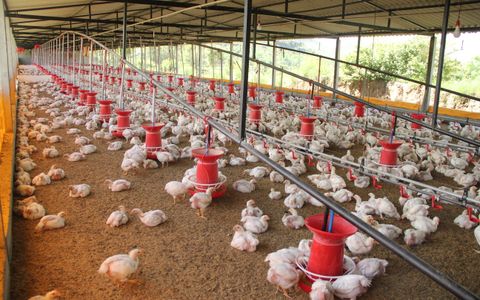
A broiler house needs clean, dry litter, air that moves without draughts at bird level, and enough feeders and drinkers for every bird. A common target for broilers at finishing is around 10 to 12 birds per square metre, though local rules and your buyer may ask for less. Overcrowding shows up first as wet litter, hock burns and slower growth, not as dead birds on day one, so it is easy to miss until the weights start to lag.
Get the house ready before the chicks arrive. Clear the last batch, scrape and disinfect the walls and floor, let everything dry, and then set up the feeders and drinkers. Check the roof for leaks before the rains. A Cobb 500 will eat and drink well in a house that is ready. It will struggle in one you are still fixing on the morning the box lands.
Keeping a Cobb 500 cool through the hot months
Heat is the enemy of a fast-growing bird. A Cobb 500 carries a lot of muscle on a short frame, and once the house runs hot the birds eat less, grow slower and pant more. Open the sides at night, use fans where you have power, and keep shade cloth or a shaded run on the hot side of the building. Cool drinking water matters, and a drinker that sits in the sun warms up faster than you expect.
Feed timing helps. Many farmers move the main feed to the cooler hours of the morning and evening, so the birds are not fighting the heat to eat. Handle the flock early or late in the day when you weigh or move birds. The dry harmattan months, roughly December to February, bring a different problem: fine dust that irritates the airways and dries the litter. Keep the litter damp enough to hold dust down but never wet, and check the birds for watery eyes or snicking sounds each morning.
What is already done when the chicks reach you
The hatchery vaccines cover Marek's, Newcastle, Gumboro (IBD), infectious bronchitis and coccidiosis, so you do not begin those from zero. The hatchery vaccines are the start of the plan, not the whole plan. Later boosters and the timing of any farm-level treatment still need a schedule, and the vaccination schedule calculator lays out the dates from the day the chicks come in.
A batch record comes with every order. File it. If the flock runs into trouble later, that record tells your vet what the chicks were protected against and when, which saves guesswork. Store vaccine vials in a cool place, out of direct sun, and follow the label on how long a reconstituted vial stays usable. A vial you mixed in the morning should not be sitting on your shelf the next week.
Book your chicks for your farm
Send breed, number and town. We reply with price, hatch date and delivery cost.
Who should buy Cobb 500 chicks
A Cobb 500 suits someone who wants table birds on a schedule. If you can sell a flock every six or seven weeks, if you have a buyer who takes whole birds or cut portions, and if you can keep the house and the feed under control, this bird will reward you. One box of 50 is the smallest order we take, so if you need a dozen birds for the family compound, this is the wrong bird and the wrong order size.
The first-time keeper who wants birds for the table and some eggs on the side is often better served by a dual-purpose bird. The dual-purpose chickens page explains the difference, and the broiler chicks for sale page shows the other broiler options we stock. Be honest about how many birds you can sell in one go, because a flock of 50 finishing in the same week needs a buyer waiting for it.
Dispatch day, delivery and getting the chicks to your town
Chicks leave the hatchery on the day they hatch. A chick can travel for about 48 hours on the yolk it absorbed before hatching, so a long road trip is manageable when the box is packed properly. We deliver to all 16 regions. The delivery cost is quoted in writing before you pay, so you know the full figure before any money moves.
Tell us your town and the day you want the birds to arrive. We will check which hatch falls on that date and confirm it. Chicks sent a long distance spend the whole journey in the box, so arrange for someone to collect from the bus station or courier depot early, before the box sits in the heat. The day-old chicks delivery notes cover the practical side, and the delivery page has the regional details.
Ordering on WhatsApp and paying by mobile money
Orders go through WhatsApp or a phone call. Send the breed, the number of boxes, your town and the date you need the chicks. We reply with the exact price in writing, and you pay once you have it. We accept mobile money, bank transfer and cash. We do not take online card payments, so if a bank card is the only way you can pay, we are not the right supplier for you.
Farm visits are welcome by appointment. Come and look at the hatchery, the crates and the way the chicks are handled before you commit. Ask for a visit time through the same WhatsApp line. For starting prices across every breed we sell, check the day-old chicks price list, and remember those are starting figures until your written quote arrives.
What to do if chicks arrive dead
Chicks should arrive alive and active. If some do not, we replace dead-on-arrival chicks free in the next hatch. Photograph the box and the dead birds before you move anything, and report the problem to us the same day with the batch details from your record. We need those details to trace the batch and match the replacement to the right order.
Do not throw the dead birds away until we have seen the photographs. Keep the box as well. A short note of how long the box spent on the road and how hot the vehicle was helps us understand what happened, and it helps you plan the next delivery.
Questions farmers ask
How much is a Cobb 500 chick in Ghana?
Our starting price is GH₵ 20 per chick, and a box of 50 is GH₵ 1,000, which is the minimum order. We confirm the exact price in writing for every order, so the figure you are quoted is the one you pay. Delivery is quoted separately.
Is the Cobb 500 better than the Ross 308 for a Ghanaian farm?
Neither is better in every case. Both sell at the same starting price with us, so the choice comes down to the buyer you sell to and how you manage the house. The Cobb 500 is often chosen for breast yield, while feed conversion is close between the two when both are well managed.
How many Cobb 500 chicks can I order at once?
The smallest order is one box of 50, and you can order as many boxes as you need in one go. Each box is priced at GH₵ 1,000 at the starting rate. If you need fewer than 50 birds, we cannot supply that, so you would need a smaller seller.
How long before a Cobb 500 is ready to sell?
Most flocks are sold somewhere between five and six weeks old, depending on the weight your buyer wants. Under good management a Cobb 500 can reach around 2.5 kg live at about six weeks, while a hot house or uneven feed pushes that back. Weigh a sample every week to know where you stand.
Can you deliver Cobb 500 chicks to my town?
We deliver to all 16 regions of Ghana. Chicks leave on the day they hatch, and the delivery cost is quoted in writing before you pay. Send us your town and the date you need the chicks, and we will confirm the hatch and the cost.
Are the Cobb 500 chicks vaccinated before they leave the hatchery?
Yes. Each batch is vaccinated at the hatchery against Marek's, Newcastle, Gumboro (IBD), infectious bronchitis and coccidiosis, and a batch record comes with the order. Keep that record for your vet and your own files.
What happens if some chicks die on arrival?
Dead-on-arrival chicks are replaced free in the next hatch. Photograph the dead birds and the box when you open it, and report the batch to us the same day with the details from your record.
Can I visit the hatchery before I buy?
Yes, by appointment. A visit lets you see the hatchery, the crates and how the chicks are handled before you commit. Arrange it through WhatsApp or a phone call.
How do I pay for Cobb 500 chicks?
We accept mobile money, bank transfer and cash. We do not take online card payments. Pay once you have the written quote, and keep the payment confirmation with your batch record.
Prices and details checked 18 October 2026 by the Halaal Farms hatchery team, Opeikuma, Kasoa.