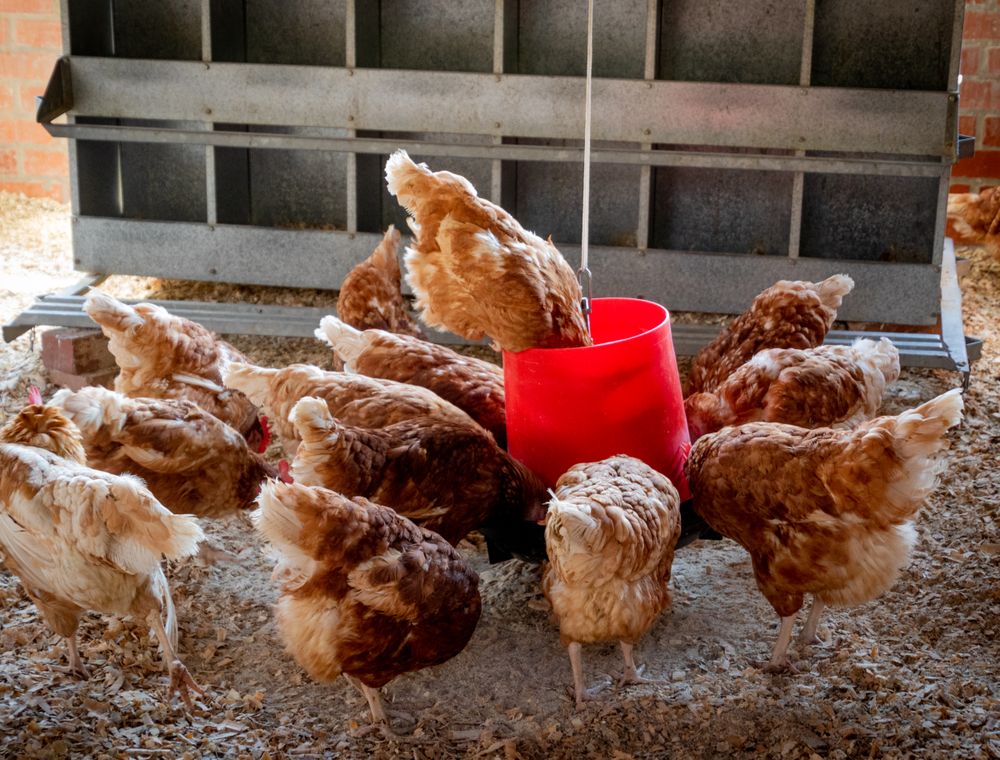
Short answer: Sasso, Kuroiler and Noiler are all coloured birds for farms that want something sturdier than a fast broiler, but they earn money in different ways. The Sasso is a meat bird that sells at about 10 to 14 weeks, the Kuroiler gives you useful eggs and a heavier cockerel at five to seven months, and the Noiler asks the least of any of them. Choose by how long you can wait for cash, how much feed you can afford and who will buy the birds. At our hatchery Sasso starts at GH₵13 per chick, and Kuroiler and Noiler at GH₵11.
Key takeaways
- Time to sale is the biggest difference. A Sasso can go to market in about three months, while a Kuroiler or Noiler cockerel usually takes longer.
- Count feed in bird-days, not birds. A bird kept five months eats far more than one sold at twelve weeks.
- Only the Kuroiler should be judged on eggs as well as meat, and only if you feed its protein needs.
- The Noiler is the low-cost bird for a family flock, but it will not match a Sasso on speed or size.
- Work backwards from your sale month, and do not start a flock you cannot hold until the festive buyers arrive.
Three coloured birds, three different jobs
These three birds get confused at the feed shop more often than they should. A farmer hears that one is hardy, another lays well and the third tastes good, and assumes they are interchangeable. They are not. Each one does one job well, and a farmer who buys it for a different job usually ends the season disappointed. The bird is rarely to blame.
We see people pick a Kuroiler because the chick is cheap, then hope it will lay like a layer and grow like a broiler. Others choose a Sasso for its meat and then keep it in a tight run, wondering why it is slow. Match the bird to the job, and the price of the chick falls to second place.
What each bird is built to do
- Sasso: bred in France for meat (our Sasso guide goes deeper). It does best when it can walk about and pick up forage alongside its feed. It reaches sale weight in its own time, usually around 10 to 14 weeks, and its firm meat is what buyers come back for.
- Kuroiler: a hybrid made for flocks that scavenge (see the Kuroiler guide). The hens lay a useful number of eggs, and the cockerels reach a heavier carcass than most local birds, provided you supply the protein they miss while foraging.
- Noiler: a West African dual-purpose bird from crosses of local and exotic stock. Its selling point is that it asks little from you. It is not the bird to buy if you want speed.
The three side by side
| Point to check | Sasso | Kuroiler | Noiler |
|---|---|---|---|
| Main purpose | Meat | Eggs and meat | Eggs and meat, on low input |
| Time to first sale | About 10 to 14 weeks | Cockerels about 5 to 7 months | Later than the Sasso, often several months |
| Hen egg output | Not the reason to keep it | Quoted around 150 to 180 a year under good care | Useful, but starts later and depends on feed |
| Feed need | Grower ration plus forage | Protein-rich supplement, especially when scavenging | Lowest of the three |
| Free-range suitability | Very good | Very good | Good |
| Our starting price | GH₵13 per chick | GH₵11 per chick | GH₵11 per chick |
| Box of 50 from us | GH₵650 | GH₵550 | Ask us |
The egg row is the one most people misread. A Kuroiler hen can be a real layer. A Sasso hen is a meat bird that happens to lay, and a Noiler hen lays steadily once she gets going. Plan your eggs around the bird that actually lays them.
The calendar test: how long your money sleeps
Time is the cost most people leave out. Every bird eats every day it is alive on your farm. So the fairest way to compare them is in bird-days of feed: the number of birds multiplied by the days each one stays in the house.
A Sasso sold at 12 weeks spends 84 days on feed. A Kuroiler cockerel sold at five to seven months spends somewhere between 150 and 210 days on feed. That is roughly 1.8 to 2.5 times the feed for the same chick price. A Noiler held until it reaches a good weight can stay on feed longer still. A Kuroiler flock may be the better bet for a farm that also sells eggs, but it is the longer bet for a farm that needs cash within one season.
Feed and forage: what a free-range flock covers itself
All three can forage. The question is how much of their diet the scavenging covers, and that decides what you buy. A Sasso on a run with good grass and insects will eat less bagged feed than one kept tight. A Kuroiler on a roaming flock finds plenty of food, but rarely enough protein for fast growth or steady laying. A Noiler is comfortable on a plain ration with some foraging on top.
Whatever bird you choose, start the chicks on a proper starter ration, move them onto a grower, and keep a separate dish of shell grit for the hens once they begin to lay. Do not make bread, maize-only mash or leftovers the main diet. They fill a crop without building a bird. For cheaper feed options that still work, see our guide to cheap poultry feed alternatives.
Housing and the free-range question
A free-range flock still needs a secure night house. Kites, dogs, rats and snakes all take birds from runs that look safe in daylight. The routine is the same for all three: close them in at dusk, check the roost and the nest boxes, and count the birds before you lock up.

The Sasso is the bird most likely to be kept in a run, because the meat is the point. Kuroilers scavenge widely, so fence the area you want them to use or give them a clear shelter they return to each evening. Noilers are the easiest to keep with little infrastructure, which is why many family flocks start with them. For more on the run itself, see our free-range breeds guide.
Eggs: which hen earns her keep
If eggs are part of the plan, the Sasso is not your bird. It is a meat bird first, and its hens are not kept for the nest. The Kuroiler and the Noiler both lay usefully, but they do it on different timetables.
The Kuroiler hen is often quoted around 150 to 180 eggs a year under good care. That is a target, not a promise. Hens that lay in clusters, go broody for weeks or take breaks in the dry season are usually short of a decent ration, not short of breed. The Noiler lays a good number too, but it starts later, so do not judge the hens until they have been through their first full laying season. For a wider look at dual-purpose birds, see our best dual-purpose chickens article. Both breeds go broody. Give a broody hen her own pen rather than letting her sit in the nest box with the layers.
Need chicks for your next batch?
Send breed, number and town. We reply with price, hatch date and delivery cost in writing.
Who buys which bird, and when
- Sasso: households who know the taste, restaurants that want a firm carcass, and festive buyers who will pay for a well-finished bird.
- Kuroiler cockerels: local markets that want a larger bird. Demand is strongest in the weeks before Christmas, when a well-grown cockerel sells far better than one that is still short of weight.
- Noiler: family flocks, small sales to neighbours, and farms that keep birds for their own table.
Plan the sale date before you buy the chicks. Count back from the festive week to the hatch date, add a fortnight of slack, and check that your feed money lasts until then. Our cockerel farming guide covers the timing for male birds in more detail.
A worked example: 60 birds, one season
Say you buy 60 chicks of each type and keep them until they are ready. The chick bill is GH₵780 for the Sasso (60 at GH₵13) and GH₵660 for the Kuroiler or the Noiler (60 at GH₵11). So far the Sasso costs GH₵120 more.
Now add the feed. Using bird-days, the Sasso at 84 days comes to 5,040 bird-days, and a Kuroiler at 150 days comes to 9,000. To keep the comparison fair, assume the same average intake of 60 grams a day for both, and a placeholder price of GH₵5 per kilogram. That gives about 302 kilograms of feed for the Sasso, worth GH₵1,512, and 540 kilograms for the Kuroiler, worth GH₵2,700. Real cockerels eat more than that average late in the cycle, so treat the Kuroiler figure as the low end.
The Sasso is cheaper to get to market. The Kuroiler flock costs more to feed, but its hens can pay some of that back in eggs. Put your own feed price and your own egg price into the sum before you decide.
Mistakes that mix the three up
- Buying Sasso expecting eggs. It will lay, but do not plan your egg money around it.
- Holding a Kuroiler cockerel too long in a bare run, where the feed bill grows but the weight does not.
- Feeding a free-range flock on maize and scraps alone, then blaming the breed for slow growth.
- Mixing the three in one pen. Sale weights become impossible to plan.
- Selling without a buyer lined up. A bird that is ready in October can wait weeks for a buyer if nobody has been told.
Ordering Sasso, Kuroiler or Noiler chicks from Halaal Farms
Sasso day-old chicks are GH₵13 each, with a box of 50 at GH₵650. Kuroiler chicks are GH₵11 each, and a box of 50 is GH₵550. Noiler chicks are GH₵11 each, and we quote the box price on request. The smallest order is a single box of 50, and anything from 1,000 chicks up gets its own quote.
Birds leave the hatchery the day they hatch, packed in ventilated boxes. We deliver to all 16 regions and confirm the delivery cost before you pay (see our delivery page). Collection from the farm in Opeikuma is also possible. Count the birds when they arrive, and send a photo of any dead chicks on WhatsApp the same day. Any chick lost on the way is replaced free in the following hatch, as long as the photo reaches us that day.
Start with the Sasso chick page or the Kuroiler and Noiler page, or message +233 24 915 1503 on WhatsApp. Tell us which bird you have chosen and the month you want to sell, and we will tell you what we can supply that week. You can also use the order form once you have decided.
Questions farmers ask
Is Sasso better than Kuroiler for meat?
For a faster sale and a firm carcass, the Sasso is usually the better meat bird. A Kuroiler reaches a heavier cockerel but takes longer, and its main advantage is getting eggs and meat from the same flock. Choose by sale month, feed budget and how much you need eggs.
Can a Noiler lay eggs as well as a Kuroiler?
Both are dual-purpose and both lay usefully. The Noiler starts later and is valued for hardiness and low feed needs. The Kuroiler is quoted at around 150 to 180 eggs a year under good care. Neither figure is a promise, so count your own eggs from the first week of lay.
Which of the three is cheapest to start?
At Halaal Farms, Kuroiler and Noiler chicks are GH₵11 each and Sasso is GH₵13. The chick price is the smallest part of the cost, though. Over a full season the bird that takes longest to sell usually costs the most in feed, so compare bird-days rather than chick prices.
Are these birds suitable for free range?
All three can forage, and each one suits a free-range system better than a tight run. They still need a secure night house, because kites, dogs, rats and snakes all take birds from open runs. Count the flock at dusk and lock it in every night.
How long until a Sasso is ready to sell?
Most Sasso flocks are sold between about 10 and 14 weeks, depending on the line, the feed and how much time the birds spend outdoors. Use your own weekly weights to set the date rather than the calendar, and tell your buyer about two weeks ahead so they can plan.
Should I keep a Kuroiler or a Noiler for eggs or for meat?
Keep them for both, or you will be disappointed on one side. Kuroiler hens are the more productive layers. Noilers suit farms where feed is short and low input matters more than volume. Keep the best hens for laying and sell the rest when they reach the weight you want.
Do these birds need a vet?
Yes, as any flock does. Our chicks are vaccinated at the hatchery against Marek's, Newcastle, Gumboro, infectious bronchitis and coccidiosis, and the batch record comes with every order. Follow your vet's advice on any extra vaccines and worm control, and call them early when birds go off their feed.


