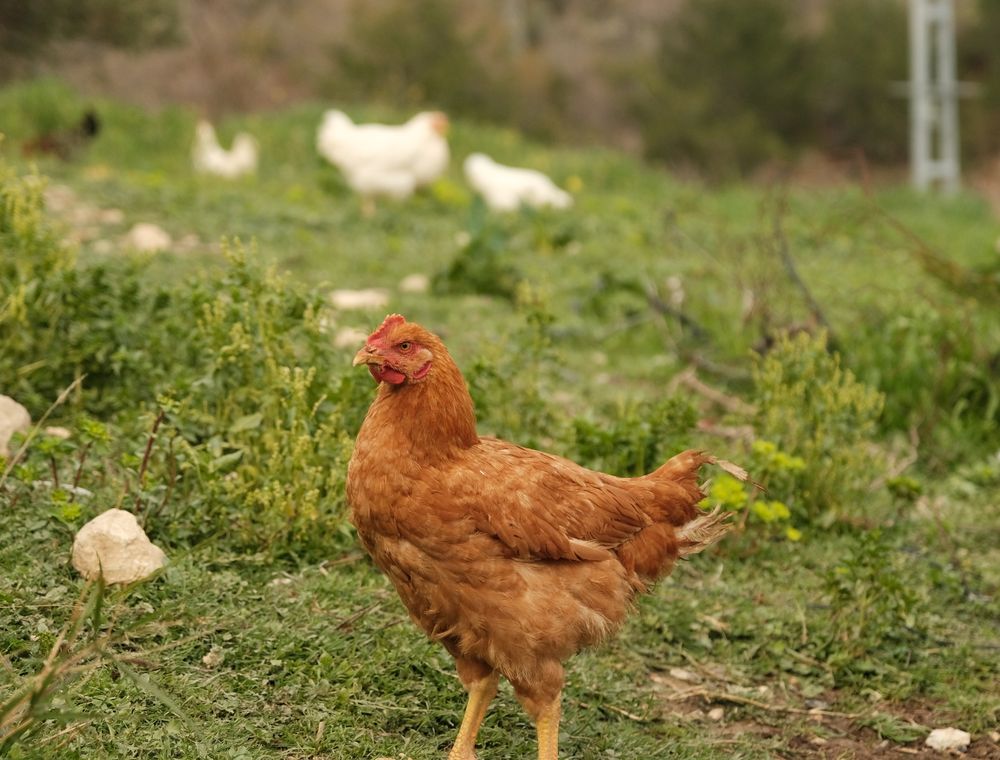
Short answer: Free range works when the land gives the birds shade, water and something to forage, and when the house is strong enough to lock them in at night. Plan about 2 square metres of run per bird and roughly 0.3 square metres of house floor. Most free-range setups fail on predators and mud, not on the birds themselves.
Key takeaways
- Choose land with shade, drainage and water access before you choose the birds.
- Plan at least 2 square metres of run per bird and about 0.3 square metres of house floor.
- Lock the birds in every night and count them in every evening.
- Bury wire at the base of the fence against dogs, and cover part of the run against hawks.
- Pick hardy foraging birds such as Sasso, Kuroiler or Noiler for open ground.
What free range really means on a Ghanaian plot
Can you let the chickens out and leave them to find their own food? Partly. Birds find grass seed, insects, worms and green shoots, and on a good plot that is a real share of their diet. On a bare compound they find very little, and what they do find is usually your neighbour's cassava leaves or your seedlings.
In practice, free range means the birds spend the day outside on land you control, come back to a house at night, and get fed and watered by you in both places. It is not a flock that roams the village and sleeps wherever it likes. That flock is the one that gets stolen, taken by a dog, or dies of something nobody saw.
The rest of this guide covers the land, the house, the fence and the birds. Each one matters, and a weak link in any of them shows up as lost birds.
Choosing the land: shade, drainage and water
Look at the land in the rainy season before you buy or fence it. Standing water in a corner, mud at the gate and a patch that stays wet for days are all signs the birds will be sick there within a few months. Ground with some slope drains well. Heavy clay that holds water does not, and the birds will spend the rainy months standing in it.
Shade matters as much as drainage. Birds in full sun at midday pant, drink more and forage less. Trees planted on the plot give shade for years, and shade netting does the job faster. Check the distance to water too. If the nearest tap is a long walk each day, you will carry water less often than the birds need it.
A short list to take on the site visit:
- Ground that drains within a day after heavy rain
- Shade trees, or room to plant them and net the run
- A water source you can reach every day, including in the dry season
- A fence line you can close all round, with no gap at the bottom
- Neighbours whose dogs you know, and a house site you can see from the road
How much land a flock needs
Take 150 birds as a worked example. That is a sensible first flock for one person to look after on foot. We plan on two numbers: about 2 square metres of run per bird, and about 0.3 square metres of house floor for each bird to roost and lay. The run is where most of the land goes.
| Item | Per bird | For 150 birds |
|---|---|---|
| House floor for roosting and nests | About 0.3 m² | About 45 m² |
| Outdoor run | About 2 m² | About 300 m² |
| Ground to fence in total | About 8 m² on a 30 by 40 metre plot | 1,200 m² |
A 30 by 40 metre plot gives 150 birds room to move and a corner for the house. If the land is smaller, you can still run free range, but the birds will lean harder on your feed and the ground will wear out faster. Rotate the run when you can. Give a patch two or three months to recover before the birds go back on it, and the grass comes back, which means less feed bought and less mud.
Shelter: the house every free-range flock needs
The house is the most important building on the plot, because it is where the birds are safest. Build it to keep out dogs, rats and snakes, not just rain. Use block or treated timber for the walls, a solid door, and mesh on the vents fine enough to stop a rat. Open-sided houses work well in Ghana's heat, but the openings need wire, not gaps.
Give the birds roost bars about 20 centimetres of perch per hen, set above the litter. Put one nest box for every four or five hens in a quiet corner. Lock the door at dusk and open it at first light, every day, without exceptions. The poultry housing designs guide shows layouts that suit the climate.
Fencing and keeping predators out
The predators on free range are dogs, hawks, rats, snakes and, after dark, anything that can climb. Each needs a different answer. Dogs dig. A fence that stops at ground level gets dug under within a week, so bury the wire or mesh at least 30 centimetres down, or fix a skirt of wire along the base. Where birds sit near the boundary, the fence should stand at least 1.5 metres high.
Hawks come from above, so a mesh or net over part of the run stops them more reliably than any extra height on the fence. Rats and snakes slip through gaps no bigger than a thumb. Walk the fence each week and close any hole the same day. The predator guide goes through each threat, and the rodent and snake control article covers the rest.
Water and feed when the birds are outside
Birds drink more than people expect on a hot day, and they will walk a long way to reach water they trust. Put water points around the run, in shade, and check them twice a day. Cover the drinkers against the sun and against droppings. Dirty water on open land is the easiest way to pass disease between your birds and the wild birds that come to drink with them.
Feed should not be left on open ground. Use covered feeders inside the house and at the shade points in the run, and fill them before the birds leave in the morning. Free range supplements the diet but does not replace it. Birds that scratch all day still need a complete feed, especially when the rains thin out the forage. For how much to supply and when to cut back, read the feeding free-range chickens guide.
Choosing birds that can cope with open land
Not every breed does well on a range. Heavy birds that grow fast on feed are built for the house, and they struggle to walk the run and find cover. For open land we look at hardier, foraging birds. The Sasso is listed from GH₵13 a chick, with a box of 50 at GH₵650, and it forages well. The Kuroiler (from GH₵11, box of 50 at GH₵550) and the Noiler (from GH₵11) are common choices for dual-purpose flocks on open ground.
Ask what the birds will do on your plot, not what they do in a catalogue. If the goal is eggs and some meat on little feed, a dual-purpose bird suits. If the goal is market weight in a fixed time, a faster bird with a house and a feed plan suits better. The best chickens for free range comparison goes through the breeds one by one.
Need chicks for your next batch?
Send breed, number and town. We reply with price, hatch date and delivery cost in writing.
Working through the rains and the harmattan
The rainy season is the hard test. The run turns to mud, the litter in the house gets damp, and the parasites and bacteria that thrive in wet ground get a foothold. Move the feeders and drinkers to the higher, drier ground, lay a path of gravel or sand from the house door, and turn the litter every few days. The rainy season guide has a full checklist.
The harmattan brings dust from December to February, cold mornings and very dry air. Birds on open land breathe that dust all day. Keep the house dry and ventilated without letting the cold wind blow straight onto the roosts, and keep the water covered, because dust settles in an open drinker within hours. The harmattan care guide covers the details.
Counting, records and health on open land
You will see less of a free-range flock than a house flock, so you have to make a habit of looking. Walk the run every morning and count the birds. Count them into the house every evening. A bird missing at dusk is a predator question, a fence question or a sick bird that has wandered off, and each has a different fix. Write the count and the date down.
Open land brings contact with wild birds, and wild birds can carry diseases your flock has no protection against. Keep feed and water away from where wild birds gather, and keep visitors and their vehicles out of the run. The avian influenza article explains the signs and who to report to, and the biosecurity guide sets out a daily routine.
Mistakes that turn free range into lost birds
- Fencing the run but leaving a gap at the bottom where a dog can dig under
- Letting birds out before the house has been checked for holes
- Putting the only water point at the far end of the plot
- Leaving the house open overnight because the evening is warm
- Expecting the ground to feed the flock through the dry season
Setup-day checklist
- Fence closed all round, with wire buried or skirted at the base
- House built with mesh on every vent and a door that locks
- Roost bars and nest boxes in place at the right heights
- Water points in shade, with covers, and at least two on the run
- Covered feeders inside the house and at shade points
- A dry path from the house to the feeders for the rainy season
- A count sheet hung inside the house door
- Chicks ordered, with delivery confirmed before you pay. We deliver to all 16 regions, and you can collect from the farm.
Questions farmers ask
How much land do I need for 100 free-range chickens in Ghana?
Plan about 2 square metres of outdoor run per bird, so roughly 200 square metres for 100 birds, plus about 30 square metres of house floor. A 30 by 40 metre plot gives room for a house and a generous run for around 150 birds. Smaller land works, but the ground wears out faster, and you will need to feed more.
Can chickens be free range in a town compound?
Yes, on a small yard with a sound fence, but space is the limit. With little ground you can give birds a daily run and feed them the rest of the day. Check your neighbours and the local rules before you start, because a flock that scatters rubbish or wakes the street will end the arrangement quickly.
Which chickens are best for free range in Ghana?
Hardy foragers do best on open ground. Sasso, Kuroiler and Noiler are common choices, with starting prices from GH₵13, GH₵11 and GH₵11 a chick on our list. Heavy fast-growing broilers struggle to walk and forage outdoors. The best chickens for free range guide compares the breeds on hardiness, foraging and egg output.
Do free-range chickens still need feed?
Yes. Free range supplies part of the diet, especially insects and green forage in the rainy season, but laying and growing birds need a complete ration. Feed in covered feeders inside the house and at shade points, and cut back when forage is plentiful. In the dry season, expect to feed more.
How do I stop dogs getting into the run?
Bury wire or mesh at least 30 centimetres at the base, or fix a skirt along the bottom, and keep the fence at least 1.5 metres high where birds sit near the boundary. Walk the fence weekly and close any hole the same day. A dog that gets in once will come back, so fix the first gap as though it were the last.
What is the biggest risk on a free-range farm?
In our experience it is the predator that comes at dusk or before first light, when the house door is not closed or a vent has a gap. The second biggest risk is mud in the rainy season. Both are cheap to prevent and expensive to fix after the first losses, so spend your time on the fence and the lock before the birds arrive.
Do free-range birds need vaccines?
Yes, and you should follow your vet's advice on the schedule. Open ground brings more disease exposure, so ask your vet which boosters matter most where you live. The hatchery vaccines we give are Marek's, Newcastle, Gumboro, infectious bronchitis and coccidiosis, and the batch record tells your vet what the chicks already had.


