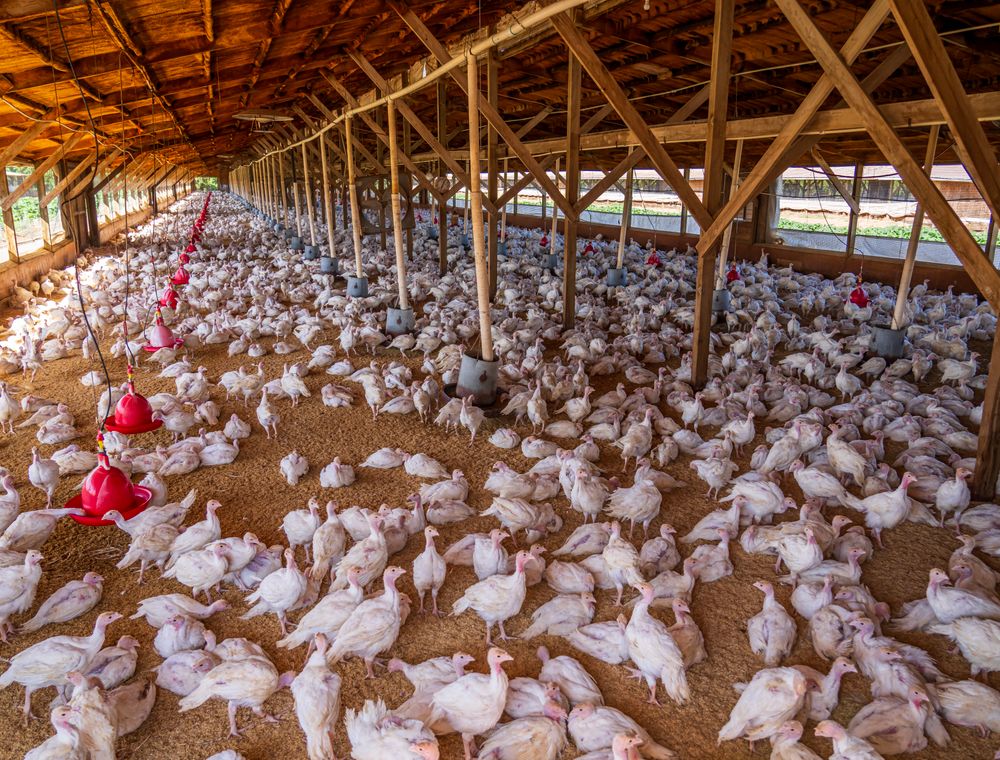
Short answer: A good poultry house in Ghana is open enough to move air through the birds, raised and well drained, oriented to avoid the hottest sun, and sized at roughly 9 to 11 broilers or 6 to 7 floor-housed layers per square metre. Get the site, orientation and ventilation right first, then add the detail. Plan the house before your chicks arrive, because a house that is wrong on day one is hard to fix by week five.
Key takeaways
- Orient the long walls to avoid the hottest sun, and face the open sides into the prevailing breeze.
- Keep the house narrow enough for natural air to cross it, usually about 10 metres or less.
- Plan floor space for the weight the birds will reach at market, not the weight they arrive at.
- Raise the site, grade the ground away from the house and use a roof overhang to keep rain and sun off the litter.
- Budget for feeders, drinkers, litter and a brooder corner before you buy the chicks.
Why housing decides the flock's results
Ask ten Ghanaian farmers what makes a flock succeed and most will say feed, chicks or medicine. Those matter, but at our hatchery in Kasoa we have seen the same pattern many times: a sound batch of day-old chicks that performs badly once it reaches the farm, and the house is almost always part of the story. Hot litter, wet corners, birds crowded around one drinker and air that never moves are not small details. They change how much the birds eat, how fast they gain weight and how often they fall sick.
A poultry house does four jobs at once. It keeps the birds at a comfortable temperature, it keeps the air fresh, it keeps predators and wild birds out, and it gives you a place to work. Good design handles all four without costing more than the farm can carry. The difficulty is that these jobs pull against each other. A house sealed tightly keeps predators out but traps heat and ammonia. A house wide open breathes well but lets rain and dust in. Tropical housing is about finding the balance for your site and your birds.
If you are still deciding which chicks to buy, read our guide on broiler, layer or Sasso first, because the bird decides much of the housing plan. A broiler house is designed around fast growth and heavy birds at market. A layer house is designed around nests, perches, litter and lighting for egg production. Both can be built from local materials, but they are not the same building. Our hatchery team sees the difference every time a farmer asks which chicks suit the house they already have.
Design around Ghana's seasons, not a textbook
Most housing advice online was written for Europe or North America, where the main enemy is cold. In Ghana the enemy is usually heat and humidity, and the season changes what you need. The main rains run roughly from April to July in much of the south, with a shorter wet spell around September to November. The harmattan, a dry and dusty north-easterly wind, blows mainly from December to February and brings cool nights and very low humidity.
A house that is comfortable in the hot, humid months can turn cold and draughty on harmattan nights, especially for young chicks. The practical answer is not a different house for each season. It is an open, well-ventilated house with a simple way to close the sides when the wind is strong or the nights are cold. Curtains of tarpaulin or woven polypropylene, rolled up or down on the side walls, cost far less than a second house and do most of the work.
Think about the time of day too. In Kasoa the morning and late afternoon sun comes in low, and at midday it is nearly overhead. Walls that face east or west take the most heat. A roof with a generous overhang, usually a metre or more on the long sides, shades the walls and the open sides when the sun is strongest.
Rain matters as much as sun. A house that floods at the doors during a heavy storm will carry wet litter for weeks, and wet litter is one of the fastest routes to coccidiosis and ammonia problems. Choose a site and floor level that keep water away from the house. We return to drainage below.
Orientation and site selection
Before you choose a design, choose the place. The best house will struggle on a low corner where water collects, beside a rubbish dump, or in the dust cloud of a busy road. Look for a site that is slightly raised, drains well, is shaded by a few trees but not hemmed in by them, and has safe access for vehicles and feed deliveries.
Orientation comes next. The long axis of the house should run roughly east to west, so the long walls do not take the sun for most of the day. The open sides should face the prevailing breeze so air moves across the birds rather than running along a closed wall. In the south the breeze usually comes from the south-west during the rains and from the north-east in harmattan, so there is no single perfect answer. Walk the site with a notebook in the morning and again in the afternoon, and note where the breeze comes from at each time. Ten minutes of observation is worth more than any general rule.
Leave space around the house. Keep a clear run of several metres between the house and the nearest building, feed store or other poultry. This slows the spread of disease and lets you move around the house in the rain without wading through mud. If you plan more than one house, set them in a line or stagger them so air from one does not blow straight into the next.
- Choose ground that is raised and drains away from the house.
- Run the long axis roughly east to west.
- Face the open sides into the prevailing breeze.
- Keep a clear buffer from other poultry, dumps and busy roads.
- Check power, water and an all-weather access road before you build.
Ventilation: moving air without creating draughts
Ventilation is where most houses go wrong. Farmers fear draughts, close the sides, and then wonder why the birds pant, gasp and smell of ammonia. Birds breathe faster when they are hot, and each bird gives off heat and moisture. In a humid climate that moisture stays in the air unless you move it out. Damp litter produces ammonia, which irritates the eyes and airways and leaves birds more open to respiratory infection.

Natural ventilation works on two principles. Wind across the open sides creates a pressure difference, and warm air rises and leaves through the ridge or the upper part of the walls. To make this work, keep the house narrow enough for air to cross it. Many tropical designs keep the width to about 10 metres or less and add capacity by lengthening the house. A wide, deep house with air entering only at one end will be hot in the middle even if its walls are open.
Put the air inlets low, at about bird level, and let the ridge or a raised roof section release the hot air above them. Avoid solid walls higher than about a metre on the long sides unless you have a good reason, because they block the air the birds need. Use curtains to control the wind rather than sealing the house.
Ventilation needs change with the bird's age. Chicks need warmth and a draught-free corner in the first two weeks, so they are usually brooded in a smaller area with partitions and a heat source. Once they are bigger, open the whole house. Our guide to the brooder setup before day-old chicks arrive explains how to set this up step by step.
A simple check: stand inside the house at bird level for a minute in the afternoon. If you feel stuffy or sweaty, or the air has a sharp smell of ammonia, you need more air movement, better litter management, or both. If you feel a cold draught on your neck while the birds huddle together, you have closed too much or left a gap at the wrong height.
Space per bird: a practical table
Space is the second thing that goes wrong. Crowded birds eat less, grow unevenly, peck at each other and pile into corners, where they suffocate or get trampled. Overcrowding also raises litter moisture and ammonia. But more space is not free. Every extra square metre costs money to roof, fence and litter. The aim is the right density for the system, not the most space you can afford.
The figures below are typical guidelines for tropical open-sided houses. Use them as a starting point and check them against your breed's supplier guide, because heavier birds need more room as they grow and hot months may call for a lower density.
| Bird and system | Space per bird (m²) | Birds per m² | Notes |
|---|---|---|---|
| Broiler, deep litter, hot season | 0.09–0.11 | 9–11 | Plan for market weight, and lower density in the hottest months |
| Broiler, deep litter, harmattan | 0.09–0.10 | 10–11 | Air is drier, so the house can carry a little more |
| Layer, deep litter floor | 0.14–0.16 | 6–7 | Nest boxes and perches are extra space and not counted here |
| Kuroiler or Noiler, dual-purpose | 0.12–0.15 | 7–8 | Often reared on litter with some outdoor access |
Two points make the table more useful. First, plan for the bird you will have at the end of the cycle. A house that holds 1,000 chicks on day one may be too small by week six. Second, leave a walkway of about a metre inside the perimeter so you can reach feeders, drinkers and birds without treading on litter you are trying to keep dry.
For layers, the floor figure does not cover nests, perches or a scratching area. Allow for these separately. If you are weighing up the numbers, read about our layer day-old chicks and the budget for starting a poultry farm so you know how many birds the house must carry to pay its way.
Three house designs that work in Ghana
Most farms we speak to fall into one of three designs. Each suits a different budget and bird type, and none is automatically the best. The right one depends on how much you can spend, how many birds you run, and how reliable your power and labour are.
Open-sided house with curtains
This is the most common design for small and medium farms. It is a rectangular shed with a solid or part-solid base, low side walls, and open or mesh sides fitted with curtains. The roof is usually corrugated sheeting with a ridge vent. It is cheap to build, easy to repair and breathes well. Its weakness is that it depends on wind and on the curtains being managed properly, so it needs someone to check it every day.
Semi-enclosed house with fans
Some larger farms add exhaust fans and a closed wall on the side facing the prevailing wind. Air enters through inlets and leaves through the fans, which gives more control in the hot months. It costs more and needs dependable electricity or a generator. Fans fail, and when they do the house can heat up quickly, so it needs an alarm or a twice-daily check and a back-up plan.
Raised or caged houses for layers
Layer systems in cages or on raised slats keep the birds off the litter, which makes cleaning easier and can lower disease pressure. They need more capital and more management knowledge. For most beginners we suggest a well-built floor house with deep litter, because it is more forgiving while you learn how your birds respond to the local climate.
- Open-sided with curtains: lowest cost, needs daily wind management.
- Semi-enclosed with fans: better control, needs dependable power and a fallback.
- Raised or caged layer systems: cleaner, higher cost, more skill required.
Choosing materials that last in the tropics
Materials should be easy to buy locally, easy to repair, and tough enough to survive termites, damp and sun. Concrete blockwork for the lower walls is a common choice because it resists rats, dogs and damp better than timber. Above the blockwork, mesh or open walls with curtains give air movement without exposing the birds to driving rain.
Roofing is the biggest single decision. Corrugated sheets are widely available and light, but they get very hot. A ceiling board or insulating layer, or a ridge that vents properly, makes a real difference. Under an unlined tin roof the air just below can run well above the outside temperature, and the birds feel it. Ask the builder to leave the ridge open and fit a ridge cap that lets hot air escape.
Timber is cheap at first but needs protection from termites and rot. Treat posts and roof timbers, raise them on concrete pads, and keep them clear of wet litter. Galvanised steel is durable, but check that no sharp edges can rub against the birds or catch their feet, and that feeders and drinkers do not hang on wire that can cut them.
Plan the floor as carefully as the roof. A concrete floor is easy to clean and disinfect, but it is cold in harmattan, so many farmers add a deep layer of dry, absorbent litter such as wood shavings or dry rice husk. Keep the litter at about 5 to 10 centimetres and turn it when it starts to cake.
Need chicks for your next batch?
Send breed, number and town. We reply with price, hatch date and delivery cost in writing.
A worked example: what the house costs per bird
Here is a simple way to think about housing cost before you commit. The numbers below are an illustration, not a quote. Building costs vary with the price of blocks, sheets and labour in your town, so get written quotes from local builders for the real figures.
Suppose you want to raise 1,000 broilers in one house. At 10 birds per square metre you need 100 square metres of floor. A house 10 metres wide and 10 metres long gives you exactly that, and you should add a walkway and extra space for feed and equipment. Now look at the chicks. At the from-price of GH₵20 per Cobb 500 chick, 1,000 birds cost about GH₵20,000 before feed, medicine, litter or labour. That is GH₵200 of chicks sitting on every square metre of floor. Check our current prices before you plan, because the figures change.
This tells you something useful. The house protects birds you have already paid for. If you build too small to save money, you overcrowd the flock, growth slows and the lost weight costs more than the saving on blocks. If you build too large, the extra space sits empty and you still pay for litter and heating on floor you do not use.
Try the same calculation for your own plan. Divide the number of birds by the density you chose, add the walkway, and multiply the floor area by your local building estimate per square metre. Then compare that total with the chick cost. If the building is far more expensive than the birds, start smaller and expand after your first cycle. Many farmers do exactly this and grow the house as their sales become reliable.
Floors, litter and drainage
A house is only as dry as the ground beneath it. Run gutters from the roof well away from the building, and build a small drain or raised lip around the perimeter so rainwater cannot flow under the walls. Ground only a few centimetres lower than the floor is enough to let water in during a storm.
Litter is the bed that absorbs droppings and moisture. Good litter is dry, low in dust and deep enough to take a day or two of moisture without going soggy. Wood shavings, dry rice husks and chopped maize stalks all work in different parts of Ghana. Avoid very fine sawdust, which packs down and holds water, and avoid material that has been rained on in a sack.
Check the litter every morning. Push a handful down. If it clumps or feels wet a few centimetres below the surface, you have a problem. Fix the cause, which is usually a leaking drinker, a draught driving rain into the house, or too many birds for the air movement. Adding fresh litter on top hides the problem for a day and solves nothing.
Keep drinkers on a raised platform or a drip tray so spilled water does not soak the litter around them. A wet ring around each drinker is one of the most common signs of a faulty or badly placed drinker, and it is easy to fix once you spot it.
Common mistakes we see on farms
Some mistakes come up again and again when farmers describe their first house. None is a disaster alone, but together they cost birds and money. Avoid these and you have a good start. They also come up in our broiler house setup notes, which cover the equipment side in more detail.
- Building for the chick, not the bird. The house looks spacious on day one and feels crowded by week five. Design for the final weight.
- Closing the sides in the cold season. Birds in a sealed house breathe stale air and ammonia builds up. Use curtains, not walls.
- Placing the house in a hollow. Water runs in and stays. Raise the floor and grade the ground away.
- Using an unlined tin roof with no ridge vent. Heat collects under the roof and the house never cools properly at night.
- Putting all feeders and drinkers in one corner. Birds crowd there and the far end of the house goes unused.
- Ignoring the wind direction. A closed end facing the prevailing breeze blocks the only air you have.
The fix for most of these is simple and costs little if you plan before building. Walk the site, draw the house, mark the walkways and equipment positions, and show the plan to someone who has run a farm before. A second pair of eyes often spots the drinker in the wrong corner. Keep disease risk in mind too: a house with clear access and a footbath at the door is much easier to protect, which is the subject of our note on biosecurity on a poultry farm.
Pre-stocking checklist
Before your chicks arrive, walk through the house with this list. It takes less than an hour, and each item prevents a problem you would otherwise be solving in the middle of the first week, when you are tired and the birds are small and sensitive.
- Site is raised, drained and free of standing water after the last rain.
- Long axis runs roughly east to west, and open sides face the prevailing breeze.
- Floor area matches your planned density at the final weight.
- Ridge vent is open, inlets sit at bird level, and curtains roll up and down easily.
- Litter is dry, spread to an even depth and not dusty.
- Feeders and drinkers are spread evenly through the house, and drinkers sit on drip trays.
- Brooder area has a draught-free corner and a thermometer at chick height.
- Gaps around doors and vents are sealed against rats, and wild bird entry is blocked.
- Power, water and a back-up light source are tested before the chicks arrive.
- A clean footbath and a visitor rule are in place at the entrance.
When the list is complete you are ready for the chicks. Order early enough to have the house ready, and confirm the delivery date with us through our order form or on WhatsApp at +233 24 915 1503. Our day-old chicks leave the hatchery on the day they hatch, so the house must be ready on arrival, not the day after. If you are not sure about delivery to your town, check the delivery page first.
Questions farmers ask
How many broilers can I keep per square metre in Ghana?
For deep litter in Ghana's climate, a common guideline is about 9 to 11 broilers per square metre, with the lower end in the hot season and for heavier birds. Plan for the weight the birds will reach at market, not the weight they arrive at. Check your breed's supplier guide and adjust for your own house, because a well-ventilated house can carry a little more than a closed one.
How wide should a poultry house be?
Many tropical designs keep the width to about 10 metres or less so that natural air can cross the house. If you need more capacity, lengthen the house rather than widening it. A wide house with air entering at one end will be hot in the middle, even when its walls are open.
Should I build an open house or a closed house?
For most small and medium farms in Ghana an open-sided house with curtains is the sensible choice. It is cheaper, easier to repair and breathes well. A semi-enclosed house with fans suits larger flocks, but only where power is reliable or you can run a generator. Closed houses trap heat and ammonia in the humid months.
What litter works best in a broiler house?
Dry wood shavings and dry rice husk are the most widely used, depending on what is available in your area. Keep the litter at about 5 to 10 centimetres and avoid very fine sawdust, which packs down and holds moisture. Turn the litter when it starts to cake and fix any leaking drinker straight away.
Do I need a raised floor?
A raised, well-drained site matters more than a raised floor. If the ground around the house is low or collects water, the litter will get wet and stay wet. Grade the ground away from the building, set gutters to carry roof water clear, and add a small drain or lip around the perimeter.
How high should the eaves be?
Eaves of about 2.5 to 3 metres give enough height for warm air to rise above the birds and for you to work comfortably. Combine that with a generous roof overhang on the long sides to shade the walls and the open sides during the hottest part of the day.
Can I convert an existing building into a poultry house?
Yes, if the building is dry, well drained and can be opened on the side facing the prevailing breeze. Check that the roof does not trap heat, that you can block rats and wild birds, and that the floor can take a deep litter bed. Test the ventilation with the birds in place before you commit to a full flock.
How do I know if my house has enough ventilation?
Stand inside at bird level in the afternoon for a minute. If the air feels stuffy, the birds pant or the house smells sharply of ammonia, you need more air movement or better litter management. A cold draught on your neck while the birds huddle means you have closed too much or left a gap at the wrong height.


