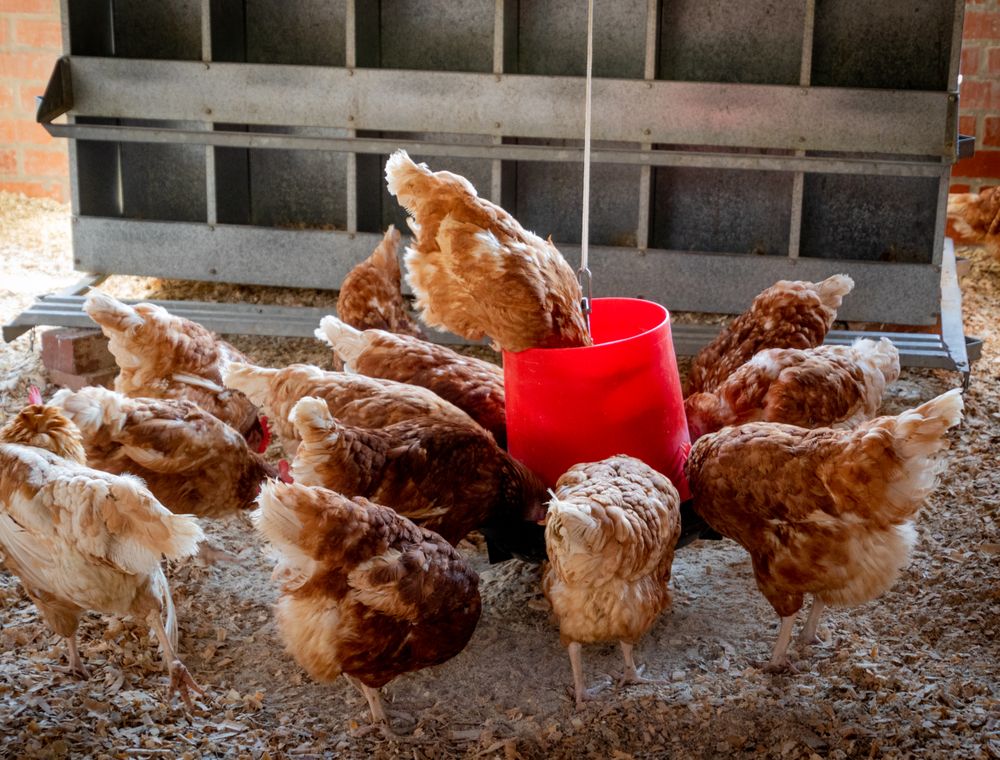
Short answer: Automatic drinkers and feeders cost more at the start, and they only save money when the flock is big enough to use them and the power and water are steady. The price of a line is set by its parts list (the pipe, the regulator, the filter, the tank and the pump) far more than by the nipple or chain that the quote leads with. Compare suppliers on the same itemised list, work out the cost per bird place, then set that against the hours and spill you save over a full cycle.
Key takeaways
- Price the system from its parts list, not from the nipple or chain on the first page of a quote.
- Automatic lines pay back only when the flock is large enough and the power and water are steady.
- Fit the regulator, filter and tank before you add birds, because they protect everything downstream.
- Compare suppliers by cost per bird place, and include the wiring and stand they left out.
- Keep a manual backup for feed and water, especially where the power drops.
Start with the parts list, not the sticker price
The first thing most farmers ask about an automatic line is the price of the nipples. It is the wrong place to start. A nipple is the cheapest part of the system and the one that fails for the most avoidable reasons, usually because the water behind it was never filtered or the pressure was never set.
Almost all of the money sits in the parts a quote treats as an afterthought: the pipe and its fittings, the pressure regulator, the filter, the storage tank and the pump that keeps the tank full. Before you compare two offers, rewrite both as the same list, line by line. Most of the gap between two totals comes from one supplier leaving items out, not from one item being dearer than the other.
We see this on farms that call us after they have already bought the first part. They have a good drinker on a poor supply, or a strong pump with no filter, and now they are buying the missing pieces at full price because nobody quoted them the whole job.
Four cost layers on every automatic line
It helps to think of the money in four layers. The first is the bird-facing equipment: the drinkers and the feeders. The second is distribution, the pipe, joints and clips that carry water or feed the length of the house. The third is control: regulators, filters, taps and, on a chain feeder, the motor and the timer. The fourth is supply: the tank, the pump, the wiring that runs them and the stand that holds the tank above the birds.
The first layer is the one everybody can see, so it gets the most attention. The other three are where a line goes wrong. A house with good nipples and no regulator will flood its litter within weeks, because the pressure at the first drinker runs water over the edge. A house with a strong pump and no filter will have blocked nipples by the second flock. Count all four layers every time, and check that each supplier lists them.
- Drinkers and feeders: type, number, height and what they are made of.
- Distribution: pipe diameter, wall thickness, joints, clips and the line layout.
- Control: pressure regulator, filter element, taps and the timer for any motor.
- Supply: tank size, stand, pump rating, wiring and earthing.
Drinker types and what they cost to live with
Bell drinkers are the cheapest per unit and the easiest to fill by hand. They also foul fastest. Birds stand in them, scratch at them and knock them over, and a bell drinker that is not emptied and scrubbed every day turns into a source of wet litter. A nipple line costs more to install, but it keeps the litter drier and gives a cleaner drink, provided the water is filtered and the lines are flushed on a schedule.
Cup drinkers and fount-style units sit between the two. For chicks in the first week they are often the best tool you have, and many farms keep a few alongside the main lines for those first days. The table sums up how each type behaves on a Ghanaian farm. It uses relative cost rather than a price, because the price depends on the material and the supplier.
| Drinker type | Where it fits best | Cost to buy | Daily labour | Main weakness |
|---|---|---|---|---|
| Hand-filled bell drinker | Chicks, small flocks, short cycles | Low | High, two or more refills a day | Fouling and spill |
| Bell drinker on a line | Medium broiler houses with a header tank | Low to medium | Medium | Needs a level line and regular emptying |
| Nipple drinker on a pressure line | Layers and longer broiler cycles | Medium | Low once the line runs well | Clogs with iron and scale if unfiltered |
| Cup drinker | Chicks and young birds | Low | Medium | Spills if knocked over |
If you already know your flock and your house, the drinker choice is usually obvious. The real cost question is what that choice does to your time and your litter over a full cycle.
Feeders: chain, pan and hopper
A chain feeder runs a loop of links through a trough, driven by a small motor on a timer. It carries feed from a bin to the birds without anyone walking the house with a bucket. For layers it is the usual upgrade, because the hens learn the sound of the motor and come running. Its weak points are the motor and the links. A stone or a lump of caked feed in the trough bends a link and jams the run, and a jammed chain starves the birds at the far end first.
Pan feeders are a common choice for broilers on larger farms. A pan drops feed as the birds peck, and a chain or auger refills it from the bin. If you are planning a broiler house, our broiler day-old chicks page shows the batch sizes, so you can match the feeder count to the birds you will actually place. Hopper feeders are the simplest of the three: a bin over a trough, filled by hand and very cheap. A hopper does not move feed for you, but it saves the walking, and on a small house that is often enough to justify it.
Price follows length, material and the drive. Galvanised steel lasts longer in the damp coastal months than a thin plastic trough, which warps when the sun reaches it through an open side. An electric drive adds wiring, a timer and an outage plan, and the outage plan is the part most buyers leave out.
A worked parts list for 900 layers
Here is the arithmetic we use when a farmer asks what a nipple line really costs. The example is a house of 900 layers with one nipple for every 10 hens, six lines of 30 metres each, a 1,000-litre header tank on a stand, one regulator and filter set, and a 0.75 kW pump. The cedi figures are illustrative placeholders chosen to make the sums easy to follow. They are not prices we quote, and they will not match the market on the day you buy. Replace every line with a current quote before you use the total for anything.
| Item | Quantity | Illustrative unit cost (GH₵) | Illustrative total (GH₵) |
|---|---|---|---|
| Nipple drinkers | 90 | 4 | 360 |
| Drinker pipe, 20 mm | 180 m | 6 | 1,080 |
| Joints, clips and fittings | 1 lot | not applicable | 400 |
| Pressure regulator and filter | 1 set | not applicable | 450 |
| Header tank and stand | 1 | not applicable | 1,800 |
| Water pump, 0.75 kW | 1 | not applicable | 1,500 |
| Total | 5,590 |
The total comes to 5,590 cedis, or about 6.20 per bird place across 900 hens. Keep that per-bird-place figure in your notebook. It lets you compare a 900-hen house with a bigger one, or a line bought in parts with one bought as a kit.
Look at what the table leaves out. There is no wiring, no valve at the header, no roof over the tank and no labour. On a real farm those are the lines missing from the first quote, and together they can add a meaningful share to the total. Ask the supplier to put them in writing, or to say plainly that they are your job.
If you are still deciding how many birds the first batch should be, our layer day-old chicks page explains how layer chicks are packed and ordered, and the prices page gives you the chick cost to set against the equipment.
The labour and spill saving you have to measure
An automatic line saves hours before it saves cedis, and it only saves cedis once you turn those hours into money. Take a house of 900 birds filled by hand twice a day. A fill takes about 25 minutes once you have carried the bucket the length of the house and back. That is 50 minutes a day, close to six hours a week, and over a full year it comes to more than 300 hours of walking with a bucket.
The second saving is spill. Hand-filled bell drinkers in a hot house waste a visible share of their water, and every drop that lands on the litter makes the litter wetter. Wet litter brings ammonia, which costs you in eye and breathing trouble and in lower lay or slower growth. A nipple line does not fix wet litter by itself, but it removes the spill a bell drinker creates every time a hen stands in it.
Measure your own spill before you decide. Put a bucket under one bell drinker for three days, empty it each morning and weigh what collects. Most farmers are surprised by the figure. Then price the hours at what you pay someone to do the job, add the spill you measured, and compare the total with the yearly cost of the line. The yearly cost is the purchase price spread over the years you expect it to last, plus power and repairs. If the line pays back within its working life, it is worth buying. If it does not, keep the buckets and hire an extra pair of hands at the busy times.
- Hours saved per day: walking time for each fill, multiplied by fills per day.
- Spill saved per day: measured under one drinker, multiplied by the number of drinkers.
- Yearly cost of the line: purchase price divided by expected years, plus power and repairs.
Chain feeders and the power they depend on
A chain feeder is only as good as the power supply to its motor. Outages in Ghana come in long and short bursts, and a chain that stops halfway down a house leaves the birds at one end with a full trough and the birds at the other end with nothing. Feed left in a trough that is only partly moving goes stale in the humid months, and it can mould within a day when the air is wet.
So the cost of a chain feeder includes more than the motor. Budget for a timer, a surge-protected socket, a plan for the outage and, for any flock of real size, a manual bin you can fill by hand. We have seen farms install a good chain system and then run the house by bucket for a week each time the power dropped. That is the worst of both worlds: the cost of the machine and the labour of doing the job by hand anyway.
If you run the feeder on solar or an inverter, check the motor's starting current, not just its running watts. A motor can draw several times its running current in the moment it starts, and a battery sized for the running figure will trip as soon as the chain tries to move. Ask the supplier for the starting figure in writing.
Need chicks for your next batch?
Send breed, number and town. We reply with price, hatch date and delivery cost in writing.
Water, dust and termites push the price up
Borehole and well water in parts of the Central Region can carry iron, and iron is what blocks nipples. A filter that is cheap to buy needs cleaning every few weeks, and a filter with a poor element lets grit through to the drinker at the far end. Budget for a proper filter, a spare element and a flushing routine. You will spend less on replacement nipples in the first year, and the birds will drink more evenly. Our water management guide for broilers covers intake and cleanliness in more detail.
Heat is the second factor. Plastic pipe laid in full sun softens and sags in the dry months, and cheap black pipe can go brittle after a few seasons of ultraviolet light. Ask for UV-stabilised pipe, and bury it or shade it where you can. The harmattan brings fine dust into every joint and every nipple from December to February, so a filter that is fine in the rains will need checking every week through the dry season.
Termites are the third item. Timber troughs and timber stands get eaten from the foot upwards, often without anyone noticing until the stand gives way under a full tank. Use steel or treated timber for anything that holds a tank. Pumps are also a theft target on some farms, so a unit that is easy to lift and hard to fix to a base is a risk you pay for later.
Buying checks before you pay
Use this list with every supplier. If one of them cannot answer a line, you have found a cost they have not told you about.
- Ask for the full parts list in one table, with quantities, unit prices and a clear note of what is excluded.
- Ask whether the pipe is UV-stabilised, and for its diameter and wall thickness.
- Ask which regulator and filter they supply, the mesh size, and the price of a spare filter element.
- Ask for the nipple's flow rate, and whether it suits chicks as well as adult birds.
- Ask for the pump's rated head and flow, so you can check it reaches the top of the tank and pushes water down the line.
- Ask how the tank stand is fixed, and what it stands on.
- Ask who installs the line, whether the price includes levelling and a flush, and what the warranty covers.
- Ask for a separate figure for the wiring, and who will do it.
- Ask which spare parts they hold in Accra or Kumasi, and how long a replacement takes to arrive.
- Get two written quotes and compare them line by line before you choose.
Our frequently asked questions cover the practical side of ordering chicks, which is the other half of the same plan. Pay in stages and keep every receipt. A deposit on order and a balance once the line has run for a day is a fair pattern. Do not pay the full sum before the parts are in the house.
Mistakes that make automation cost more
- Buying nipples for the flock you hope to have, rather than the flock you have this season.
- Choosing a pump that starts the line but cannot hold pressure at the far end, so the last nipples drip.
- Skipping the regulator, so the first drinkers run hard and flood the litter beneath them.
- Laying the pipe on uneven ground, so water collects at the low point and the birds there go without.
- Leaving the lines unflushed, so a film builds up inside the pipe and the nipples clog within a month.
- Installing a chain feeder with no plan for the power going off.
Most of these come from one habit: buying the part in front of you and leaving the rest for later. Later is usually the week the birds arrive.
When hand-fed drinkers are still the right answer
For a small house, a few hundred birds at most, hand-fed bell drinkers and a hopper feeder are often the sensible choice. The line costs more than the labour it saves, the power bill is zero, and you learn your flock's water use by carrying the buckets yourself. Many good farmers start that way and automate once the flock has grown and the cash flow allows it.
The honest test is simple. If you would be unhappy walking the house twice a day for a year, automate. If you do not mind the walk and the flock is small, keep the cedis for the next batch of chicks. Our day-old chick prices page shows what a batch costs before housing and equipment, so you can see where the line fits in the whole plan. If you are still choosing a breed, our breeds page sets out what each one needs from its feeders and drinkers.
When you are ready to order, place it through the order form, or message us on WhatsApp at +233 24 915 1503 with your flock size and house size. We will tell you what the first batch looks like in boxes of 50 and when the chicks can leave the hatchery. Chicks are dispatched the day they hatch, and our delivery page covers the regions we reach. If you are in Kasoa, our Kasoa page explains collection at the farm as well.
Questions farmers ask
Are automatic drinkers worth it for a small flock in Ghana?
Usually not below a few hundred birds. A line has fixed costs for the tank, pump, pipe and regulator that do not shrink with the flock, so the cost per bird place is high on a small house. Hand-fed bell drinkers and a hopper feeder are cheaper to start and simpler to repair. Automate when the walking time and the spill cost you more than the line, and when your power and water are steady enough to keep it running.
What is the most reliable automatic drinker set-up for layers?
For most layer houses, a nipple line on a pressure system is the most reliable option, provided it has a regulator, a proper filter and a tank on a stand. Bell drinkers on a line cost less to buy but need more cleaning. The cheapest reliable set-up is not the one with the lowest sticker price. It is the one you can keep running without calling a fitter every month.
How do I know if my pump is big enough?
Check the pump's rated flow and head against the height of the tank and the total length of pipe. Then test it with the line full and the last nipple open. A slow, steady drip at the far end means the pump or the pipe diameter is too small for the run. Get the figures in writing from the supplier, and check them on the farm before the flock arrives.
Can a chain feeder run on solar?
It can, if the battery and inverter are sized for the motor's starting current as well as its running current, and the feeder runs mainly in daylight. Ask an installer to check the figures before you buy. Keep a manual bin on the farm for days when the battery is low, because a stalled chain leaves some birds without feed for as long as it stays stuck.
How often should drinker lines be cleaned?
Flush the lines at least once a week, and more often in the harmattan dust or during hot spells, when a film builds up fastest. Clean the filter every few days, or whenever the pressure falls. Ask your vet before you put any treatment into the drinking water, and follow the vet's directions on dose and timing rather than copying one from a shop shelf.
What does a chain feeder cost to run?
The electricity for the motor is small. The larger running costs are repairs to the links and the motor, and feed lost when the trough is uneven or the drive stops. Keep a simple log of breakdowns for three months, with the date, the cause and the time lost. The log will show whether the feeder is paying its way, and it gives you evidence to use if a warranty repair is disputed.
Should I buy a second-hand drinker line?
Only if you can inspect it under pressure before you pay. Look for cracked or brittle pipe, corroded fittings, a pump that will not hold pressure, and nipples that have been pulled out and refitted. Galvanised steel troughs and tanks can be sound after years of use. Second-hand plastic pipe often is not, because sun and heat leave it brittle.

