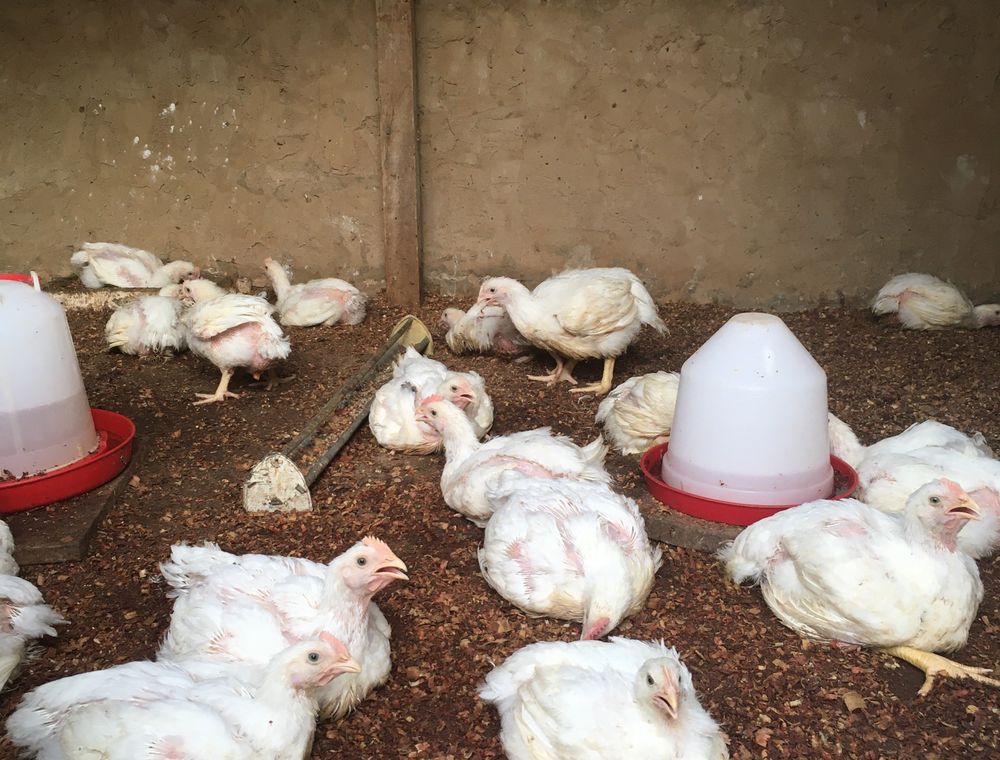
Short answer: A broiler drinks about twice its feed weight in water, and far more on a hot afternoon, so water is the first thing to get right in the house. Set drinker numbers and height for the flock you have, clean the tank and lines on a fixed routine, and fix every leak before it wets the litter. Read the tank level twice a day, because a sudden drop in intake is often the first sign of trouble.
Key takeaways
- A broiler drinks about twice its feed weight in water, and more when it is hot.
- Set drinker numbers and height for the flock in front of you, then raise the height every week.
- Clean tanks, lines and drinkers on a fixed routine, because biofilm comes back within days.
- A leaking drinker is a litter problem, so fix the drinker before you blame the feed.
- Read the tank twice a day and treat a sudden drop in intake as a warning.
Water comes before feed in the house
A box of day-old chicks that reaches the farm at seven in the morning should be drinking by nine. If it is not, the problem is usually the drinkers, not the chicks. A buyer phones us in the second week to say the birds are "not eating", and more often than not the birds are eating fine. They just cannot reach the water easily, or the water tastes of iron, or the tank ran dry at noon.
Water does three jobs at once. It carries feed through the gut, it keeps body temperature down when the house gets hot, and it keeps the litter in condition, because a bird that drinks steadily passes a drier dropping. If one of those fails, the flock slows down. A good feed programme on a poor water system still gives you slow birds.
This article covers how much water a broiler really drinks, how to set up drinkers, where the water comes from and how to keep it clean, and what to do when a flock starts drinking less. If you are still planning the house, read our broiler house setup guide first, because drinker placement is far easier to get right on an empty floor. For the bigger picture on weight, our heavy broilers guide treats clean water as one of the core levers.
How much water a flock really drinks
The working rule is that a broiler drinks about twice its feed intake by weight. In mild weather that means roughly 1.8 to 2 litres of water for every kilogram of feed the flock eats. In hot weather the ratio climbs, because birds drink more to shed heat, and a hot afternoon can take a flock well past the normal figure.
The table gives approximate daily figures for a Ross-type broiler in mild weather. Treat it as a planning guide, then replace it with your own flock's numbers once you have measured them for a few days.
| Age | Feed per bird per day (approx.) | Water per bird per day (approx.) | Water for 1,000 birds per day |
|---|---|---|---|
| Week 1 | 20 g | 40 ml | 40 litres |
| Week 2 | 45 g | 90 ml | 90 litres |
| Week 3 | 75 g | 150 ml | 150 litres |
| Week 4 | 100 g | 200 ml | 200 litres |
| Week 5 | 120 g | 240 ml | 240 litres |
| Week 6 | 140 g | 280 ml | 280 litres |
Read the last column with a tank in mind. A 1,000-litre tank that is full on a Monday gives a week-six flock of a thousand birds about three and a half days at normal demand. On a hot afternoon, when intake jumps, it can run empty within two days. That is why the tank level belongs on your daily check, next to the feed bin.
Birds also drink in bursts. Most of the water goes down in the late morning and the afternoon, after the birds have fed and the house has warmed up. A drinker that is full at six in the morning and dry at two in the afternoon produces a flock that eats well at dawn and then stands in the heat looking miserable. The feed side of the same calendar is in our feeding schedule.
Drinker numbers and height, set before the birds arrive
Drinkers are the item most farmers under-buy. Two planning figures are common starting points. Nipple drinkers are often planned at one nipple for every 10 to 12 birds. Bell drinkers are often planned at one for every 70 to 100 birds. Your equipment supplier's figures take priority over ours, and a long house needs more drinkers than a short one, because a bird will not walk the length of a shed to drink.
For 500 broilers, the starting plan is about 42 to 50 nipples, or five to seven bell drinkers. Put a bell drinker near each end of a run and one in the middle, and you have covered the walk.
Height matters as much as number. The rim of a bell drinker should sit at about the height of the birds' backs as they stand, so they drink without stretching and without scooping litter into the pan. Set the first height for the chicks, then raise it every week. A drinker set too low gets spat in, spilt and filled with litter. A drinker set too high is out of reach for the small birds, and the small birds are the ones you most need drinking.
In the first days, chicks need shallow drinkers so they cannot drown. Put clean pebbles or coarse grit in the chick pans so the chicks stand on something solid, and move them onto the house drinkers once they are feathering and drinking confidently. Chicks that have never seen a nipple can take a few hours to learn it, so start the water and show them before you open the box.
Where your water comes from, and whether it is safe
Water sources in the Kasoa area tend to fall into four groups: mains water, borehole water, water carted in by tanker, and rainwater from roofs. Each brings its own problem, so find out which one you are dealing with before you blame the birds.
- Borehole water is often clean at source but can carry iron. Iron shows up as a rusty stain in the tank and an orange slime in the lines and nipples. The slime narrows the nipple opening, so birds work harder for less water.
- Mains water is treated at source, but storage tanks let it pick up dust, algae and whatever falls in from the roof.
- Tanker water is only as good as the tanker and its last load. We would not give chicks tanker water without a recent test result for the source.
- Rainwater is soft and cheap, but the first rains wash the roof, and dust, lizards and droppings all end up in an open tank.
Ask the water supplier, or a lab, for a basic test once a year, and any time the water changes colour, smell or taste. The test will show iron, hardness, salt and bacteria. If iron is high, a treatment step before the tank saves a lot of cleaning later. The right treatment depends on your water, so get advice from a water engineer or your vet rather than copying what a neighbour does.
Cleaning tanks, lines and drinkers on a routine
Clean water is a routine, not a rescue. Biofilm, the slimy layer of bacteria and organic matter that grows inside pipes and on drinker rims, forms within days. Once it is established, it shelters bacteria from whatever you put in the water, so cleaning has to happen before the slime is visible.
Drain the tank once a month and scrub the walls. Flush the lines every week. Scrub bell drinkers at least twice a week, and check nipples by hand, because a blocked nipple looks fine from the aisle. Use a poultry-approved sanitiser at the strength on its label, and ask your vet which product suits your water. Do not mix two chemicals in the same tank because you think it will work better.
After any cleaning, run the lines until the water comes out clear at the far end, not just at the tap. Dead ends are where the slime hides. A line that finishes at a closed valve is the first place we look when one corner of the house is thirsty and the rest are fine.
| Item | How often | What to look for | What to do |
|---|---|---|---|
| Storage tank | Check weekly, drain and scrub monthly | Slime, algae, sediment, dead insects | Drain, scrub, refill, sanitise to label |
| Supply lines | Flush weekly | Slime film, weak flow at the far end | Flush until the far end runs clear |
| Bell drinkers | Check daily, scrub twice a week | Green or orange film, spilt water | Wash in warm water, dry, reset height |
| Nipple drinkers | Press a sample by hand daily | Dripping, blocked nipples, slime | Clear or replace nipples, check pressure |
| Filters, if fitted | As the maker states | Falling flow, visible silt | Clean or replace the element |
The full clean-out between flocks, which is where the tank and lines get emptied for good, is part of our all-in all-out guide.
Why a leaking drinker wrecks the litter
A nipple that drips, or a bell drinker set so low that birds spill it every time they drink, puts water exactly where you do not want it. A wet patch under a drinker turns into caked litter within a few days. Caked litter holds ammonia, keeps coccidia alive, and gives birds sore feet and hock burns. The birds did not catch anything from the drinker, but the drinker started the trouble.
When you walk the house, look at the litter under each drinker as well as at the birds. A damp ring the size of a dinner plate means a leak or a wrong height. Fix the leak, lift the drinker, and take out the caked litter around it. The wider story of the floor is in our broiler litter guide, and the cocci side is in our coccidiosis article.
Water through the seasons in Kasoa
The hot spells before the rains are the hardest weeks for water. A flock that drinks 200 litres on a cool day can drink 300 on a hot afternoon, so a tank that was comfortable in January can run low in March. Check the tank twice a day in the hot weeks, not once. Shade the tank if you can. Water left in full sun warms up, and birds drink less warm water, so a tank in the sun can cut intake just when the house needs more. Heat losses in the last fortnight are covered in our mortality guide.
The harmattan, roughly December to February, brings the opposite trouble. Mornings are cool, birds drink less, and it is tempting to top up the tank less often. But harmattan dust settles in open tanks and blocks nipples, and dry air makes the litter dusty. Cover the tanks, wipe drinker rims, and check the litter for dust as well as damp.
In the rains, the risk is contamination. Rainwater tanks fill with run-off from the roof, and muddy yards and open drains can reach the supply. Keep tank lids closed, keep supply pipes well away from drains, and clean more often. Wet weather also slows the litter from drying, so the drinker checks matter more, not less.
Need chicks for your next batch?
Send breed, number and town. We reply with price, hatch date and delivery cost in writing.
Using water intake as an early warning
Water is the cheapest sign of trouble you have, and the easiest to measure. Read the tank level at the same time each morning and each evening, work out how much the flock drank since the last reading, and write it in the record book beside the mortality count. After a few days you will have a normal line for your flock, in your weather.
Here is how it works in practice. A house of 800 birds in week four normally drinks about 160 litres a day in the same kind of weather. One afternoon the reading shows 120 litres, a drop of a quarter, and nothing in the house has changed. The drinkers are working. A drop like that is worth a call to your vet that day, before the birds start to look ill. It can come from a respiratory problem, a gut problem, or a flock that is simply uncomfortable, and your vet will want to see the birds, not just the number.
Watch the other direction too. A sudden jump on a mild day can mean spillage, a leaking line, or a drinker that was dry all morning and filled up in one go. Spilt water shows in the litter, so pair the reading with a walk through the house.
The daily water checklist
- Read the tank level at first light and again at dusk, and write both numbers down.
- Walk the house and check the far end of every line for flow.
- Lift the rim of every bell drinker and look at the litter underneath.
- Press a sample of nipples by hand to make sure each one releases water.
- Confirm the tank lid and the inlet screen are closed.
- Compare today's intake with the last three days in similar weather.
- Record any drop of more than about a tenth, and call your vet if the drop holds for a second day.
The checks themselves take about twenty minutes. The hard part is doing them on the day you would rather be somewhere else.
Water mistakes we see most often
- Filling the tank only when it is empty. By then the flock has been thirsty for hours, and the birds that drink first set the pattern for everyone else.
- Setting drinkers at chick height and never raising them. By week five the birds stand on the litter and spill everything.
- Cleaning the tank but not the lines, so the slime simply comes back through the new water.
- Adding things to the water on a guess. Medicines, vitamins and sanitisers all change the taste, and a bird that dislikes the taste drinks less.
- Trusting a full tank. A full tank can sit beside a blocked line, and the birds on the far side do not care how full it is.
If you want to put anything into the water, ask your vet first and follow the product label to the letter. Medicines in water only work if the bird drinks enough of them, and a sick bird often drinks less, so the dose can drop without you noticing. Write down what went in and when, so your vet has something to work with.
If you are ordering chicks for a new house and want to talk through water and drinkers before the box arrives, call or WhatsApp us on +233 24 915 1503. Our broiler chicks page has the breeds we supply, the price list is updated as prices change, and you can place the order through the order form once you are ready.
Questions farmers ask
How much water does a broiler drink each day in Ghana?
In mild weather a broiler drinks roughly twice its feed intake by weight. That works out at about 40 millilitres a day in week one and around 280 millilitres by week six. Heat raises those figures a lot, so a hot afternoon can take a flock well above the table. Measure your own flock's intake for a few days from the tank level, and use that as your baseline.
How many drinkers do I need for 500 broilers?
As a starting plan, about 42 to 50 nipples, or five to seven bell drinkers, for 500 birds. The exact number depends on the length of your lines and the specification for the nipples you use. Spread the drinkers along the house so that no bird has to walk far to reach one, and check the far end of every line every day.
What height should broiler drinkers be?
Bell drinker rims should sit at about the height of the birds' backs as they stand, so they drink without stretching and without spilling water into the litter. Raise them every week as the birds grow. For the first few days, use shallow chick drinkers so the chicks cannot drown, then move them onto the house drinkers once they are feathering and drinking confidently.
Can I put vitamins or medicine in the drinking water?
Ask your vet before you add anything, and follow the product instructions exactly. Water medicines only work if the bird drinks enough of them, and a bird that is ill often drinks less, so the dose can drop without you noticing. Never add a product because a neighbour swears by it. Keep a record of what went in and when, so your vet can make sense of the flock's response.
Why is my flock drinking less all of a sudden?
A fall in intake in the same weather is one of the earliest signs of illness, and it often shows before the birds look sick. Check the drinkers first, because blocked nipples and low bell drinkers can cut intake without any disease. If the drinkers are fine, call your vet the same day, and have the last few days of tank readings ready to share.
How often should I clean the drinkers and the water tank?
Scrub bell drinkers at least twice a week and check nipples by hand every day. Flush the lines weekly, scrub the tank monthly, and clean any filter as the maker says. Use a poultry-approved sanitiser at the label strength, and ask your vet which one suits your water. The common mistake is cleaning the tank and forgetting the lines, because the slime in the lines seeds the clean water.
Is borehole water safe for broilers?
Borehole water is often clean at source, but it can carry iron, which blocks nipples and leaves a slime in the lines. Test the water once a year, and any time it changes colour, smell or taste. If the test shows iron or bacteria, get advice from a water engineer or your vet on treatment before the water reaches the birds. Do not guess the treatment from a label.


