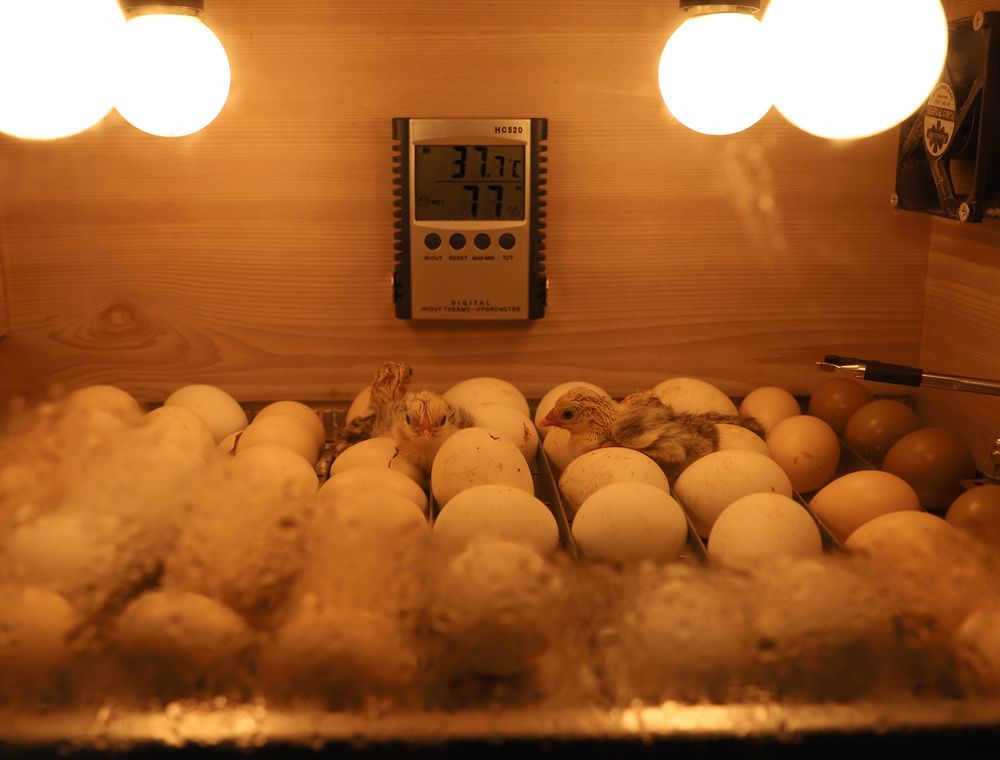
Short answer: Most light duck breeds, including Pekin, Khaki Campbell and Indian Runner, hatch in 28 days in a forced-air machine held at about 37.8 °C, with 55 to 60 percent humidity until day 25 and 70 to 75 percent at lockdown. Muscovy run longer, around 35 days, so their lockdown and hatch dates move with them. Weigh a sample of eggs to check whether the humidity is right, and mist with warm water if the weight loss is behind.
Key takeaways
- Most light duck breeds hatch on day 28. Muscovy eggs take about 35 days, so do not use the duck chart for them.
- Run a forced-air machine at about 37.8 °C, and keep humidity at 55 to 60 percent until day 25.
- Lockdown on day 25 means no more turning and humidity up to 70 to 75 percent, not a shut machine and a prayer.
- Weigh a sample of eggs at the start and at lockdown. The weight loss tells you whether humidity and misting are right.
- Duck eggs have a thicker shell and a dirtier surface. Dry-clean them and do not soak them before the set.
Can I set duck eggs in the chicken machine?
Yes, and many farmers do. The machine is the same, the trays are the same, and the thermometer you calibrated for chicken eggs works for duck eggs as well. What changes is the timing and the humidity, and those two changes are where most duck sets go wrong. A duck egg that goes into a chicken programme will be lockdown-ready long before it is ready to hatch, and it will often hatch soft and wet, or not at all.
Before you load a single egg, write the duck schedule on the machine and separate it from the chicken log. If the same machine holds chicken eggs for the week, the duck dates need their own column. Keep duck eggs in their own trays and mark them clearly, so nobody lifts a duck tray on day 21 and turns it as though it were a chicken batch.
It helps to see the duck schedule side by side with the chicken one. Chicken eggs are set at a cooler, drier humidity in the setter, roughly 50 to 60 percent, and they hatch on day 21. Duck eggs are set at a higher humidity, which is a deliberate difference, and they need a week more. Use the duck numbers below, and do not split the difference between the two. Our day-by-day chicken guide is the chicken version of this chart, and the two should never share a timetable.

Twenty-eight days for most light ducks, and longer for Muscovy
Pekin, Khaki Campbell and Indian Runner eggs take about 28 days from setting to hatch. That is the chart in this article. Muscovy take longer, usually about 35 days and sometimes a day or two either side, so a Muscovy set needs its own timetable. Its lockdown falls later, its humidity steps happen later, and its candling dates move out by a week.
The gap matters for planning. If you start a set of Muscovy eggs on the same day as a set of Pekin eggs and run both on one schedule, the Muscovy will be turned off too early and the Pekin will be lifted too late. Set them on different days, or in different machines, and write the hatch dates on the outside of the machine before the first egg goes in. Our Pekin and Muscovy comparison explains why the two breeds suit different farms, which is useful before you buy eggs for either.
Count day 1 as the day the eggs go into the machine. Do not count the day you collected them, and do not count the storage days before the set. The chart runs from that first day in the machine, and the hatch clock does not care how long the eggs waited in your store.
Temperature for ducks: 37.8 °C in a forced-air machine
In a forced-air machine, set the duck programme at about 37.8 °C, which is 100 °F. That is half a degree warmer than the 37.5 °C we use as a standard for chicken setters, and it is the number that keeps the duckling developing on time without pushing the embryo too hot. Let the machine run empty for a day before you load it, and read the air temperature at egg height, not just at the top of the cabinet.
Still-air cabinets stratify: heat collects high, so the eggs under the lid can run hot while the thermometer reads fine at the bottom. Put the probe at the level of the eggs, check it at several points, and set the machine so the average at egg height is close to the duck figure. If you cannot get an even reading, move to a forced-air machine before the next duck set.
Temperature drift is the most common problem in the first week. A machine that sits in the sun at midday, or near a door that opens and closes, will swing by a degree or more. Log the readings morning and evening for the first three days, and move the machine before you change the setting. Our guide to calibrating an incubator's thermometer shows how to check the probe against a reference before you trust it. Clean the machine between sets with the routine in our cleaning and disinfecting guide, because a duck set is the wrong time to find old residue in the tray.
Humidity: 55 to 60 percent, then 70 to 75 at lockdown
Duck eggs need more humidity than chicken eggs. The shell is thicker and the membranes are tougher, and a duck egg that dries out in the early days is hard to bring back. Hold the humidity at 55 to 60 percent from day 1 until day 25. Then, at lockdown, raise it to 70 to 75 percent and keep it there through the hatch. Those are the bands we use, and the weight loss in the next section tells you whether they are right for your machine.
A humidity that is too low shows up as a small duckling that is stuck to the membrane, or a duckling that dries out in the shell before it can pip through. A humidity that is too high shows up as large, soft ducklings that stay wet for a long time and take hours to dry. Both problems are fixed by changing the water surface and the vents, not by guessing. Our humidity troubleshooting article goes through the fixes in order.
The Ghanaian climate changes the job. Harmattan weeks dry a machine out, and the water tray empties faster than any chart predicts. Add water surface, close the vents a notch and check the hygrometer twice a day. In the rainy season, the air is already wet, and the machine can climb past 60 percent on its own. Open the vents slightly and keep the water tray shallow so the humidity does not run away when the rain is heavy.
Misting: when it helps, and when it just wets the floor
Misting is the habit that duck keepers argue about most. Some mist every egg once or twice a day from day 1 to day 25, and some never mist at all and rely on the water tray. Our view is that misting is a tool for a weight loss that is behind, not a ritual. If the eggs are on track, leave them alone. If they are losing too little weight, a fine spray of warm water on the eggs in the tray will help for a few hours.
Use water at about the incubator temperature. Cold water on a warm egg cools the shell, and the egg then takes a while to come back to temperature, which costs you time and can stress the embryo. Use a clean sprayer, not a dirty bucket, and spray lightly. Do not soak the eggs, and do not spray the thermometer or the vents. Stop misting at lockdown unless the weight loss is behind, because the humidity you set at lockdown is meant to do the work.
Misting a machine that is already at the right humidity wastes time and can push the humidity past the band. Mist after the readings, not before, and write down what you sprayed and when. If you find you are misting every day for two weeks, the water tray is too small or the vents are too open, and that is the problem to fix.
Turning duck eggs, and what happens when you skip it
Turn duck eggs at least three times a day from the day they go in until lockdown on day 25, and five times is better if you can manage it. Turning keeps the embryo off the shell membrane and stops it sticking to one side. A set that is turned only once or twice a day shows more dead embryos on candling day, and the surviving ducklings are often weaker.
Mark each egg with a pencil dot on one side and a cross on the other, or use the machine's tray marks, so that you know which eggs have been turned in a given round. Turn the whole tray, not just the eggs at the edge, and turn it in a smooth motion. Do not turn the eggs by hand in an open room, because the change of air and the handling both cost moisture and temperature.
Stop turning at lockdown on day 25, and leave the eggs flat. Ducklings need to find their position in the shell and pip the air cell at the right angle, and a turned egg at this stage can drop the duckling out of position. If you have a machine with an automatic turner, switch it off at the same time. A turner that keeps going on lockdown is one of the commonest reasons for a late, stuck hatch.

Candling dark-shelled duck eggs without losing your patience
Candle duck eggs on day 7 and again on day 14 if you want a second look, and do a final check on day 25 before lockdown. The shell is thicker than a chicken's, and many breeds lay green, blue or brown-tinted eggs, so the light from a torch goes through less of the shell. You need a stronger light than you use for chicken eggs, a dark room and patience.
On day 7, a fertile duck egg shows a dark spot with blood vessels spreading from it. A clear egg with no spot is infertile, and it should come out before it starts to rot. On day 14, a healthy embryo fills a good part of the egg, and the vessels are clearly visible. On day 25, the duckling should fill most of the egg and the air cell should be clear and large. Our egg candling guide covers the technique in more detail, and the duck eggs are read in the same way, with more light.
Keep a count of the clear eggs and the dead eggs at each check, and write it on the same sheet as the temperature readings. A clear count of two out of thirty on day 7 is normal. A count of ten is a sign that the eggs, the breeding or the storage went wrong before they reached the machine.
Weight loss: a worked example for a 72-gram duck egg
The weight of the egg tells you what the humidity is doing, and it does it better than the hygrometer alone. Weigh a sample of eggs on setting day with a scale that reads to 0.1 gram, mark them, and weigh the same eggs again at lockdown. The difference is the water they have lost. For duck eggs the usual target is roughly 13 to 15 percent loss by lockdown, a little higher than the chicken target.
Take a duck egg that weighs 72 grams on setting day. At 13 percent loss, it should weigh about 62.6 grams at lockdown. At 15 percent, it should weigh about 61.2 grams. The window is small, which is why a scale that reads to a whole gram is no use for this job. The table shows the readings we would act on.
| Lockdown reading (from 72 g) | Loss | What it means | What to do |
|---|---|---|---|
| 62.7 g or more | Under 13% | Too little water lost, humidity too high | Open the vents a notch and cut the water surface |
| 61.2 to 62.6 g | 13 to 15% | On target | Lift to 70 to 75 percent and leave it |
| 61.1 g or less | Over 15% | Too much water lost, humidity too low | Mist gently with warm water and close the vents |
Weigh a few eggs from the top and the bottom of the machine, because the readings differ across the trays. If the top trays run dry and the bottom trays run wet, the airflow is uneven, and that is a machine problem rather than a humidity problem.
Need chicks for your next batch?
Send breed, number and town. We reply with price, hatch date and delivery cost in writing.
Lockdown on day 25: the duck version of the routine
Lockdown on day 25 has three jobs. You stop turning, you raise the humidity to 70 to 75 percent, and you leave the machine alone. The eggs should be flat, the air cell should be fixed, and the ducklings should start to take up their final position inside the shell. The machine should not be opened more than it has to be, because every opening drops the humidity and the temperature.
Check the readings at lockdown and then once a day. Look at the water tray, the thermometer and the hygrometer, and fill the tray if it is low. If you need to mist, do it with warm water on the lower trays only and close the lid again quickly. Write the lockdown date on the machine, the weight at lockdown, and the expected hatch date, which is day 28 for light breeds and about day 35 for Muscovy.
Some ducklings pip on day 27, and some hatch over a day and a half from first pip to last. Let them dry in the machine. A duckling that is still wet and sticky does not need your help, and opening the lid to lift it out will drop the humidity for everything still in the shell. Our article on assisted hatching explains when, if ever, you should help a chick out, and the rules for ducklings are stricter.
Storing duck eggs before the set, and the dirt problem
Duck eggs are usually dirty when they arrive, because the hens lay near water and mud. Do not wash them before the set. A wash in cold water pulls contamination through the shell, and a soak in a bucket removes the protective bloom. Dry-clean the shell with a cloth or a fine sandpaper block, and set only eggs that are clean enough not to need more than that.
Store the eggs at about 15 to 18 °C, pointy end down, in a room that is cool and not too dry. A kitchen counter in a Ghanaian house is usually too warm, and a fridge is too cold and too dry. Seven days is the longest we would hold eggs before a set, and fewer days is better. Turn the stored eggs once a day to keep the yolk centred.
If the eggs have to wait more than a few days, record the storage dates and the temperature. A duck egg that waited three weeks in a warm room will hatch badly, and the hatch rate will tell you the problem only after the damage is done.
Duck eggs and ducklings are quoted on request, so send us a WhatsApp on +233 24 915 1503 if you are weighing a set. Our duck farming guide covers the flock side of the decision, and our duck egg farming guide covers what happens to the eggs once the hens lay them.
Mistakes that keep a duck set from hatching
- Using the chicken timetable. The duck eggs lock down ten days too early and hatch soft.
- Setting the humidity at chicken levels. The ducklings stick to the membrane or dry out in the shell.
- Misting every egg every day. The humidity climbs past the band, and the shell takes in water it does not need.
- Washing the eggs before the set. The protective bloom goes, and the contamination goes in.
- Leaving the turner on after lockdown. The ducklings are moved out of position and the hatch stalls.
- Opening the machine during pipping. The humidity drops for everything still in the shell.
A checklist for a duck set
- Confirm the breed, and set the chart for 28 days for light breeds or 35 days for Muscovy.
- Calibrate the thermometer at egg height, and run the machine empty for a day at about 37.8 °C.
- Dry-clean the eggs, do not wash them, and sort out any cracked or dirty eggs.
- Weigh a sample of eggs to 0.1 gram, and write the weights on the sheet.
- Set the humidity at 55 to 60 percent, and fill the water tray to the mark.
- Turn at least three times a day, and mark the trays so every round is recorded.
- Candle on day 7, and count the clear eggs before you move on.
- Raise the humidity to 70 to 75 percent at lockdown on day 25, stop turning and weigh the sample again.
- Let the ducklings dry in the machine, and leave the lid shut until the hatch is finished.
Questions farmers ask
How long do duck eggs take to hatch in Ghana?
Pekin, Khaki Campbell and Indian Runner eggs usually hatch on day 28 in a forced-air machine. Muscovy eggs take about 35 days, sometimes a little more or less. Count day 1 as the day the eggs go into the machine, not the day they were collected, and pencil the lockdown and hatch dates onto the machine card before loading.
What temperature should I set for duck eggs?
In a forced-air machine, set about 37.8 °C, which is 100 °F. Read the temperature at egg height rather than at the top of the cabinet. With a still-air cabinet, probe several spots and set the average, since the upper eggs run warmer.
What humidity do duck eggs need?
Keep the machine at 55 to 60 percent from day 1 to day 25, then raise it to 70 to 75 percent at lockdown and hold it through the hatch. That is higher than the setter humidity for chicken eggs, because duck eggs have a thicker shell and need more moisture kept in the machine.
Should I mist duck eggs?
Only when the weight loss is behind. Mist lightly with warm water, at about incubator temperature, on the lower trays, and then close the machine again. Misting every day as a habit usually pushes humidity past the band. Stop misting at lockdown unless the weight loss shows you still need it.
Can I wash duck eggs before I set them?
No. Washing in cold water can draw contamination through the shell, and soaking removes the protective bloom. Dry-clean the shell with a cloth or a fine sandpaper block. Set eggs that are clean enough without washing, and discard any that are badly soiled or cracked.
Why do my duck eggs hatch soft and wet?
The most common cause is humidity that is too high in the last days, or a machine that stayed closed too long with the vents shut. Check the weight loss at lockdown, since a light egg has lost too little water. Ventilation during pipping also matters. Cut the water surface and open the vents a notch next time.
How do I candle dark-shelled duck eggs?
Use a stronger light than you use for chicken eggs, in a dark room. On day 7, a fertile egg shows a dark spot with spreading blood vessels. A clear egg should come out. Count the clear eggs at each check and write the number down, because a high count points to a problem before the machine.


