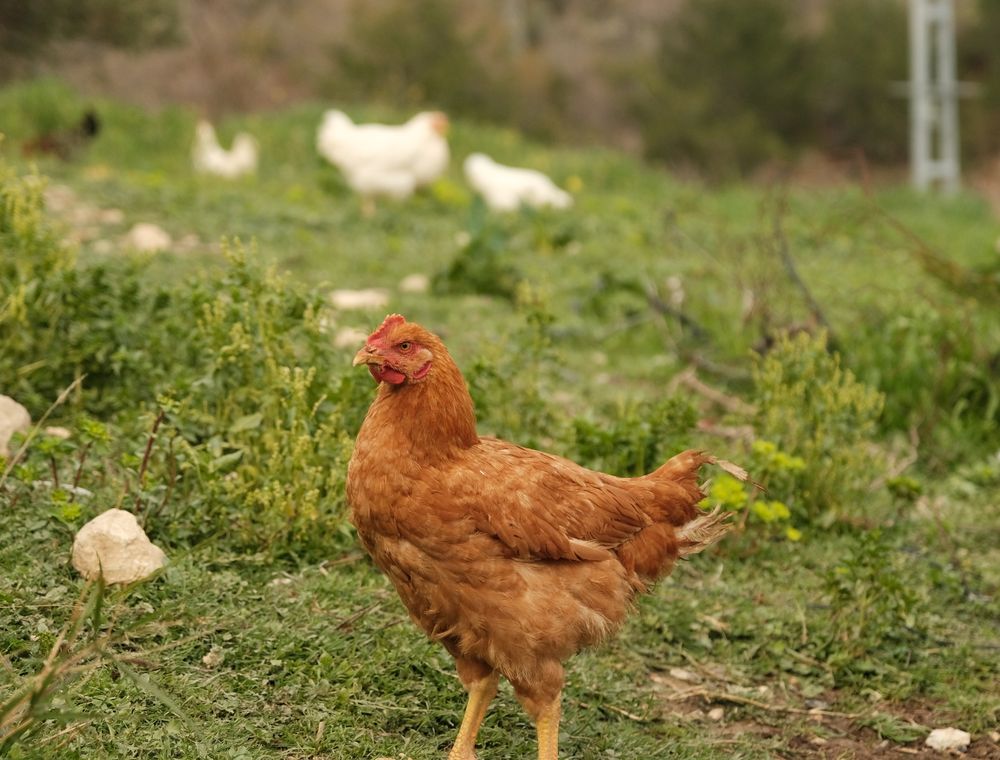
Short answer: Yolk colour comes mainly from yellow pigments called xanthophylls that the hen takes in through her feed, so the lever is what goes into the mash and what the birds can forage. Yellow maize, green leaf meals and marigold are the usual natural sources, and a change in the ration normally shows in the yolks within about a week. A pale yolk is not automatically a poor egg, because heat, disease and low intake can also pale the yolk on a sound ration.
Key takeaways
- Yolk colour comes mainly from yellow xanthophyll pigments in the feed, not from the shell colour or the breed alone.
- White maize contributes little yellow pigment, so a mash built on it tends to give paler yolks.
- A feed change usually shows in the yolks within about a week, so judge any trial over at least two weeks.
- Score yolks with a colour fan under the same light, rather than by eye from one egg.
- Check the flock for heat stress, worms and disease before you blame the feed for pale yolks.
What actually puts the colour in a yolk
Ask most farmers what makes a yolk yellow and they will say maize. They are partly right, but the detail matters if you want to change the colour on purpose. The pigment in a yolk is a group of yellow compounds called xanthophylls, including lutein and zeaxanthin. The hen takes them in through her feed, carries them in her blood, and deposits them into the yolk while it is forming. What she eats on a given day shows up in the yolk laid days later.
Beta-carotene is the other carotenoid people often mention, and it is a different story. A hen uses most of the beta-carotene she eats to make vitamin A, so it does little for yolk colour. That is why a feed rich in orange-red carotene is not automatically a feed that gives deep yolks. If you are reading labels or talking to a feed seller, ask specifically about xanthophylls.
This also explains why yolk colour is a feed question first. The breed plays a smaller part, and the shell colour plays none at all. Our article on brown or white eggs makes the same point about shells, so read the two together. For the wider questions buyers and farmers ask, our FAQ is the next stop.
Yellow maize and white maize: the simplest lever
Most of the energy in a Ghanaian layer ration comes from maize, and the colour of that maize matters. Yellow maize carries a useful amount of xanthophylls. White maize carries very little. A great deal of the maize eaten as food in Ghana is white, and some farms end up with white grain in the mash because it was the cheaper or easier lot to buy that month. The result is a flock that lays pale yolks no matter how carefully the rest of the ration is balanced.
Ask your feed supplier, in plain words, whether the maize in your mash is yellow or white, and whether it is the same grain from bag to bag. If it is white, a switch to yellow is the cheapest step you can take. Make the change gradually, because a sudden swap in the grain changes the energy and the texture of the mash, and birds notice. A common approach is to replace part of the white maize with yellow for a trial period and watch both the yolks and the intake.
Consistency matters more than the first batch. A mash that is yellow one month and white the next will give you yolks that go up and down, and that is hard to read. Buy from the same source where you can, and write down the grain in each delivery on your feed record.
Green leaf meal and what the hen finds outdoors
Green leaves carry xanthophylls, so birds that get to forage tend to lay deeper yolks than birds kept entirely indoors. That is one of the reasons free-range eggs often look richer in the yolk. The effect depends on how much green material the hens actually eat, and on the season. In the rains, grass and weeds are plentiful and the yolks often deepen. In the dry months, the pasture is thin and the yolks tend to pale.
If you cannot give your birds a range, you can bring green material into the ration in the form of dried leaf meal. Leucaena leaf meal and moringa leaf meal are both used in Ghana for this purpose, and our article on moringa leaf meal goes into the inclusion rates and the cautions. Leaf meals vary a lot in quality, so buy from a supplier who can tell you where the leaves came from and how they were dried. Dried leaf loses colour quickly in damp, hot storage, so keep it dry and use it within a sensible time.
Leaf meal will not rescue a ration that is short on energy or protein. It adds colour and some useful nutrients, but it does not replace the core ingredients. Think of it as the finishing touch on a balanced feed, not as the feed itself.
Marigold and other pigment sources, and their trade-offs
Marigold is one of the best-known sources of yellow pigment in poultry feed. It is grown for the purpose, and it is sold as meal or as a concentrated extract. Used properly it gives a strong, consistent colour, which is exactly what a farm needs when the grain is changing from batch to batch. The trade-off is cost and supply. A pigment that is not available every month, or that is priced out of reach, makes a poor base for a plan.
Red palm oil appears in farm discussions often, and some farmers use it for colour. It does contain carotenoids, but most of them are beta-carotene, which as we saw does less for the yolk. It is also a concentrated fat, so a little goes a long way in energy terms, and an overfed flock can put on weight it does not need. If you try it, treat the result as something to measure, not something to assume.
Whatever you use, do not add pigments, dyes or additives to the feed without advice from your vet or your feed adviser. Ask what the product contains, how much to include and what withdrawal advice applies if it is ever used near sale. Follow your vet's advice on all of this, and keep the product labels in the record.
Why a pale yolk is not always a feed problem
A pale yolk is not always a sign of a poor ration, and it is not always a sign of a poor egg. The yolk tells you about the pigment the hen had available in the days it was forming. Anything that cuts her intake for a day or two will pale the yolks laid in that period, even if the feed is excellent. Heat is the most common example in Ghana. A hot house reduces feed intake, the birds pant rather than eat, and the yolks reflect the drop.
Disease and parasites do the same. A flock with worms, coccidiosis or any illness that makes birds go off their feed will show paler yolks, and the first signs are often in the eggs rather than the birds. Stress from handling, a change of house or a sudden noise can pale the yolks as well. Age matters too: as hens get older, the yolks can change, and you should not expect the same colour from a flock at the end of its lay as from one at its peak.
So before you change the feed, rule out the flock. Check the water, look at the droppings, count the birds off their feed and speak to your vet if anything has shifted. Our article on oyster shell and calcium for layers covers a different part of the ration, but the same habit of checking the whole flock first applies.
How long a feed change takes to show
The yolk is not formed in a single day, so the colour of today's eggs reflects what the hen ate over the last several days. A change in feed usually shows in the yolks within about a week, and the full effect can take a little longer to settle. This is the single most common mistake in yolk trials. A farmer switches to yellow maize on Monday, looks at the eggs on Tuesday, sees nothing, and decides it does not work.
Give each change at least two weeks before you judge it, and record the start date. Keep the flock on the same feed through the trial, because switching twice in the same fortnight makes the result impossible to read. If you need to stop the trial early for a health reason, write that down too, so the next person to read the record knows why the data stops.
Measuring yolk colour with a fan, not your eye
Your eye is a poor instrument for yolk colour, because the light, the plate and your mood all change the result. The trade uses a yolk colour fan, which is a set of shade tabs running from pale to deep, and the Roche colour fan is the one most often referred to. A fan costs little, lasts for years and gives you a number you can record and compare from one week to the next.
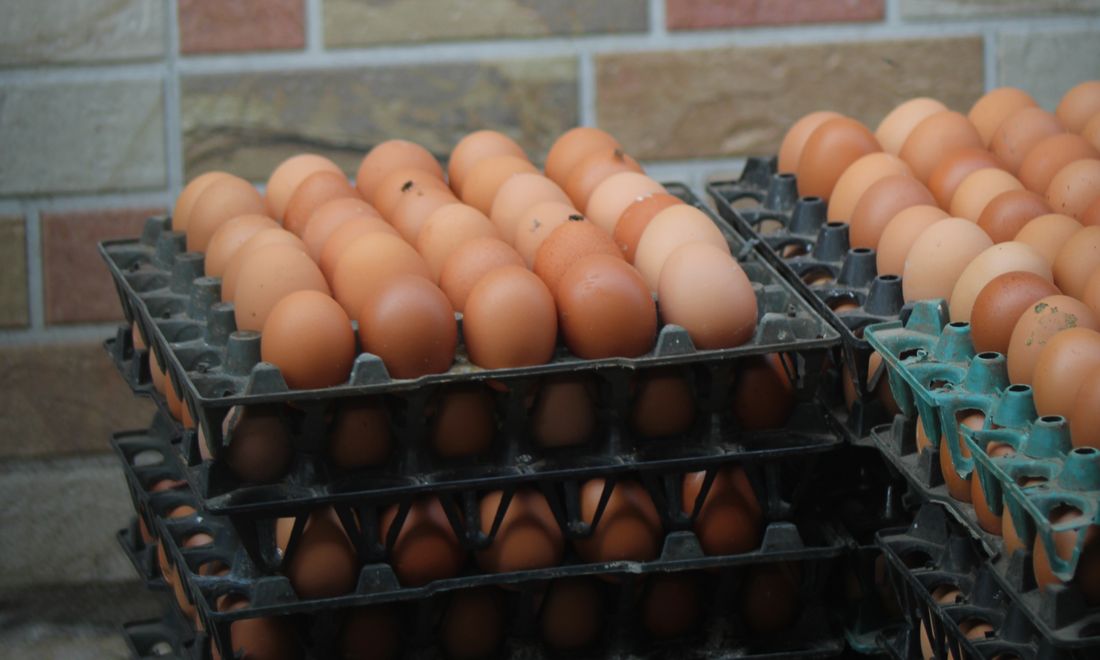
Score the yolks the same way every time. Crack the egg onto a plain white plate, in daylight from a window if you can, and hold the fan next to the yolk. Score ten eggs from different parts of the flock and average the result. Using ten eggs smooths out the individual variation that makes one egg look better than the next. Write the average down with the date, the feed and the weather. That row is your evidence.
If you have a second person doing the scoring, have them use the same fan, the same light and the same method. Two people scoring differently will show a change that is not there.
A two-week trial you can run on your own farm
A trial needs three things: a baseline, one change, and a fixed time to judge it. Here is a sequence that a small layer farm can run without any special equipment.
- Score ten eggs on the day you start, and record the average on the yolk colour sheet.
- Make one change only, such as swapping part of the white maize for yellow maize.
- Keep everything else the same: the same feed supplier, the same house, the same vaccine routine.
- Score ten eggs every second day, using the same fan and the same light.
- Look at the trend after about a week, and decide at the end of two weeks.
- If the change works and the birds are eating well, keep it. If not, go back to the baseline and try something else.
Track feed intake and egg output alongside the colour. A change that deepens the yolk but drops the number of eggs is not a win, and you will only see that if you record both.
Need chicks for your next batch?
Send breed, number and town. We reply with price, hatch date and delivery cost in writing.
What buyers ask for, and what they do not care about
Some buyers in Ghana ask for a deep yellow yolk, and they will say so. Others care more about the shell being clean, the egg being the right size and the crate being full of unbroken eggs. A deep yolk does not make an egg more nutritious in any way that a shopper can taste, and a pale yolk does not make it less safe to eat. The yolk colour is a selling point for some buyers, not a measure of quality on its own.
That means you should decide whether the colour is worth the feed cost before you chase it. If your buyers are happy with the colour you have, and your feed is balanced, leave it alone. If they keep asking for a deeper yolk, or you are selling into a shop where a richer colour stands out on the shelf, the trial is worth the time.
Mistakes that keep yolks paler than they need to be
The same handful of errors comes up again and again on farms with pale yolks. Each of these is simple to correct once you spot it.
- Using white maize in the mash because it is the cheapest lot, without checking the colour.
- Judging a change after one or two days, when the yolks have not yet caught up.
- Changing the feed and the flock routine in the same week, so the cause is lost.
- Scoring by eye under a bright bulb or in a dark coop.
- Leaving dried leaf meal in a damp store until it has lost its colour.
- Ignoring heat, worms or a drop in water intake that is cutting feed intake.
If you are also seeing eggs with cracks or weak shells, that is a separate problem with its own causes. Our article on reducing egg breakage and cracks covers the shell and handling side, and it should be read as a different job from colour.
Sources, what they add and what to watch
Use this table to choose your sources and to set up the record. The effects are general, and your own scores will tell you the truth about your flock.
| Source | What it adds | What to watch |
|---|---|---|
| Yellow maize in place of white | A steady base of yellow pigment in the mash | Keep the source consistent and check the mash does not change texture |
| Leucaena or moringa leaf meal | Yellow pigment plus some useful nutrients | Quality varies, and dried leaf loses colour in damp storage |
| Pasture and free range | Natural pigment when the grass is green | Dry months thin the pasture and the yolks tend to pale |
| Marigold meal or extract | Strong, consistent yellow pigment | Cost and supply; take advice on inclusion rates |
| Red palm oil | Some carotenoids, mostly beta-carotene | Adds energy, so overfeeding is easy; little effect on yolk colour |
Whatever you choose, record the start date, the ingredient, the amount and the average score every week. A record that shows the trend is worth more to you than any single good egg.
A yolk colour checklist for the flock
Run through this list before you change the feed for colour. Most farms find the cause in the first three lines.
- Find out whether the maize in the mash is yellow or white, and whether it is consistent.
- Check the flock for heat, worms, disease and any drop in feed or water intake.
- Set a baseline by scoring ten eggs with the fan, under the same light.
- Make one change at a time, and keep the rest of the routine the same.
- Judge each change over at least two weeks, with feed intake and egg count alongside.
- Keep leaf meal and any pigment dry and within its useful life.
- Check any additive with your vet or feed adviser before it goes into the feed.
If your flock is still young, the colour you see now is not the colour you will see at peak lay. Our layer chick page sets out the layer side of our range, and our layer feeding guide covers the ration from the first weeks through to peak. Placing an order is simple: go through the order form, or send us a WhatsApp at +233 24 915 1503. Questions about transport are answered on our delivery page.
Questions farmers ask
Does a deep yellow yolk mean a better egg?
Not in a way that changes nutrition or safety. A deep yolk reflects the yellow pigment the hen had in her feed, and some buyers prefer it for how it looks. A pale yolk from a sound flock is still a good egg. Decide whether the colour is worth chasing based on what your buyers ask for, not on the belief that deeper always means better.
Will yellow maize alone turn the yolks orange?
It will usually deepen them if the mash was built on white maize, but how far it goes depends on what else is in the ration, the season and the flock's health. Yellow maize is a steady base, not a magic ingredient. Give the change two weeks and score the yolks with a fan before you decide how much it has done.
How long does a feed change take to show in the yolks?
Usually about a week, with the full effect settling over a little longer. Judging a change after one or two days is the most common mistake in yolk trials. Record the start date and score ten eggs every second day so you can see the trend clearly.
Can I use marigold in my layer mash?
Marigold is a well-known source of yellow pigment, but it has a cost and must be supplied consistently. Ask your feed adviser or vet about inclusion rates and about any withdrawal advice if the product is used near sale. Do not add pigments or additives without that advice, and keep the product labels in your record.
Why did my yolks go pale in the hot season?
Heat is the usual culprit here in Ghana. Hot houses cut feed intake, and the yolks laid in those days reflect the drop in pigment. Improve shade and airflow, keep water cool and clean, and check that the flock is eating before you change the ration. If the paleness persists, call your vet, because disease can cause it too.
Do free-range hens always lay darker yolks?
Often, when the pasture is green and the birds are eating it. The effect falls in the dry months when the grass is thin, and it depends on how much the hens actually forage. A range is a helpful source of colour but not a guarantee, so keep scoring the yolks to see what your birds are really doing.
Does the breed decide the yolk colour?
The breed plays a smaller part than the feed. Strains can differ a little in how their yolks look, but the ration, the grain colour and the health of the flock matter more. Our <a href="/breeds/">breeds page</a> compares what we stock for lay. If you are choosing chicks, pick the breed for lay and hardiness first, then manage the colour through the feed.


