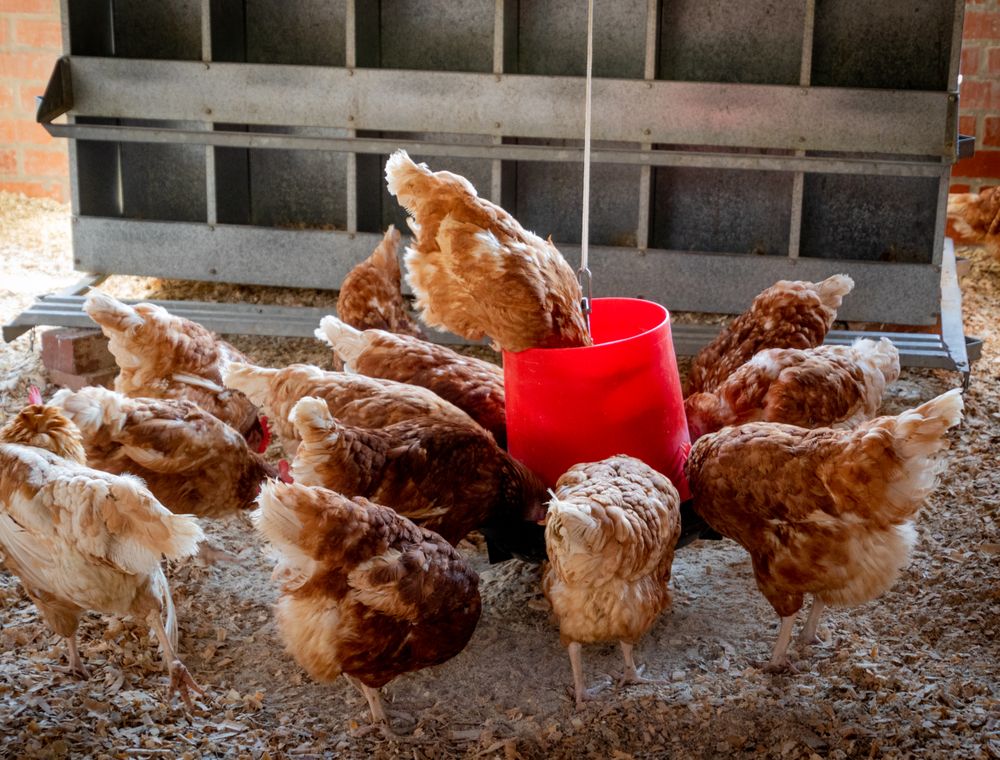
Short answer: Layers need a different feed at each stage of life. Starter feed builds chicks, grower feed builds frame, pre-lay feed prepares calcium stores, and layer mash carries about 3.8 to 4.2 per cent calcium once eggs start. A hen eating about 110 grams a day on a 4 per cent calcium mash takes in roughly 4.4 grams of calcium, close to the daily amount a laying hen needs for a strong shell. Change feed slowly, keep oyster shell in its own feeder, and store mash dry.
Key takeaways
- Match the feed to the bird's age and stage, because a layer mash is not a chick feed.
- During lay, aim for roughly 16 to 17 per cent crude protein and 3.8 to 4.2 per cent calcium.
- Offer coarse oyster shell in a separate feeder so hens can meet their own calcium needs.
- A 300-hen flock eats about a tonne of mash a month at peak, so plan purchases around that figure.
- Change feed over five to seven days, and store mash off the floor in dry air.
Why the feed has to change with age
A chick and a laying hen need very different things from their feed, and the wrong feed does damage even when the birds look healthy. A chick is building muscle, bone and feathers at a fast pace, so it needs high protein and balanced energy. A laying hen is making an egg almost every day, which takes protein for the white, fat and energy for the yolk, and calcium for the shell.
Calcium is where the mistakes happen. Layer mash carries far more calcium than a young bird can handle. Giving layer mash to chicks can strain the kidneys and does not make them grow faster. On the other side, grower feed fed to hens in lay does not have enough calcium to build a strong shell, so eggs thin out within weeks. Each phase has its own feed for a reason.
Buy the feed for the stage the flock is in, read the label, and do not stretch one feed across two stages to save money. Stretching feed is one of the most common cost-saving moves on small farms, and it is usually the most expensive one in eggs. If you are still choosing your flock, the day-old chicks section of our site explains how the stages line up with the birds you buy.
Feed by phase: what each stage needs
The table gives typical targets. Brands differ, so use the figures on your feed label and check them against your breed's guide. The feed amounts are approximate daily intakes per bird, and they rise with body size and weather.
| Phase | Age | Crude protein | Calcium | Approx. feed per bird per day |
|---|---|---|---|---|
| Starter | 0 to 6 weeks | 20 to 21% | 0.9 to 1.0% | 10 g, rising to about 40 g |
| Grower | 7 to 15 weeks | 15 to 16% | 0.9 to 1.0% | 40 g, rising to about 80 g |
| Pre-lay | 16 weeks to first egg | 16 to 17% | 2.0 to 2.5% | 80 g, rising to about 100 g |
| Layer | First egg to end of lay | 16 to 17% | 3.8 to 4.2% | 100 to 120 g |
Starter feed suits chicks, and grower feed carries them through the frame-building weeks. Pre-lay feed starts the calcium reserves before the first egg, and layer mash takes over once the flock reaches about 5 per cent lay. Our feed formulation basics article explains where the protein and energy numbers come from. Each strain has its own weight and feed curve, so check the breeds page against your bird before you settle on a phase table.
Protein and energy: the balance behind each egg
Protein supplies the amino acids that go into egg white and into the body the hen keeps. Lysine and methionine matter most, and a mash short of them will cut egg size before it cuts egg numbers. Most ready-made layer mashes balance these, so the practical question is whether your feed has a steady protein level and whether you have changed brands.
Energy controls how much the hen eats to meet her needs. A feed with lower energy makes hens eat more, while one that is too energy-dense can make them fat and less productive. Watch the bird rather than the bag: a hen in lay should feel firm over the breastbone, neither soft nor bony.
Maize is the main energy source in most Ghanaian mashes, so its quality matters. Maize stored damp can carry mould and aflatoxin, and that lowers the performance of the whole flock. If your mill buys maize in bulk, ask for a mycotoxin test on each batch.
Calcium: how much, from what, and when
A laying hen needs roughly 4 grams of calcium a day to build a shell, which takes about 20 hours. That calcium has to come from the feed in her gut, and bone reserves cannot cover a long shortfall. The feed label shows calcium as a percentage. A layer mash at 4 per cent calcium, eaten at 110 grams a day, gives 4.4 grams of calcium. A mash at 3.5 per cent gives 3.85 grams, which is short for a hen laying well.
Calcium comes in two particle sizes, and both have a job. Finely ground limestone in the mash supplies calcium through the day. Coarse crushed oyster shell, in pieces of around 2 to 4 millimetres, stays in the gizzard overnight and releases calcium while the shell is forming. The best setup is a mash with adequate calcium plus a separate feeder of oyster shell, so the hen takes what she needs.
Phosphorus and vitamin D3 help the hen use calcium. Your feed supplier builds these into the premix, so you do not usually add them yourself. Do not add extra calcium to a mash that already has 4 per cent, because too much calcium can reduce intake and cause problems of its own. If shells are still weak, our soft-shelled egg guide sets out the other causes to rule out.
How much feed a 300-hen flock really uses
Feed planning is easier when you turn grams into bags. Take a flock of 300 hens at 110 grams each per day. That is 33 kilograms of mash a day, or about 990 kilograms in a 30-day month. Round the figure up in your planning, because wastage, weather and mortality all shift it.
| Flock size | Daily mash at 110 g per hen | Monthly mash (30 days) |
|---|---|---|
| 100 hens | 11 kg | 330 kg |
| 300 hens | 33 kg | 990 kg |
| 500 hens | 55 kg | 1,650 kg |
Oyster shell is harder to predict, because a free-choice feeder is eaten according to need. Weigh what you put in the feeder each week and check what is left before topping up. A feeder that is always empty tells you the hens need more calcium; a feeder still full a week later tells you the flock is getting enough.
Feeder space matters as well. Allow around 10 centimetres of feeder per hen for mash, so 300 hens need about 30 metres of trough. In a crowded house the lowest-ranking hens get pushed off the feeder, and their output drops first.
Mash, crumbles or pellets: which to choose
Mash is the most common form in Ghana and the cheapest to make. Its drawback is dust and selective eating: hens pick out the tastier bits, often the maize, and leave the calcium and protein behind. The effect is worse in a crowded house and in hot weather, when intake is already low.
Crumbles and pellets are more uniform, so each hen gets the same balance. They cut wastage and dust, and they often improve feed conversion. The trade-offs are price and careful storage, because pellets soften and crumble when they get damp. If you stay on mash, make sure it is fresh, smells clean and is not dusty when you stir it.
- Mash: lower cost, more dust, more picking.
- Crumbles: more balanced intake, less waste, a middle price.
- Pellets: most uniform intake, least waste, sensitive to damp.
Feeding practices that waste less and lay more
Much of the feed a farm buys can be saved through better practice rather than cheaper feed. Feed in two small meals, one early and one late in the day, so the flock is not waiting hungry through the heat. Fill feeders to a level the hens can reach without climbing in. Keep feeders clean and dry, because wet mash sours and birds turn away from it.

Check feed intake every day. A sudden drop is one of the first signs of heat stress, illness or water shortage. Write it down next to the lay rate so you can see the drop before the eggs fall.
Need chicks for your next batch?
Send breed, number and town. We reply with price, hatch date and delivery cost in writing.
Storing feed in Ghana's heat and humidity
Storage is where many flocks lose their feed's value. Damp, warm air lets mould grow in mash within days, and mould produces toxins that cut performance and stress the liver. Store bags off the floor, against a dry wall, with air moving around them. Keep the store closed to rodents and birds, and use the oldest bags first.
In the rainy season, aim to use mash within three to four weeks of milling. During the harmattan the air is dry but dusty, so keep bins sealed to keep out dust and insects. Never top up an old bin with new feed, because the old feed will be used last and go stale.
- Stand bags on pallets or planks, never on bare concrete.
- Label each batch with the date it arrived.
- Smell and look at the feed each time you open a bag.
- Throw away feed with a musty smell or clumps of mould.
Weekly checks that catch feed problems early
- Weigh 20 hens or pullets at the same time of day and compare with the breed target.
- Record feed put in and feed left in the feeders.
- Check that the calcium on the bag matches the phase you are feeding.
- Look at droppings: watery or unusually green droppings can point to a feed or water problem.
- Note egg size and shell quality, not just the count.

Weighing is the best early warning. If the average falls behind the breed guide for two weeks running, look at the feed, the water and the house before you assume it is genetics. Our record keeping article shows a simple sheet you can copy, and the FAQ page answers the common questions that come up at the feed store.
What to ask when you buy layer feed
Ask the question, read the label, and keep the bag. A good supplier will answer each of these without fuss.
- Which phase is this feed for, and what age range does it suit?
- What are the crude protein, calcium and phosphorus levels on the analysis?
- When was it milled, and how long can it stay in the store?
- Has the batch been tested for mycotoxins?
- Can I change to it in steps if I switch brands?
We sell day-old chicks rather than mash, so your local feed mill is the right first call for brand-specific questions. If you tell us your breed and the age of your flock on WhatsApp at +233 24 915 1503, we can tell you which phase the birds should be on, and you can see our layer day-old chicks range. When you are ready to restock, place your order at our order form. Current chick prices are on our prices page, and delivery options are on our delivery page.
Mistakes that cost lay
- Feeding layer mash to chicks or growers.
- Letting calcium drop when the feed changes brand without checking the label.
- Filling the oyster shell feeder only when the hens look thin.
- Storing mash on the floor during the rainy season.
- Mixing grain or kitchen scraps into the mash without checking the balance.
Questions farmers ask
Can I feed layer mash to my chicks?
No. Layer mash is built for hens in lay and carries far more calcium than a young bird can use. Chicks and growers should be on starter and grower feed, which have lower calcium and higher protein for growth. Feeding layer mash early can strain the kidneys and does not produce faster or heavier birds. Switch to pre-lay about two weeks before the first egg is expected, and move to layer mash once the flock is laying.
How much calcium should layer feed contain?
During lay, most layer mashes carry about 3.8 to 4.2 per cent calcium. Pre-lay feed sits lower, around 2 to 2.5 per cent, to start building reserves without overloading the kidneys. Check the figure on your bag, since brands vary. Calcium alone is not enough, because the hen also needs phosphorus and vitamin D3 to use it, and the premix supplies those. Pair the mash with a separate oyster shell feeder so hens can add calcium when the shell needs it.
How much does a layer eat each day?
At peak, a laying hen typically eats around 100 to 120 grams of mash a day, depending on her size, the density of the feed and the weather. Hens eat less in heat, which is why intake is such a useful early warning. A flock of 300 hens therefore uses about 30 to 36 kilograms a day. Weigh the feed you put out and what is left each day, so the figures from your own farm replace these typical numbers.
Should I give oyster shell and grit as well?
Oyster shell, yes, for layers, in a separate feeder. Whether you also need grit depends on the feed: a fine mash usually does not need it, but a whole-grain or scratch diet may. Ask your vet or feed supplier. Keep oyster shell in coarse pieces of 2 to 4 millimetres, because these stay in the gizzard overnight and release calcium when the shell is forming.
Can I mix maize into layer mash to save money?
Maize is a normal part of layer mash, but adding it yourself is risky. Home mixing often unbalances protein, calcium and amino acids, so the flock can perform worse even though the bag looks fuller. If maize is damp or has been stored a long time, it can carry mould and aflatoxin. If you must mix, start from an analysed formula, change gradually, and check intake and egg size for two weeks afterwards.
When should I move pullets from grower to pre-lay feed?
Change around 16 weeks of age, or when the breed guide's pre-lay stage starts, and then move to layer mash once the first egg appears or the flock reaches about 5 per cent lay. Do the changes over five to seven days. Weigh a sample of pullets first. If they are behind weight, extend the grower phase and ask your vet or supplier before you rush the change.
How do I stop feed wastage on my farm?
Most wastage comes from feeders that are set too high or filled too full, hens scratching mash out, and feed that is damp or mouldy and gets thrown away. Set feeders at back height, fill them in small amounts twice a day, and keep them dry. Compare feed in with feed left each week to find your real wastage percentage. Crumbles or pellets can cut waste further, because hens cannot pick through them.
Does harmattan dry air make mash safer to store?
Dry air helps, because mash keeps its moisture low and stays fresh longer. The harmattan brings dust, though, so keep bins closed, cover feeders where you can, and check for insects. Do not assume dry weather makes storage safe. Smell and look at the mash, check the date on each bag, and keep to the same rules of rotation and off-the-floor storage you use in the rainy season.


