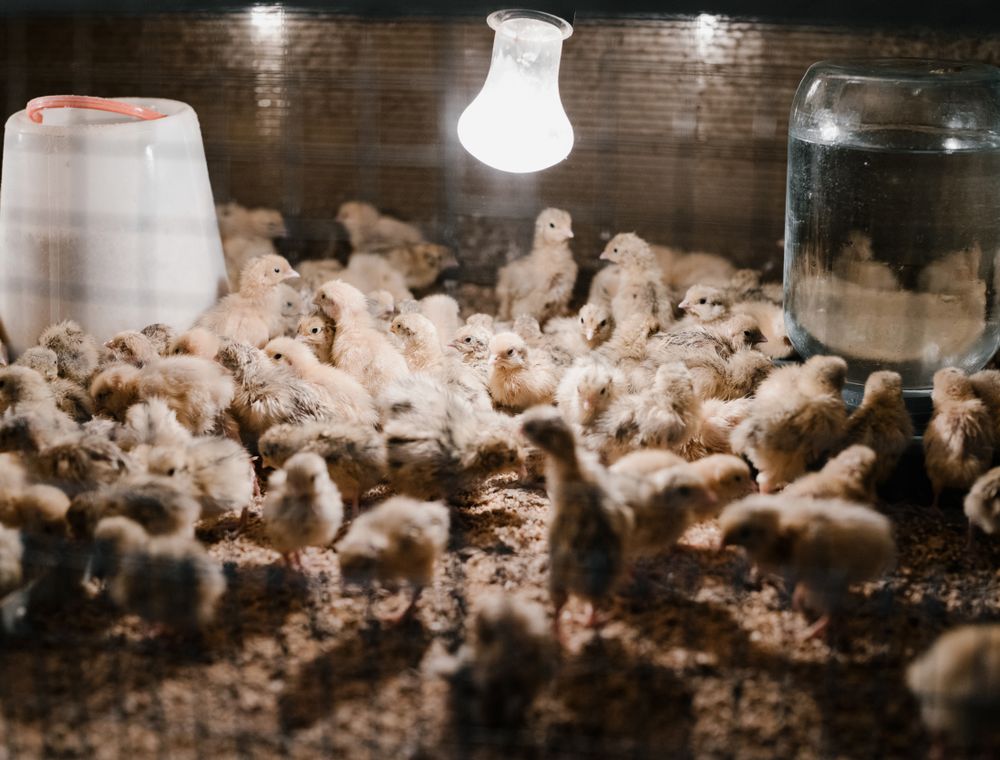
Short answer: Spraddle leg and curled toe are two different leg problems that often appear in the first weeks. Both can come from a slippery floor, a poor start or a ration that lacks certain vitamins. Spraddle leg usually improves once the floor gives good footing, with a gentle, short hobble as support. Curled toe needs a complete starter ration and a vet's view. Check the floor, the feed and the chicks every day, and call a vet if the problem does not improve.
Key takeaways
- Spraddle leg and curled toe are different problems that often appear together, so look closely before you treat.
- A slippery floor is a common cause of splayed legs, and it is also the cheapest thing to fix.
- A hobble can support the legs for a few days, but it must be gentle, checked often and removed as soon as the legs hold.
- Curled toes point towards the ration, so check that the feed is a complete starter and that it has been stored well.
- Keep a dated first-week checklist, and call a vet if the problem spreads or does not improve.
- Leg problems that persist after the floor and feed are corrected need a vet's assessment, not more guesswork.
Two leg problems that often arrive together in the first weeks
A chick with its legs splayed out to each side, pushing itself along on its belly, is a heart-sinking sight on a farm where you have just set up the brooder. Another chick in the same house may stand on the back of its hocks with its toes curled under, walking awkwardly. These are two different problems, but they show up together often enough that many farmers mix them up. Both are about legs that are not doing their job, and both deserve quick attention, because a chick that cannot reach feed and water falls behind the others within a day or two.
Spraddle leg, sometimes called splayed leg, is mainly a problem of footing and of how the legs are held in the first days of life. Curled toe is a nutritional problem that affects the nerves and tendons of the foot. Treating them the same way is a mistake, so the first step is to look carefully at the chicks rather than assuming which one you have.
How a slippery floor pushes the legs apart
Chicks are born with soft, still-forming bones and leg muscles that are not yet strong. On a smooth surface their feet slide sideways under the weight of the body. Each slip forces a leg out to the side, and when a chick keeps sliding and trying to stand, the hip and thigh can settle into an open position. The legs then set in that wide stance before the bone and joint have had a chance to harden properly.
Common culprits include smooth polythene sheets laid straight on concrete, glossy paper, polished or wet cement, and metal trays with no grip. Even ordinary newspaper turns slippery once it gets damp. Dry, clean litter with some texture gives the feet something to push against, and the difference can be visible within a day. A brooder floor that looks clean is not automatically safe, so test it by watching chicks try to walk across it in the first hour.
When the start in the hatch sets the legs wrong
Some leg problems begin before the chick reaches the brooder. Eggs incubated at a temperature or humidity far from the target can hatch chicks that are weak, slow to stand or uneven in size. Chicks left too long in the hatcher on slick trays, or packed into a basket, can start life with their feet slipping. Chicks crowded together during transport or in a holding room may pile up and press against each other, which adds stress to legs that are still soft.
Our chicks are dispatched on the day they hatch, which shortens the time they spend on slick trays or in crowded boxes. Delivery timings are covered on our delivery page, so plan the first hours of the chicks' arrival with that in mind. If you incubate your own eggs, check your temperature and humidity records, and move chicks out of the hatcher once they are dry and standing, rather than leaving them in a warm, slick tray for hours. The start in the hatch cannot be undone, but it can be kept from making things worse.
Fast growers and the weight their young legs must carry
Fast-growing broiler strains put on weight quickly, and their legs have to carry that weight while the bone and joint are still developing. Strains bred for quick growth are more prone to leg weakness than slower-growing types, so a bird that looks sound in the first days can start to struggle around the second or third week if it grows too fast on a rich ration. Feed intake, the number of birds in the house and the temperature all influence how quickly the body grows.
This does not mean broilers should be starved or kept small. It means the first two weeks are when the foundations are laid, and the floor, the density and the feed should all support steady, balanced growth. If you are choosing between strains, the broiler chicks page and the breed guide set out what we supply, and the broiler profit calculator helps you weigh growth against cost.
Telling the two apart at a glance
The two conditions look alike in the first hour and differ by the second day. The table below sets out the main differences. It is a guide for watching, not a final diagnosis.
| Sign | Spraddle leg | Curled toe |
|---|---|---|
| Leg position | Legs stretched out to the sides, often from the hip | Legs roughly normal in position, toes curled inwards |
| Walking | Pushes along on the belly, or dragged with legs out | Walks on the back of the hocks, sometimes unsteadily |
| Toes | Normal shape, but unable to grip | Curled under the foot, often in the same direction |
| Usual cause | Slippery floor and legs spreading in the first days | Shortfall of certain vitamins in the ration, especially riboflavin |
| Response to a better floor | Often quick, sometimes within a day or two | Slow, and depends on correcting the feed |
If you are unsure which problem you have, put the chick on a clean, textured floor for an hour and watch it. Spraddle leg usually shows some improvement with better footing. Curled toe does not improve on the floor alone.
The careful hobble, used for a few days only
A hobble is a soft band that holds the legs at a natural width while the joints and muscles firm up. It is a support, not a cure, and it must be applied gently. Use a strip of clean, soft cloth or a light tape loop, placed around both legs above the hock joint, and set so the legs are held just short of the splayed position. The chick should still be able to stand, move a short distance and reach feed and water. If it cannot reach them, the band is too tight or sits in the wrong place.
- Choose a soft material that will not cut into the skin, and clean it before use.
- Place the band above the hock, then adjust it so the legs sit close to a natural stance.
- Check the chick two or three times a day, and loosen or move the band if the skin reddens, swells or feels cold.
- Remove the band as the legs begin to hold their own, usually within a few days.
- Stop the hobble and call a vet if the chick is no better after a few days of support.
Do not leave hobbles on for long periods, and do not use them on a chick that is already weak, dehydrated or unable to feed. A hobble only helps when it goes with a better floor and a chick that can still reach the drinker.
A floor that gives the feet something to grip
Change the floor first, before anything else. Cover the brooder with clean, dry litter, such as fine wood shavings or chopped straw, spread to a depth that gives the feet a surface to push against without burying the chicks. Remove any smooth sheet or glossy paper from under the litter. If chicks are standing on a coarse woven sack or a rough cloth, check that the weave is not catching their toes or grazing their skin. A slightly rough surface is far better than one that is perfectly smooth.

Lift the drinkers and feeders onto raised trays or platforms, so that spilt water does not turn the litter into slick mud. Keep the brooder dry, and replace the litter wherever it becomes wet. Reduce crowding in the first week, because too many chicks in one corner pile up and push each other off their feet. The floor matters more than any single feed or vitamin, and it is the cheapest fix you have.
Vitamins, minerals and what a complete ration means
Curled toe, and some cases of weak legs in young birds, can be linked to the vitamins and minerals in the ration. Riboflavin, also called vitamin B2, is one of the key nutrients for nerve and foot function. Others, including manganese, choline, niacin and biotin, play roles in bone, joint and tendon development. A complete starter feed made by a reputable mill is designed to supply these at adequate levels, so most farms do not need to add single vitamins on top.
The danger lies in home-mixed rations that leave out a premix, and in old feed that has lost its vitamins through storage and heat. Vitamins break down over time, especially in hot, humid conditions. Check the bag's date and how it has been stored, and make sure it is labelled as a complete starter feed. If you mix your own, use the poultry feed calculator to plan quantities, then ask a qualified nutritionist or your vet to check the mix before you use it on the whole batch.
Do not dose chicks with large amounts of vitamins in the hope of a quick fix. Some vitamins build up in the body and can cause harm in excess. Any supplement should be used as the label or your vet directs, and only when there is a reason to add it.
Need chicks for your next batch?
Send breed, number and town. We reply with price, hatch date and delivery cost in writing.
Curled toes that do not straighten on their own
Curled toes often improve slowly once the ration is corrected, and the pace varies. In milder cases a chick may begin to use its feet better over days or weeks. In more severe cases the toes may stay curled, and the bird can have lasting difficulty walking. The sooner the feed is corrected, the better the chance of recovery, because the nerves and tendons are still developing in young birds.
Watch the whole group, not just the worst bird. If a few chicks show curled toes, the rest of the batch may be on the same short ration, so check the feed bag, its storage and how it was mixed before you assume the problem is limited to a few birds. Record how many birds are affected each day. If the number grows, call your vet and send them the feed label and a description of how the feed was stored.
When a chick cannot stand: slipped tendons and hard decisions
Some chicks develop joint or tendon problems that do not respond to floors or hobbles. A slipped tendon, where the tendon moves out of its groove at the hock, can leave a chick unable to bear weight on that leg. This is usually not reversible in the same way as spraddle leg. A vet can examine the bird and advise whether any treatment is worthwhile. Often the sensible decision is to move the bird to a dry, easy-access corner where it can reach feed and water, or, if it cannot manage at all, to end its life humanely.
Decisions like this should be made with a vet or a trained person, not by guesswork. Do not leave a chick to suffer, and do not keep a bird on a wet floor where it cannot eat or drink. If a bird has to be culled, follow local welfare guidance and dispose of the carcass as your vet advises.
A first-week checklist for the brooder
Use a short, dated checklist during the first week. Tick the items each day, and write down anything that does not match. Small, consistent checks catch leg problems early, when they are easiest to reverse.
- Floor covered with dry, clean, textured litter, with no smooth sheets exposed
- Drinkers and feeders on raised trays, and no standing water on the floor
- Chicks able to stand, walk and reach feed and water within the first day
- Brooder temperature and crowding checked, with the chicks spread evenly
- Feed bag dated, stored dry and labelled as a complete starter ration
- Any splayed or curled chicks recorded, with the number and the time they were seen
If you run a brooder for more than one batch, keep the checklist with the brooder records so each batch can be compared. The day-old chicks page covers the chicks we supply, and our frequently asked questions answer common questions about dispatch and delivery.
A worked example: 80 chicks on smooth paper for two days
This is a hypothetical example, to show how quickly the problem can grow. Imagine a farmer setting up a brooder for 80 Ross 308 chicks, bought at the starting price of GH₵ 20 each, with prices confirmed per order. The brooder is a corner of a room with a smooth polythene sheet laid on concrete and covered with thin paper to catch droppings. On the first morning, six chicks are sliding and splaying. By the second morning, fourteen are affected, and a few sit still at the edge of the drinker, unable to reach the feeder.
The fix is the floor, not the feed. The farmer removes the paper and polythene, spreads clean dry shavings deep enough to grip, raises the drinkers onto trays and reduces the crowding. Within a day, most of the splayed chicks walk without support. The farmer keeps a hobble only on the few that still struggle, checks them morning and evening, and removes the bands once the legs take their weight. The loss is small, but the farmer now knows what to check first next time.
When to call the vet about legs, and what to tell them
Call a qualified vet if leg problems spread beyond a handful of chicks, if the numbers grow day by day, if the chicks also have diarrhoea, breathing trouble or deaths, or if the problem persists after the floor and feed have been corrected. Tell the vet how old the chicks are, what the floor is made of, what feed they are on, how the feed was stored, how warm and crowded the brooder is, and how many chicks are affected.
Bring a sample of the feed, or at least a note of the brand, the batch mark and the date. Photograph the affected chicks in clear light, with a ruler beside them if possible, so the vet can see the leg position and the toes. The vet can then decide whether to adjust the ration, look for other causes or examine the rest of the batch. The Halaal Farms blog has further reading on common brooder problems that you can look at while you wait for the visit.
Questions farmers ask
Is spraddle leg the same as curled toe?
No. Spraddle leg is mainly about legs spreading out on slippery footing, and it often improves quickly once the floor is fixed. Curled toe is linked to the vitamins in the ration, especially riboflavin, and it improves more slowly once the feed is corrected.
How long should I keep a hobble on a chick?
Only as long as it is needed, usually a few days, and checked two or three times a day. If the legs are not holding within that time, or the skin shows rubbing, remove the band and call a vet. A hobble supports the legs while they firm up, and it is not a permanent fix.
Can I give vitamins to every chick in the brooder to be safe?
Not without a reason. A complete starter feed usually supplies what chicks need, and extra vitamins can cause harm in excess. Use supplements only as the label or your vet directs, and check whether the feed itself is the problem before adding anything.
Will a chick with a splayed leg ever walk normally?
Many do, if the floor is corrected early and the chick can reach feed and water. Chicks that stay splayed for a long time, or have joint damage, may walk less well. Ask your vet to examine them if they are not improving after a few days.
Should I cull a chick that cannot stand?
That is a decision for a vet or a trained person, and the aim is to avoid suffering. A chick that cannot reach food or water and shows no improvement may need to be humanely put down, and the vet can advise on the best method.
How warm should the brooder be for chicks with leg problems?
Keep the brooder warm enough that the chicks spread out evenly and are not huddled, with cooler areas they can move into. Watch the chicks rather than a single number: crowding in one corner and chicks scattered and panting are both warnings. Adjust the heat using your vet's or a brooding guide's advice.


