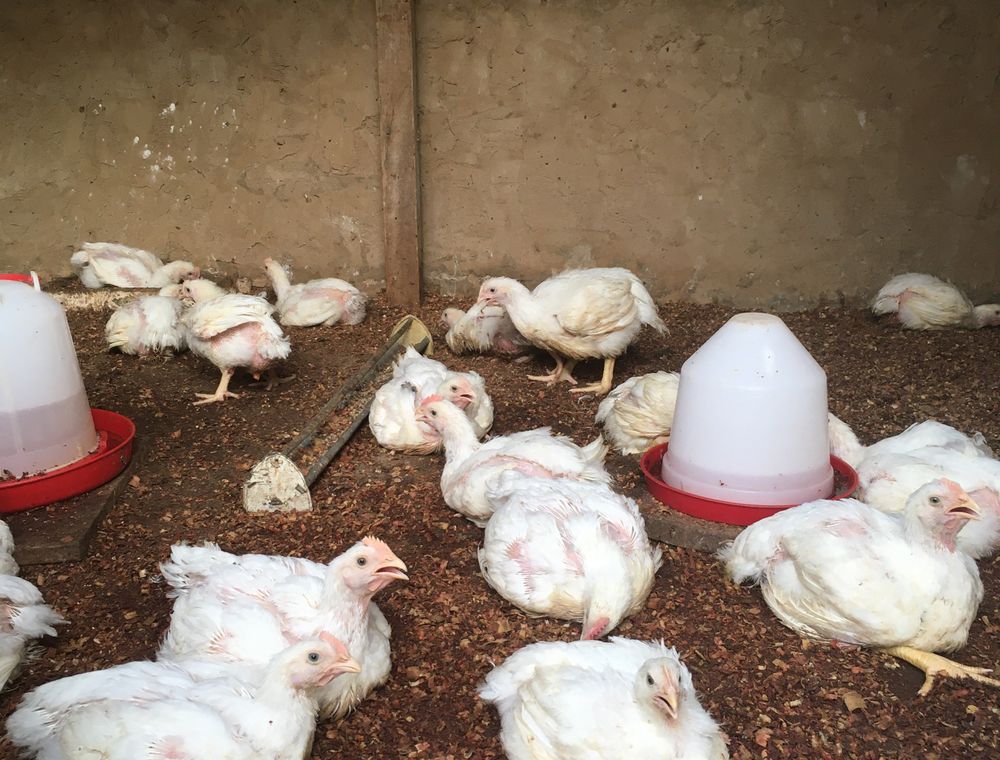
Short answer: Aflatoxicosis is poisoning by a mould toxin, aflatoxin B1, that grows on groundnut cake, maize and other grain stored damp and warm. In Ghanaian flocks it rarely arrives as a wave of deaths; it shows up as slow growth, lower laying, bruised skin and vaccines that do not take. Stop the suspect feed, keep what is left dry, and get the feed and a bird tested, because switching feed does not undo liver damage that is already done.
Key takeaways
- Aflatoxin hits the liver and the immune organs, so the first clue is often a flock that drifts rather than a pile of dead birds.
- Pale, enlarged livers and bleeding under the skin at post-mortem make aflatoxin a serious suspect.
- A flock carrying the toxin can fail its vaccines and fall to other infections.
- Old groundnut cake and maize stored damp are the usual sources in our experience, and a clean-looking bag can still be contaminated.
- Pull the suspect lot, keep the rest dry, and have feed and birds tested through your vet before you decide.
The flock that drifts instead of dying
The birds that die of aflatoxin rarely look like poisoning cases. Nobody walks into the house and finds a row of dead hens with foam at the beak. What we usually hear on the phone is vaguer: "the birds are not picking up like before", "eggs have dropped and I cannot say why", or "the broilers are all the same size but none of them are big."
That drift is what makes this disease easy to miss. A farmer who has lost five birds in a week will look at disease, heat or bad water long before he looks at the bag of groundnut cake that came in on Tuesday. The bag looked fine, the birds ate it, and nothing happened on the first day.
In our experience aflatoxin is one of the feed problems that causes the most confusion on Ghanaian farms, and it is one of the easiest to explain once you know where to look. This article covers what the toxin is, how it damages the bird, what a post-mortem can show, how to test a suspect lot, and what to change so the next bag does not do the same harm.
What the toxin is and which feed it likes
Aflatoxins are poisons made by moulds of the genus Aspergillus, mainly Aspergillus flavus and A. parasiticus. The moulds can start growing on crops in the field, and they grow much faster in grain that is stored with too much moisture and too much warmth. Groundnuts, maize and cottonseed carry the most risk on the farms we deal with, and groundnut cake is the product we worry about most, because it is a concentrated protein feed that often sits in a market store for weeks before it reaches a farm.
Of the family, aflatoxin B1 is the one that matters most for poultry. It is the most toxic and the most common in tropical feed. You cannot see it, you cannot reliably smell it, and cooking or drying the feed afterwards does not remove it. A feed can look clean and still carry enough toxin to hurt a flock.
Visible mould is a warning, not a verdict. Clumping, a musty smell and grey or green patches mean the feed has been wet long enough for fungus to grow, and that is the moment to worry. But a bag can carry aflatoxin with no visible mould at all, which is why the bag inspection is only the first step and never the last.
What the toxin does inside the bird
Once a bird eats aflatoxin, the liver tries to process it. The liver converts the toxin into a reactive form that can bind to the cell's DNA and proteins. Liver cells are damaged, bile flow can be disturbed, and the liver makes fewer of the proteins that help blood clot. That is why bleeding under the skin is one of the first things we look for at the post-mortem table.
The second target is the immune system. The bursa of Fabricius, the organ where young birds build part of their immune response, shrinks and loses cells when aflatoxin is in the ration. The thymus and spleen can be hit as well. A bird with a weaker immune system does not just get sick from the toxin. It catches everything else more easily and responds poorly to vaccines.
Growth suffers for a simple reason. A liver that is working badly handles protein and fat less efficiently, and a bird with a weakened immune system spends feed fighting infections instead of building muscle. The result is a flock that is not sick enough to call a vet but is clearly not growing.
Sudden losses or a slow slide: two pictures
Aflatoxin comes in two broad patterns, and the one you see depends on the dose and on how long the birds ate it. A large dose over a short time causes a sharp illness with deaths. A small dose over weeks causes a slow decline that is easy to blame on something else.
The slow version is far more common on the farms we visit, because most farmers do not buy a bad lot on purpose and the contamination is patchy. One bag may have a hot pocket of mould in the middle. A bird that gets a big mouthful from that pocket is sick, and the bird beside it that gets less may simply grow slowly and lay a little less.
| Pattern | What you see | When it usually shows | First check |
|---|---|---|---|
| Acute | Sudden deaths, depression, birds hunched, bleeding under the wing and leg skin | Within days of a new lot | Stop the lot, call the vet the same day, keep a fresh bird for post-mortem |
| Subacute | Lower feed intake, uneven flock, pale comb, poor weight gain | Two to four weeks into the lot | Compare feed use and weights against the last batch, check the bag |
| Chronic | Slow lay, repeat infections, vaccines that do not hold | Across the production cycle | Review the whole feed programme and sample stored feed |
What a post-mortem shows when aflatoxin is the suspect
Open the bird before it goes in the pit. The liver is where aflatoxin does its most obvious damage. In a bird that has eaten enough toxin, the liver looks pale, is often larger than normal, and may be mottled or streaked with small bleeds on the surface.
Look at the muscles of the legs and the skin under the wings. Small bleeds, bruise-like patches and wet-looking haemorrhages point toward a clotting problem, which fits the toxin. Look at the bursa too. A shrunken bursa in a bird of the right age is a strong hint that the immune system has been hit.
A post-mortem cannot prove aflatoxin on its own. Gumboro disease, some forms of coccidiosis and several bacterial infections also change the liver, the bursa and the muscles. That is why we ask for the feed bag, the lot number and the dates, and why feed samples and bird samples should go to the vet together. The post-mortem gives you a direction, and the lab gives you the answer.
If you want to open the bird yourself, the step-by-step is in our simple post-mortem guide. Keep the carcass cool and covered while you wait for the vet, and never put a suspect bird near the feed store.
Why vaccines stop taking in a poisoned flock
A vaccine works by waking up the immune system. If aflatoxin has suppressed that system, the bird may receive the vaccine and make a weak response, or none at all. You then see what looks like vaccine failure: Newcastle or Gumboro cases in birds that were covered on paper.
The batch record we send with each order shows what was given at the hatchery, and the vaccines we use cover Marek's, Newcastle, Gumboro, infectious bronchitis and coccidiosis. Those are the right tools. A vaccine is only as good as the bird receiving it, though. A flock eating a bad lot can be vaccinated on schedule and still break with disease in the fourth week.
So when a vaccinated flock breaks, do not start by blaming the vaccine or the supplier. Ask what the birds ate in the two weeks before the break. Ask whether the cake came from a new seller and whether the store was wetter than usual. A vaccination schedule only helps if the birds can respond to it.
Where the risk enters Ghana's feed chain
On most farms we visit, the risk comes in through three doors. The first is groundnut cake bought loose from a market trader, often stacked on a wet concrete floor or in a sack that has been opened and left. The second is maize dried in the field during a wet spell and then stored in a shed without raised pallets. The third is the farmer's own store, where a bag sits against the wall for six weeks through a rainy season.
The seasons matter. The main rains in the south, usually April to July, bring the highest humidity and the most risk to stored grain. Harmattan dries the air and cuts the mould risk for a while, but warm, dusty weeks can still leave moisture pockets inside a bag. The minor rains from about September to November are when we hear most often about feed that looks fine on the surface and smells off underneath.
Mixing feed at home adds a fourth door. A farmer who buys one bag of cake and mixes it with maize every week takes the risk again each time he opens a new bag. For what that does to a home mix, read our guide to mixing your own feed.
Need chicks for your next batch?
Send breed, number and town. We reply with price, hatch date and delivery cost in writing.
Testing a suspect lot before you blame the birds
Testing is the only way to know whether a lot holds aflatoxin above a safe level. Your vet or a veterinary or food-safety laboratory can arrange it and will tell you how much feed they need and how to pack it. Do not decide from a smell or a single handful.
Sample from several points in the bag or pile: the top, the middle, the bottom and the corners. Mix the portions in a clean container, take a representative amount, and seal it in a clean, dry bag. Label it with the seller's name, the date you bought it and the lot number if there is one. Keep the rest of the bag closed and off the floor while you wait, because a rotting bag gives a worse sample every day.
Bird samples matter too. A bird that died in the last day and was opened properly gives the lab much more to work with than one found three days after death. Keep the carcass cool, wrapped and labelled, and send the feed and the bird together where you can.
What to do this week if you suspect it
Work through these in order, and do not switch feeds until the first three are done. A quick feed change can make a flock look better for two days and hide the evidence you need.
- Stop feeding the suspect lot. Move it out of the house into a closed, dry, raised store, or set it aside for testing.
- Take a feed sample from several points in the bag and keep it sealed and cool.
- Call your vet the same day and give the flock age, the feed brand, the seller and the first sign you noticed.
- Open one or two freshly dead birds in good light and photograph the liver, the leg muscles and the bursa.
- Keep water clean and give the flock fresh feed from a different, verified bag while the test runs.
- Write down daily feed intake, deaths, and egg count or weights for the next two weeks.
Some farmers want to add a product to the feed the same afternoon. We understand the urge, but binders and supplements do not replace removing the source. The toxin binders guide explains what they can and cannot do, and it is worth reading before you buy one.
A worked example from a 500-bird broiler batch
Say you started 500 Cobb 500 chicks at GH₵20 each. That is GH₵10,000 in chicks before the first bag of feed. The batch was on course for about 2.1 kg live weight at day 35, and you weighed a sample of birds each week to track it.
Around day 21 the sample weights began to fall behind the chart. By day 28 the flock was about 0.2 kg lighter on average than the target, with uneven sizes and a few birds staying in the corner. Feed use had not risen, but the birds were not turning it into weight. Mortality crept from almost nothing to around 2 per cent over the same ten days, and the bruising on two dead birds made you check the feed.
The new groundnut cake had come from a new seller in the same market, bought in a 50 kg sack that had been stacked against a wall. Suppose a bird of about 2.5 kg sells live for GH₵110. A 0.2 kg shortfall across 500 birds is 100 kg of live weight, which is about 40 birds' worth, or roughly GH₵4,400 of sales you did not make, before you count the mortality, the labour and the extra days in the house. The chicks were not the expensive part. The feed bag was.
Keeping the next bag clean
Buy from sellers who can show you how fast they sell through their stock. A trader who turns over cake every few weeks is a safer bet than one who keeps a sack for a season. Ask when the cake was made, and walk away from anything clumped, grey, damp-dusty, or sour when you open it.
At the farm, keep feed on pallets or a raised rack, away from the wall and the floor. Use a lidded bin for what you will use in the next week. Buy only what you can finish within a few weeks, and rotate so the oldest bag goes first. Never top up an old bag with a new one, because the new bag picks up moisture from the old one.
Keep a simple feed log: date bought, seller, bag mark, amount, and the flock it went to. When a flock breaks, that log tells you in five minutes what to pull, and it protects you if you need to return a bad lot. For a fuller store plan, see our storage guide.
- Check each bag on arrival for clumps, mould, sour smell and wet patches.
- Store feed on pallets, off the wall and off the floor.
- Keep bins lidded and open only what you will use in the next few days.
- Rotate stock first in, first out, and write the date on each bag.
- Log the seller, date and bag mark for every bag that enters the store.
When you restock after a bad batch, look at the Sasso chick page or the current prices. Your order can start on the order form, and we will talk the house through on +233 24 915 1503 if you want a second opinion on the breed.
Questions farmers ask
Can aflatoxin kill a flock quickly?
Yes. A large dose of contaminated feed can cause sudden deaths, depression and bleeding within days. That pattern is less common than a slow decline, but it calls for a same-day call to your vet. Keep the suspect feed away from the birds, get a fresh bird opened if you can, and do not spend a week hoping the flock recovers on its own.
Is there a cure for aflatoxicosis in chickens?
No product reverses aflatoxin damage to the liver. What matters is removing the source, giving clean dry feed and water, supporting the flock through the stress, and treating any secondary infection your vet identifies. Binders are a support, not a cure. Follow your vet's advice on what to give and for how long.
Can I tell if my feed has aflatoxin by looking at it?
No. Mould and a musty smell are warnings, but aflatoxin can be present in feed that looks and smells normal. Only a laboratory test on a properly taken sample gives you the level. A clean-looking bag is not proof of safety, and a mouldy-looking bag is not proof of contamination either.
Can I sell eggs or birds from a flock I suspect?
Hold off until your vet has examined the flock and told you what they think. Selling birds that may be unwell, even by accident, is a bad outcome for your customers and for you. Keep a record of anything you have already sold from that house.
Does mixing a suspect bag with good feed dilute the toxin?
It spreads the problem rather than solving it. Any part of the bag that carries toxin still goes into the trough, and the rest of the batch is now exposed as well. If a lot is in doubt, take it out of the ration entirely rather than cutting it in small amounts.
Is groundnut cake always the source?
No, though it is the one we hear about most. Maize, sorghum, cottonseed and other grains can carry aflatoxin too, and a mould problem in one stored ingredient can spread to others kept in the same damp shed. Look at every stored ingredient in the ration, not just the cake, and keep each one in its own dry, raised container so a bad lot does not travel.
Why did my flock fail its vaccines?
Often because the immune system could not respond well. Toxin damage to the immune organs can blunt a vaccine response. Check the feed history, the store conditions and the vaccination dates first. A vaccine schedule is only one part of the picture.


