Short answer: A sensible price starts with what one bird or one tray really costs you, not with what the seller down the road is charging. Add up chicks, feed, medicines, litter, fuel, transport and losses, divide by the birds you actually sell, then add a margin you can defend. Check that price against the local market and the quality you offer, and review it every month so it never quietly drops below cost.
Key takeaways
- Price from cost first: add every input, including the birds that die before sale.
- Divide the total cost by the birds you sell, not by the birds you started with.
- Set a margin you can defend, and check it against what buyers in your area actually pay.
- Price eggs by the tray and the crate, and allow for cracked and soiled eggs.
- Write each price list with a date, and review it monthly rather than when you feel pressure.
- Use the profit calculators to test what happens to your margin if feed or the price moves.
Start with the unit you are actually selling
Before you write any number, decide what the buyer is paying for. A live bird, a dressed bird, a tray of thirty eggs and a crate of eggs are four different products, and each carries different costs. Many losses in poultry come from quoting one price for all of them and then discovering later that the dressed bird was costing more than the live one to produce.
Pick the unit that matches the way your customer buys. A chop bar may want a dressed bird by weight. A household may want a whole live bird. A shop may want eggs by the tray. Once you know the unit, the cost has to be measured in the same unit, or the comparison will mislead you. Our poultry calculators page lists the tools that handle the sums for each unit.
The cost list you must complete before any price
Write down every cost that goes into a batch. Missing one line is the most common reason a price looks fine on paper and then fails in practice. For a broiler batch, the list usually includes the chicks, feed, vaccines and medicines, litter, electricity, water, transport and crates, labour, and the cost of any equipment you are using up over the cycle. For layers, add the cost of pullets or hens, feed across the laying months and the cost of trays and packaging.
Record the cost of each line in cedis, using the price you actually paid. If you bought feed in a bag at one price and the price has moved since, note the change. A cost list that is a few weeks out of date is a plan, not a record, and it will mislead your pricing. For the chick line, the day-old chicks cost calculator gives you a clean starting figure.
Dividing by the birds you sell, not the birds you buy
This is where many small producers make an error. If you start a batch of 100 chicks and 95 reach market, the cost of the five that died does not disappear. Their feed, their space and their chicks all have to be paid for by the birds that survived. The sensible way to work out the cost per bird sold is to add up the whole batch cost, then divide by the number you sell.
A simple formula is the total cost of the batch divided by the number of birds sold. If your total cost is GH₵ 5,000 and you sell 95 birds, the cost per bird sold is GH₵ 52.63, not GH₵ 50. The gap grows when losses are high, which is why keeping good mortality records matters as much as keeping good cost records. Our poultry feed calculator can help you estimate feed use per bird before you buy.
Three ways to set a price, and what each one misses
Most farmers set a price in one of three ways, and each has a blind spot. The method that works best is usually a combination, with cost as the floor and the market as the ceiling you check against.
| Method | How it works | The main risk |
|---|---|---|
| Cost-plus | Add a fixed margin to your cost per bird or per tray. | Ignores what buyers in your area will actually pay. |
| Market-led | Charge the going price in your town or market. | In a weak week you may sell below your own cost without noticing. |
| Competitor-led | Match or undercut the sellers nearby. | You may be copying a seller with lower costs, and a price war helps nobody. |
A cost-plus price tells you the least you can accept. The market tells you what a buyer will pay today. A good price sits between them, and it moves within that band as your costs and the market change.
Reading the local market without a formal survey
You do not need a research budget to understand the market. Visit two or three sellers in your area on a market day and note the price, the size of the bird or tray and whether the bird is live or dressed. Ask how often the price changes and what drives it. Take notes in the same format each time, so you can compare the same week in later months.
Talk to the buyers as well. A chop bar owner will tell you what size bird works for them, and a household buyer will tell you how much they will pay for a fresh, clean bird that is delivered. Their answers are often more useful than the prices shouted across a market.
Quality, consistency and why the cheapest seller is not your target
Some sellers in every market charge less because they use cheaper feed, sell older birds, keep bigger volumes or accept thinner margins. You do not have to match them. If your birds are fresher, more even in size, or delivered on time, that is worth money to a buyer who has been let down before.
Consistency is often the strongest part of a price. A buyer who knows they will get the same size of bird every Friday will pay a little more than they would for a bargain that varies week to week. Write down what you offer that a cheaper seller does not, and put a price on it only when you can deliver it reliably.
Converting between per bird and per kilogram
Many poultry sales are by weight, while your costs are by bird. Converting between the two is simple arithmetic, but it is easy to get wrong when the birds are different sizes. Divide your target price per bird by the average live weight to get the price per kilogram. If the average bird weighs 2.0 kg and you want GH₵ 60 per bird, the price per kilogram is GH₵ 30.
For dressed birds, the weight that matters is the dressed weight, which is lower than the live weight. Work out your dressing loss from a sample of birds, and convert the price using the weight the buyer receives. A price per kilogram of live weight can look attractive and then produce much less cash once the bird is dressed.
Eggs: pricing by the tray and allowing for breakage
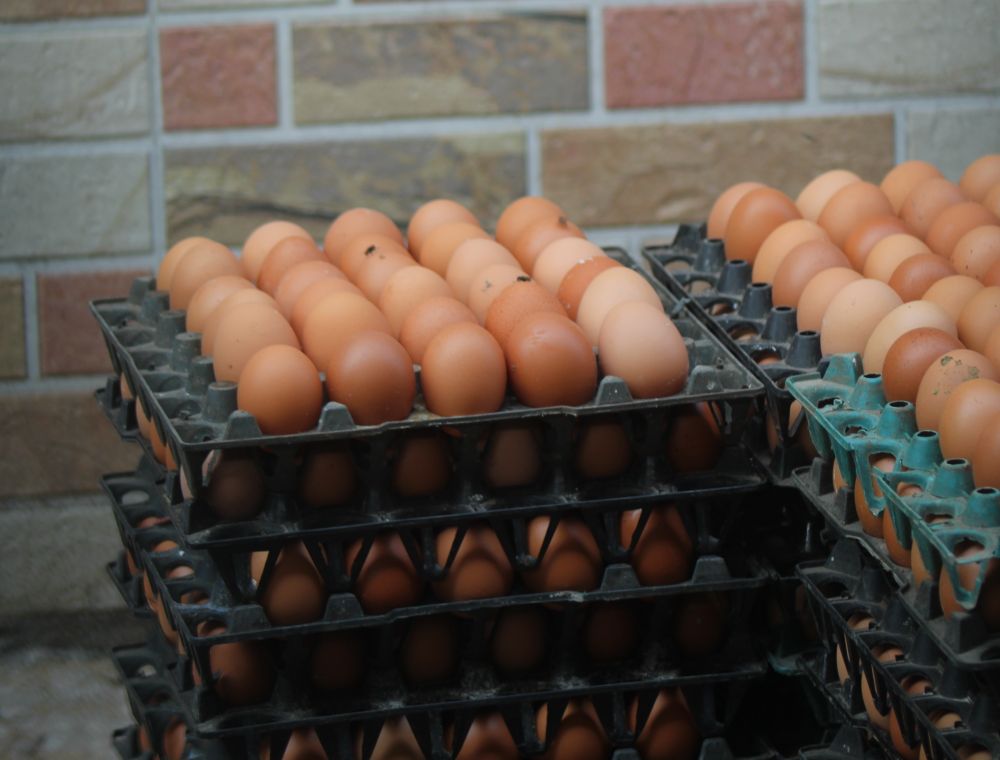
Eggs are usually sold by the tray of thirty or by the crate, and a buyer will expect the trays to be full and the eggs to be clean. Your cost per egg depends on feed, labour, housing, depreciation of the flock and the number of eggs you actually collect. Divide your monthly cost by the eggs you sell, not the eggs you collect, because cracked and soiled eggs need to be written off.
Plan a small allowance for breakage and grading. A bad batch of eggs that reach the shop cracked will cost you the sale and the goodwill. If your system produces a few second-grade eggs, decide in advance whether you will sell them cheaper or keep them for home use, and show that on the price list. The layer egg profit calculator lets you test how breakage and feed costs move the margin.
Need chicks for your next batch?
Send breed, number and town. We reply with price, hatch date and delivery cost in writing.
A worked example for one broiler batch
The numbers below are an illustration, not a quote from any market. They show how the sums fit together. Suppose you place 100 chicks at a starting price of GH₵ 20 each. Feed takes about 3.6 kg per bird at an assumed GH₵ 6 per kg, vaccines and medicines add GH₵ 2 per bird, litter, electricity and water add GH₵ 3, transport and crates add GH₵ 1.50, and labour adds GH₵ 3. That is GH₵ 51.10 per bird placed, or GH₵ 5,110 for the batch.
Now suppose 5 birds die. The batch cost of GH₵ 5,110 must be spread over the 95 birds that reach sale, which gives GH₵ 53.79 per bird sold. If you want a margin of 15 per cent on the selling price, divide by 0.85, which gives about GH₵ 63.28 per bird. For a bird averaging 2.0 kg live, that is about GH₵ 31.64 per kilogram. Your local market may pay more or less, and that is why you check.
Before you use these figures, run your own batch through our broiler profit calculator. Change the feed price and the losses to see how fast the margin moves.
How farmers sell below cost without noticing
Most losing sales are not dramatic. They happen in small steps: a regular buyer asks for a small discount, the feed bag goes up but the price list stays the same, a batch loses more birds than usual, and nobody updates the sums. After three months the flock is busy and the bank balance is not.
Guard against this with two habits. First, check the cost per bird every time a major input changes, such as feed or chicks. Second, track the price you actually received, not the price on the list, since discounts and short weights quietly lower what you earn.
Writing a price list that buyers can trust
A price list should say what you sell, the unit, the price, the date and the terms. A line such as "dressed broiler, per kilogram, from Monday" is clearer than a number scribbled on a board. Include delivery, minimum orders and how you accept payment, such as mobile money, bank transfer or cash.
Buyers trust a price more when they can see it is reviewed. Put the date on the list and change it on a set day. If you need to change the price in the middle of a week, say why in a short message. A clear reason, such as a feed rise, is far easier to accept than an unexplained jump.
A short monthly check on the numbers
Set aside one hour a month to check your prices. Compare the cost per bird or tray with the price you received, check mortality and breakage, and look at the market notes you made. If the margin has shrunk, decide whether to raise the price, cut a cost or change the product before the next batch. Do not wait for a crisis to make the decision.
If you are still planning your first flock, our guide to how to start poultry farming in Ghana sets out the steps in order. The prices page lists starting prices for the chicks we hatch, which feed into your cost list from day one, and each order is confirmed separately. For more reading on the business side, the blog covers related topics.
Questions farmers ask
How do I know the lowest price I can accept?
Add up the cost of the whole batch, including the birds that die, and divide by the number you sell. That gives your break-even per bird or per kilogram. Accepting less is sometimes a deliberate choice to clear stock, but it should be a decision you make on purpose, with the loss written down.
Should I price live birds or dressed birds?
Price each one separately. A dressed bird carries the cost of slaughter, cleaning and packing, and it sells by weight, so you need your dressing loss to convert accurately. Work out both prices on paper before you choose which one to sell.
How much profit should I add to my cost?
There is no single right figure. Many small producers look for a margin that covers their time and risk and pays for the next batch. Compare the margin with what the same money would earn elsewhere, and adjust it for the risk of losses in your area.
What if a competitor is selling cheaper than me?
Find out why. They may use cheaper feed, sell older birds, buy in bulk or accept a thinner margin. If your birds are fresher, more even or delivered better, make that part of the price. If not, the answer may be to lower your costs rather than your price.
How often should a farmer revisit the price list?
Review your numbers once a month, and change the price when a cost has moved for a sustained period. Frequent small changes confuse buyers. A large feed rise deserves a clear announcement with a date, so the buyer understands why.
Should I give discounts to regular buyers?
Only when the discount is paid for by something real, such as a larger order, a fixed collection day or faster payment. Write the terms down so that a discount does not become the new price by habit.
Do I need a calculator, or is a notebook enough?
A notebook works if you record every cost and every sale. A simple calculator makes the sums easier to repeat each month. Our profit calculators are a practical starting point, but they do not replace your own records of what you spent and what you sold.


