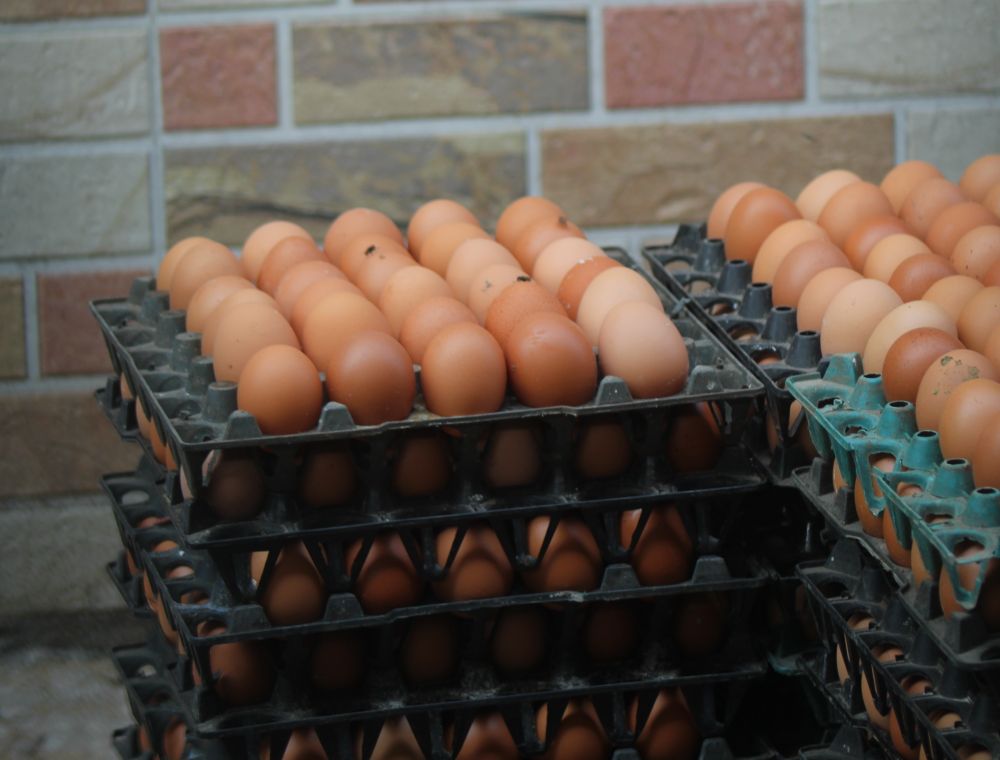
Short answer: Boiled eggs sell fast at lorry stations, school gates and office lunch hours, but the business is food safety, not cooking. Buy clean eggs by the crate, boil them to a firm yolk, cool them in cold water straight after, and keep them cold until the moment they are sold. At our crate price of 50 cedis for 30 eggs, each egg costs about 1.67 cedis before salt, packaging, fuel and your time, so price from that number.
Key takeaways
- Food safety is the business. A boiled egg left out in Kasoa heat for an afternoon is the complaint that closes a stall.
- Eggs two or three days old peel more cleanly than very fresh ones, so buy for boiling a few days ahead.
- Cool each batch fast in cold water, then keep the eggs in a cooler with ice packs until they are sold.
- Work out the cost per sold egg with fuel, salt, packaging and time, then choose a price that covers it with room to spare.
- Pick one spot and two fixed selling windows. Regulars come back for a routine, not a surprise.
Where boiled eggs sell, and the hours people actually buy them
A boiled egg is the cheapest protein a busy person can eat standing up. That is why it sells at lorry stations before the first bus leaves, at school gates at break time, and at office compounds around one o'clock, when everyone is hungry and nobody wants to queue for a plate of rice.
We have walked past plenty of stalls that started in the wrong place. A stall at a quiet junction with no bus traffic sells very little, however good the eggs are. Watch a spot for three mornings before you commit. Count the people who walk past, how many stop, and how many leave with something. The count takes ten minutes a morning and saves a season of guessing.
Your hours matter as much as your place. Early mornings suit commuters, lunch suits office workers, and late afternoons suit people leaving school. Pick two windows you can keep every day. A stall that opens at a different time each day loses the regulars it had.
A self-test before you buy the first crate
Answer these honestly before you spend anything. If three of them are no, fix that first.
- Can you boil at least two crates of eggs before the first customer arrives, every day you plan to trade?
- Do you have clean water in quantity, and a clean place to cool and dry the eggs?
- Do you have gas or charcoal that will not run out halfway through a batch?
- Can you sell for four hours without going home to rest between batches?
- Do you have a cooler box, ice packs and the money to keep them topped up?
- Will you write down every batch, its boiling time and the time it was sold?
For most people the boiling is the easy part and the rest is the job. A stall that boils well and sells badly is still a failed business. A stall that sells well with poor hygiene is one complaint away from closing.
Choosing eggs for boiling: age, shell and cracks
Eggs for boiling need a different eye from eggs for the table. You want shells that are clean and whole, and you want an egg that peels without taking half the white with it. That second point surprises new vendors. Eggs laid that morning cling to their membrane and tear when you peel them. Eggs a few days old peel much more cleanly.
| Egg condition | Peeling | Use it for boiling? |
|---|---|---|
| Laid the same day | Clings and tears | Only if you cannot wait, and expect waste |
| Two or three days old, clean shell | Peels well | Best choice |
| A week or more, clean and cool | Peels well, but the white ages | Yes, if quality holds |
| Dirty, cracked or stained | Unpredictable | No. Do not boil for sale |
Keep the eggs cool and dry while they rest. A crate left in a hot corner ages faster and its white turns watery. Rotate the shelf so the oldest eggs go first. Buy from one supplier so the ages line up, and so that a bad crate can be traced to one source. Our guide to egg quality sets out what buyers check when they open a crate.

Wash the eggs gently in clean water before they go into the pot, and do not soak them. Our washing guide covers why a soak can push germs through the shell.
Boiling and cooling in batches you can count
Boil in batches that match what you expect to sell in one selling window. A large pot left on the fire for an hour is not a stock. It is a risk.
- Wash the eggs in clean water, dry them, and set them in one layer in the pot.
- Cover with cold water by a few centimetres, bring it to a rolling boil, then turn the heat down to a steady simmer.
- Cook for about ten to twelve minutes. That gives a firm yolk in most eggs, and a little longer for big eggs.
- Move the eggs straight into a bowl of cold water with ice, or fresh water changed often. Leave them there for at least five minutes.
- Dry each egg and store it in a clean, covered container in the cooler. Peel only at the moment of sale if you sell peeled eggs.
- Write the boiling time on the lid of the container.
Cooling quickly matters more than people think. A hot egg left to cool slowly in its pot keeps cooking, the yolk greys at the rim, and the egg sits in the warm range where bacteria grow fastest. The ice bath is the step that makes an egg safe to hold, so do not skip it when the queue is long. If you peel, wash your hands between eggs and keep the peeling board separate from the money tray.
Keeping boiled eggs safe in the heat
Heat is the enemy. At 30 degrees Celsius in the afternoon, a boiled egg on a tray is in the danger zone within minutes of the sun reaching it. Food-safety guidance generally says cooked eggs should not sit out for more than about two hours, and in Ghana's heat you should aim for less. Plan each window so the stock is gone before that clock runs out.
- Keep most of the stock in a cooler with ice packs, not in the sun or in a bucket of water.
- Put only a small tray on the table, and refill it from the cooler every hour.
- Wash your hands before you touch the eggs and before you touch money. Use one cloth for the table and a separate one for your hands.
- Cover the stock with a clean lid or cloth, so dust and flies cannot settle on it.
- Keep the cooler out of reach of children and animals.
A cooler box costs far less than one lost customer. A buyer who gets a warm egg does not come back, and they tell three colleagues why. Our guide to storing eggs in Ghana's heat covers the same temperature problem for table eggs, and the same logic applies to the cooler you carry.
What one boiled egg really costs you
Start with the egg. At our crate price of 50 cedis for 30 table eggs, each egg costs about 1.67 cedis. That is the floor. It leaves out the salt, the packaging, the fuel for the pot, the water, the ice, the cooler and your own time. Those costs are real, and new vendors almost always leave them out of the sum.
Fill in your own figures for a typical day. Use two crates, sixty eggs, as the unit so the sums are simple.
| Cost line for a day's batch | Your figure |
|---|---|
| Eggs, two crates at 50 cedis each (60 eggs) | 100 GH₵ |
| Fuel for the pot, gas or charcoal | Your cost |
| Ice and water for the cooling bath | Your cost |
| Salt, pepper and sachets or cups | Your cost |
| Cooler upkeep, shared over the month | Your cost |
| Eggs that cracked or were thrown away | Your loss |
| Your time, at a wage you would accept elsewhere | Your cost |
Divide the total by the eggs you sell, not the eggs you boil. Every egg you throw away belongs in the cost of the eggs that did sell. A vendor who boils 60 and sells 45 has a cost per sold egg about 29 per cent higher than a vendor who boils 60 and sells 58. The difference is not in the eggs. It is in the forecast.
For a full farm-side view of what an egg costs to produce, our worked egg business example walks through the flock side of the same sum.
Pricing without a price war with the stall next door
Most new vendors price against the stall beside them. That is a poor guide, because the stall next door may be buying cheaper eggs, boiling a day behind, or simply losing money to win the lunch rush. Price from your cost per sold egg, add the margin you need to keep the cooler running and to pay yourself, then look at the market as a check.
Think about how people buy. Some want one egg with a sachet of pepper. Others want two or three for the bus ride home. A pack of three sold at a fixed price often moves more stock than single eggs, because the customer makes one decision instead of three. Keep the single egg for the person who wants one, but do not make a bundle cheaper per egg than your costs allow.
Be careful with late discounts. Cutting the price on the last six eggs to clear them teaches regular customers to wait. A cleaner rule is to make a smaller batch and sell it out at full price. A sold-out tray is worth more than a few extra cedis at four in the afternoon.
Need chicks for your next batch?
Send breed, number and town. We reply with price, hatch date and delivery cost in writing.
Permits, hygiene rules and the officer who may visit
Selling cooked food on the street is regulated, and the rules apply to you even when you are small. Start with your district assembly, which controls trading and market spots in your area. Then ask the Environmental Health Officer what they expect to see at your stall. The Food and Drugs Authority sets the wider food-safety standards. Ask both offices what current permits, registrations or inspections apply to you, and what they cost. Those rules and fees change, so we will not quote them here, and you should not rely on a figure from a friend.
Officers look for the same things every time: clean hands and clean cloths, covered stock, cold storage that works, and a written record of batches. Show them the notebook before they ask. It is the simplest way to show that you know what you are doing.
A day at the stall, from 5 am to 2 pm
- 5.00 am: Collect the eggs you rested the day before, check each crate for cracks and dirt, and put the clean eggs on the rotation shelf.
- 5.30 am: Light the pot, fill it with clean water, and boil the first batch of the morning.
- 6.15 am: Move the batch to the ice bath, then into the cooler. Write the boiling time on the lid.
- 6.45 am: Set up the table at your spot with a clean cloth, cups, salt and pepper. Keep the cooler out of direct sun.
- 7.00 to 9.00 am: Sell the morning window from a small tray, refilling from the cooler every hour.
- 11.00 am: Check the tray. Anything out of the cooler for more than two hours goes in the bin, however good it looks.
- 12.30 pm: Start the lunch batch, smaller than the morning one, for the office crowd.
- 2.00 pm: Close, wash the pot and cooler, and write the day's sales and waste in the notebook.
The timing is tight on purpose. Each step has a clock on it, and the clock is what keeps the eggs safe. After two weeks of this routine you will know the right times for your own spot, and you will stop guessing.
The mistakes new vendors make in the first month
- Buying eggs that are too fresh, then blaming the supplier when they will not peel.
- Boiling the whole stock on a slow morning and then selling it in the afternoon heat.
- Leaving the cooler open while chatting at the stall.
- Using the same cloth for money, eggs and the tap.
- Choosing a spot by how busy it looks at two in the afternoon, not by how busy it is at seven in the morning.
- Keeping no record. A complaint with no batch time on it is a complaint you cannot answer.
The first month is a learning month. Keep the sums simple and the batches small until your numbers hold for a full week.
Where the eggs come from, and when to buy them in a weekly plan
Table eggs from us are 50 cedis a crate of 30. Many vendors who start small buy two or three crates a day from one supplier, so the ages line up and a bad batch traces back to one source. When you order, ask about the lay date, and check each crate on arrival.
Once your daily count is steady, move to a weekly plan. Ordering on a set day beats chasing eggs on a busy morning. Our order form takes a crate count and a delivery town, and our WhatsApp line, +233 24 915 1503, handles the questions. Deliveries reach all 16 regions, and the fee is quoted up front. For the wider picture of getting birds and eggs to your door, see our delivery page.
If you are building a laying flock of your own, our layer day-old chicks page covers the birds that give a steady supply. A stall that owns its own flock has a cost advantage, but it also takes on the job of keeping that flock healthy. Our about page explains how we work as a hatchery, which may help you decide.
Questions farmers ask
How many eggs should I boil on my first day?
Start with two crates, sixty eggs, and sell them in one clean window. Note what is left and how fast the rest goes. Most new vendors overbuy in the first week because they are afraid of running out. A sold-out stall looks busier than a half-full one, and it wastes less. Increase the batch only when the sell-out time keeps coming earlier in the day.
How long can boiled eggs stay out of the fridge in Ghana?
Keep them out as briefly as you can. Food-safety guidance generally puts a limit of about two hours for cooked eggs at room temperature, and Ghana's heat makes the real margin smaller. Keep the stock in a cooler with ice packs, serve from a small tray, and bin anything that has been out too long.
Do I need a permit to sell boiled eggs on the street?
Most likely, in some form. Ask your district assembly about trading and market rules, and ask the Environmental Health Officer and the Food and Drugs Authority what applies to a small food stall. Ask about current fees and forms at the office, because they change, and keep the answers in writing.
Should I peel the eggs before I sell them?
It depends on your customers. Peeled eggs sell faster to people in a hurry, but peeling adds handling and hygiene risk and makes the eggs harder to keep. If you peel, do it after cooling, with clean hands and a clean board, and sell them within your short window. Shell-on eggs keep better and are easier to run.
Can I boil cracked or dirty eggs for sale?
No. A cracked egg can let bacteria into the white during cooking and cooling, and a dirty shell carries germs into the pot and onto the next egg. Set those eggs aside and dispose of them safely. Never sell them as boiled eggs.
Is boiled egg vending profitable in Ghana?
It can be a good small business when the volume is steady and the cost per sold egg is low. The margin per egg is small, so the profit comes from selling out every day at a good spot. Work the sums with your own fuel, time and waste. Do not trust any figure, including ours, that you have not checked against your own counts.
Can I buy my table eggs from Halaal Farms for boiling?
Yes. Table eggs from us are 50 cedis a crate of 30. Send your crate count and delivery town through the order form, or on WhatsApp to +233 24 915 1503, and ask for the figure in writing before you pay anything. For a bigger weekly plan, ask for a quote first.


