Short answer: Pasture is the cheapest feed a Ghanaian farm will ever grow, but only when the animals are moved before they strip it. Split the land into paddocks, rest each one for several weeks in the rains, match the number of animals to the grass you can measure, and set aside hay or crop residues for the long dry spell. Chickens and small ruminants can share the same grass if you time their grazing and keep the water clean.
Key takeaways
- Split the grazing into paddocks and move the animals before they graze the regrowth to the root.
- Measure the grass with a simple cut-and-weigh test before you decide how many animals to put out.
- Plan dry-season feed in October and November, using hay, crop residues and fodder trees.
- Fence off the wettest ground and provide water close to the grazing, so the animals do not walk far.
- Return dung to the land, and treat poultry manure as a fertiliser that needs the same care as any other.
- Time the grazing of free-range birds so they clean up the paddock without competing with grazing livestock.
Grass is the cheapest feed you own, if you manage it
A goat or a sheep does not know that the grass in front of it cost money. It only knows that the grass is there. The keepers who get the most out of a small holding are the ones who decide when the animals eat, not the animals themselves. Left alone, a flock wanders back to the same favourite patches and eats the sweet young shoots over and over. Within a season the good grass is gone, the weeds have moved in, and the flock is hungrier than it was in March.
Managed grazing turns the same land into a steady supply of feed. The principle is simple. Let the animals graze one area hard for a short time, move them to the next, and give the first area a rest long enough for the grass to recover. It sounds like common sense, and most farmers agree with it in the abstract. The difficulty is in the fencing, the water and the timing, which is what this guide covers.
This article is written from the side of a day-old chicks hatchery. We do not sell land, grass seed or livestock. But many of the farmers who buy our chicks also run a few goats, sheep or cattle, and they have asked us how the grazing side of the farm should fit together with the poultry. The answer usually starts with the grass.
What grows where in Ghana, and why it changes the plan
Ghana is not one grazing country. The coastal plains around Accra and the Central Region have short, sparse grass and a long dry spell. The forest belt of the Ashanti, Eastern and Western regions has more rain and more shade, with a lot of fallow weed and a tree canopy that limits the grass under it. The transition zone sits between the two. In the north, the savannah grasslands grow tall in the rains and dry out to brown stalks by the harmattan. The plan that works in Kasoa will not be the plan that works in Tamale, so start by looking at what grows on your own ground.
| Zone | Typical grazing | Main planning point |
|---|---|---|
| Coastal plains (Greater Accra, Central) | Short grasses, fallow weeds, crop stubble | Dry spell is long; plan hay and fodder trees early |
| Forest belt (Ashanti, Eastern, Western) | Shade grasses under trees, fallow regrowth | Clear the regrowth in sections so the grass gets light |
| Transition zone (parts of Ashanti and Bono) | Mixed grass and scrub, maize and cassava stubble | Rains are reliable, so rotation pays back quickly |
| Northern savannah (Northern, Upper, Savannah regions) | Tall grasses that cure in the dry season | One growing season; the dry-season feed gap is the big risk |
Walk the land after the first heavy rains and note which grasses come up first. Those are usually the palatable ones, and they tell you what the animals will prefer. Your local extension officer from the Ministry of Food and Agriculture can name the common species in your area and suggest which ones to protect.
Native grass, sown grass and the legumes that carry the protein
Most pasture in Ghana starts with what is already growing. Native grasses are free and they are adapted to your rainfall, so you rarely go wrong by protecting them. The problem is that many native grasses are coarse and low in protein, especially when they are mature. Improving the pasture is mostly about adding a few better species, rather than replacing everything.
Guinea grass (Panicum maximum) and Napier grass (Pennisetum purpureum), sometimes called elephant grass, are widely grown in Ghana for cattle, goats and sheep. Guinea grass tolerates shade and grows back quickly after cutting. Napier is taller and heavier, and it suits cut-and-carry feeding better than open grazing, because the stems get tough if they are left to run. Both are usually planted from cuttings or sown seed, and the seed or planting material should come from a reliable source such as a research station or an accredited seed supplier. Ask CSIR-SARI or your local agricultural college what they recommend for your area.
Legumes are the second half of a good pasture. Stylosanthes (stylo) is a low, hardy legume that grows well on poor soils and improves protein in the grass beside it. Leucaena and Gliricidia are fodder trees that can be cut and fed, and they also give shade and add nitrogen to the soil. A few rows of fodder trees along a fence line give you a feed reserve that is still green when the grass has dried out. Plant them early in the rains, and keep the animals away until they are established.
Dividing the land into paddocks that you can actually move between
A paddock is just a piece of grazing with a fence or a line of trees around it. The number of paddocks matters less than the rule you follow when you move the animals. A common pattern on a small holding is four or five paddocks, grazed in turn. The animals spend a week or two in each one during the growing season, then the paddock rests for several weeks while the grass regrows. Longer rests are needed in the rains, when regrowth is fast, and shorter ones may be enough in the late dry season, when growth has nearly stopped.
Fencing does not need to be expensive. Live fences of Gliricidia or cassava, rows of stakes with wire, and temporary electric or mesh fencing all work in the right place. Check the costs with local suppliers and the district agricultural office, because materials and labour vary a lot from one region to another. The key is to be able to move the animals without chasing them across the land. A gate that works is worth more than a long fence that does not.
Start small. Two paddocks, moved every ten days, teach you more about the grass than a complicated system that you cannot keep up with. Write down the date you moved the animals in and out, and the state of the grass on each day. After one season the record shows you the rest period your land actually needs.
Matching the number of animals to the grass you can measure
Stocking rate is the number of animals a piece of land can carry through a season without damage. Textbooks give figures for hectares of improved pasture in other countries, and those figures are no use on a Ghanaian plot with uneven rain and a mix of native grass and weeds. The honest way to find your own figure is to measure the grass.
Use the cut-and-weigh test. Pick a square metre in an average part of a paddock, cut the grass down to about five centimetres above the soil, and weigh the fresh grass. Do this in three or four places and take the average. Multiply up to a hectare, then take off a share for the grass you leave standing for regrowth. Your local extension office can help you turn the number into a stocking rate, and the result changes with the season, so repeat the test each time you move a flock onto a new paddock.
When the grass is short, cut the number of animals rather than hoping they will manage. The animals that lose condition in a poor season take many months to recover, and the land takes longer still. A smaller flock on good grass usually makes more money than a larger flock that is thin and slow to grow.
Reading the signs of overgrazing before the land gives up
Overgrazing rarely announces itself. The first sign is usually a patch near the water or the shade where the grass has disappeared. Walk the paddock with the animals out and look at the ground. Bare soil that crusts after rain, gullies running downhill along the animal tracks, and dust that rises when the flock moves are all signs that the cover has gone too thin.
Look at the plants as well. When the grass is grazed hard, the palatable species are eaten out first, and tougher or unpalatable weeds take over. A field that was once a mix of grasses becomes a field of one or two hardy weeds. The animals then have to walk further and work harder for less feed. This is the point where a farmer starts to feed bought bran or maize stover, and the cost of the flock rises while the weight gain falls.
The fix is time. Rest the worst paddock for a full season if you can, keep the animals off the eroded ground, and plant the legumes and fodder trees on the bare patches. Gully control needs proper work with stones and grass planting, and your district assembly or extension officer can advise on the local methods.
Fire, the harmattan and the dry-season gap
The dry season is when most pasture problems come to a head. Grass cures, the animals lose weight, and some keepers turn to bush burning to clear the old growth and encourage a flush of fresh shoots. Burning can work in the savannah, but it is a blunt tool. It destroys litter, exposes the soil and kills the young trees you may want for fodder. If you burn, do it early in the dry season, make firebreaks, and never let the fire run onto a neighbour's land or a cocoa farm.
The better answer is to make hay and keep residues. Cut grass before it goes to seed and while it is still green, dry it in the sun on a raised rack or a clean concrete floor, and store it under cover where the rain and the damp cannot reach it. Crop residues have a place too. Groundnut haulm, maize stover and cassava peel can carry animals through a dry spell if you add a protein source and make sure they have clean water. Our own guide on groundnut haulm as a forage covers the poultry side of this, which is worth reading if you keep both species.
Plan the dry-season feed in October and November, not in January. By January the price of hay and residues has usually moved, and the animals are already losing weight. Keep a rough count of how many kilos the flock needs each week and how much you have stored. A simple sum, made early, saves a bad February.
Water, shade and the walk to the trough
Every extra hundred metres an animal walks to water is energy it does not spend on growing, and in the dry season that walk can take a visible toll on a flock. Place water as close to the grazing as you can, and keep it clean. A trough that is topped up every few days and scraped out once a week is far better than a dam that the cattle wade into and the goats drink from in turn.
Shade matters as well, especially for animals grazing in the north at midday. A line of trees or a simple shade structure lets the animals rest in the heat and come back to graze when it cools down. Keep the shade off the best grass, though, or you end up with a bare circle around every tree.
Dams and ponds are a special case. Animals that drink and graze at the water's edge can pick up liver fluke and other worms, so fence the margin and provide a trough outside the fence. Keeping animals off the water's edge is also the simplest way to cut worm exposure, and our guide to deworming livestock in Ghana sets out the rest of that plan. Our guide on poultry manure in fish ponds looks at the same water on the fish side of the farm, and the two ideas belong together on a mixed holding.
Need chicks for your next batch?
Send breed, number and town. We reply with price, hatch date and delivery cost in writing.
Manure, and the nutrients that come back to the land
Every grazing animal is also a fertiliser spreader. Dung and urine return nitrogen, phosphorus and potassium to the soil, and on a well-managed holding the paddocks get richer over time. The trouble is that the dung piles up in the places the animals rest, such as the shade and the pen, and the grass around those spots grows rank while the rest of the paddock starves.
Move the pen or the night shelter every few months, and spread the dung over the paddock by hand or with a cart. Poultry manure is stronger than goat or cattle dung, and it can burn young plants if it is spread fresh and heavy. Let it compost or dry for a period before you put it on crops or pasture, and follow the advice in our guide on using poultry manure as a fertiliser. The same rule applies to mixed manure from a pen where goats and chickens share the floor.
Keep a note of which paddock got the manure and when. In a year or two you will see the difference in the grass, and you can time the next grazing round around the flush that follows.
Free-range birds on the same grass as the goats
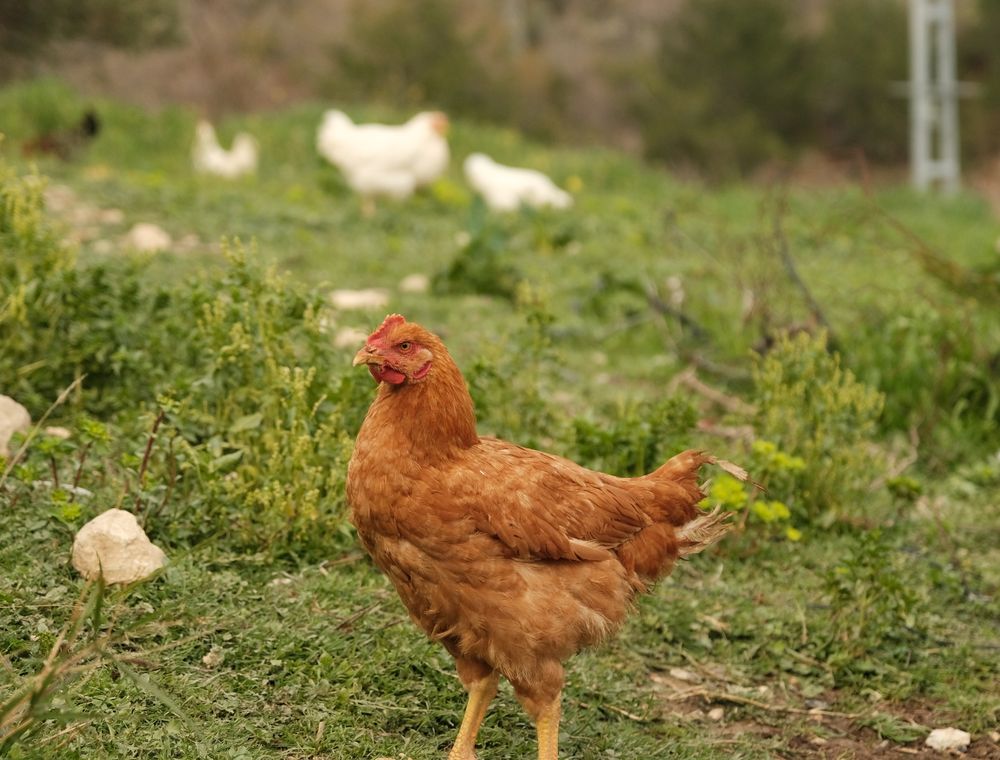
Chickens and grazing livestock can share a plot, but they do not share the same timing. Birds scratch up the soil, eat insects and seeds, and pick at the young shoots. A small flock of free-range birds clears a paddock of pests and fallen grain, and it spreads manure in small amounts across the whole field. A goat or cow eats the grass down and leaves the dung in heaps. The two work well together when the birds follow the animals, not when they are on the same patch at the same time.
Dual-purpose birds such as Kuroiler and Noiler are often chosen for free-range work because they forage well and hold their weight. Our day-old Kuroiler and Noiler chicks start at GH₵11, and the guide to the best free-range chickens for Ghana compares the breeds we hatch. Free-range birds need shelter at night, protection from dogs and snakes, and clean water. They also need a worm plan of their own, which is separate from the one for the goats and sheep.
Do not let the birds into a paddock straight after the animals have been there for a few weeks of heavy grazing, when the grass is short and the worm eggs on the ground are at their highest. Give the chickens the rested paddock, and keep them away from the trough.
A grazing calendar for a Ghanaian farm
The table below is a starting point, not a rule. Adjust it to your rainfall, which can be late or early in any year, and to your own grass. The point is to see which months need planning and which months need action, so the work is done before the grass runs out.
| Months (typical, south) | Grass condition | Main job on the pasture |
|---|---|---|
| December to February | Cured, low quality, harmattan dust | Feed hay and residues, protect the shade and water |
| March to April | Stirring as the first rains arrive | Repair fences, plant fodder trees and legumes |
| May to July | Fast growth in the major rains | Rotate paddocks quickly, control worms, cut surplus for hay |
| August to early September | Growth slows, short dry spell | Rest the most used paddocks, check body condition |
| September to November | Minor rains, a second flush | Graze the rested paddocks, make hay and silage |
| October and November | Dry season approaching | Plan the dry-season feed and count the stock |
The north follows a single rainy season, so its calendar compresses the second half of the year into a shorter window. The principle does not change. Plan the dry season in the wet season, and the animals will meet it in better shape.
A checklist to work through before the rains
Set aside a weekend in March or April, before the first heavy rain, and work through the list below with someone who knows the land. Most of these jobs are cheaper to do before the grass is up, and they are much harder to fit in once the animals are on the move.
- Walk each paddock and note the bare patches, gullies and the state of the fences.
- Repair gates and check that every paddock can be reached without chasing the animals.
- Cut and weigh grass in at least two places per paddock to estimate what is there.
- Check that the water supply works, and clean troughs and tanks.
- Mark the wet ground and plan to keep stock off it during heavy rain.
- Plant or replace fodder trees and legumes on the bare patches.
- Count the hay and residues you have stored, and set a target for the dry season.
- Agree a rest period for each paddock and write the moving dates on the wall.
A paddock plan written on paper is not the same as one that is working in the field. Walk it once a month, and change the dates when the grass tells you to.
Start with the agricultural extension officer from the Ministry of Food and Agriculture (MoFA) in your district. They know the local grasses and can advise on the programmes that are running in the area. Research institutions such as CSIR-SARI in the north and the Crops Research Institute at Kumasi publish recommendations for forage and crop residues, and your nearest agricultural college can often arrange a soil test. Ask about current terms for any support scheme before you commit, because programmes change from one season to the next.
Where the poultry side fits on the grazing farm
Halaal Farms supplies day-old chicks, fertile eggs, table eggs and grown birds. It does not supply land, grass, seed or the animals that graze it. We write about pasture because our customers ask how the birds, the goats and the manure fit together, and because a well-run grazing plot is one of the cheapest ways to feed a free-range flock.
If you are thinking about adding birds to a grazed plot, start with the chicks. Our day-old chicks in Ghana page explains the breeds and how we pack and deliver them, and our delivery information covers the regions we reach. You can order through the order section or send us a WhatsApp message on +233 24 915 1503 with the number of birds and your region. If you are starting from nothing, the poultry start-up budget guide sets out what a first flock costs.
For the grazing itself, your extension officer and your district office are the right people to ask. We can tell you about chickens, and they can tell you about the grass.
Questions farmers ask
How many paddocks do I need for a small goat or sheep flock?
Four or five paddocks is a useful number on a small holding, grazed in turn. Two paddocks moved every ten days is a fair start if the land is small. The aim is to give each paddock a rest of several weeks in the rains, so the grass can regrow before the flock returns.
Can I graze goats on the same land as my chickens?
Yes, if you time the grazing. Birds are best turned onto a paddock after the larger animals have left it and the grass has had a short rest. Keep the chicken house, feed and water separate from the goats' troughs, and give the birds shelter at night.
What is the best grass to plant for goats in Ghana?
Guinea grass and Napier grass are widely grown, and stylosanthes and fodder trees such as Leucaena and Gliricidia add protein. The right choice depends on your rainfall, soil and whether you plan to graze or cut and carry. Ask your extension officer or a research station for planting material and advice on your area.
How much grass does an animal need?
The honest answer depends on the animal, the season and the grass quality, so measure the grass rather than relying on a general figure. A cut-and-weigh test on several spots in each paddock gives you an estimate you can use. Adjust the number of animals to the result, and repeat the test as the season changes.
Is bush burning a good way to renew pasture?
It can give a flush of new growth in the savannah, but it also destroys litter, exposes the soil and kills useful trees. If you burn, do it early in the dry season, with firebreaks and proper supervision, and never let it spread onto other land. Hay and residues are usually a safer way to carry the animals through the dry months.
How do I make hay that the animals will eat?
Cut the grass while it is still green and before it goes to seed. Dry it on a clean raised surface in the sun until it is crisp, turning it so it dries evenly, then store it off the ground under cover. Mouldy or rain-soaked hay can harm animals, so check it before you feed it.
Should I buy feed or grow my own forage?
Both have a place. Growing your own forage gives you control over quality and timing, but it takes land and labour. Buying feed is simpler but depends on the market, which changes through the year. Check current rates in your local market before you commit to either, and compare the cost per unit of protein rather than the price per sack.


