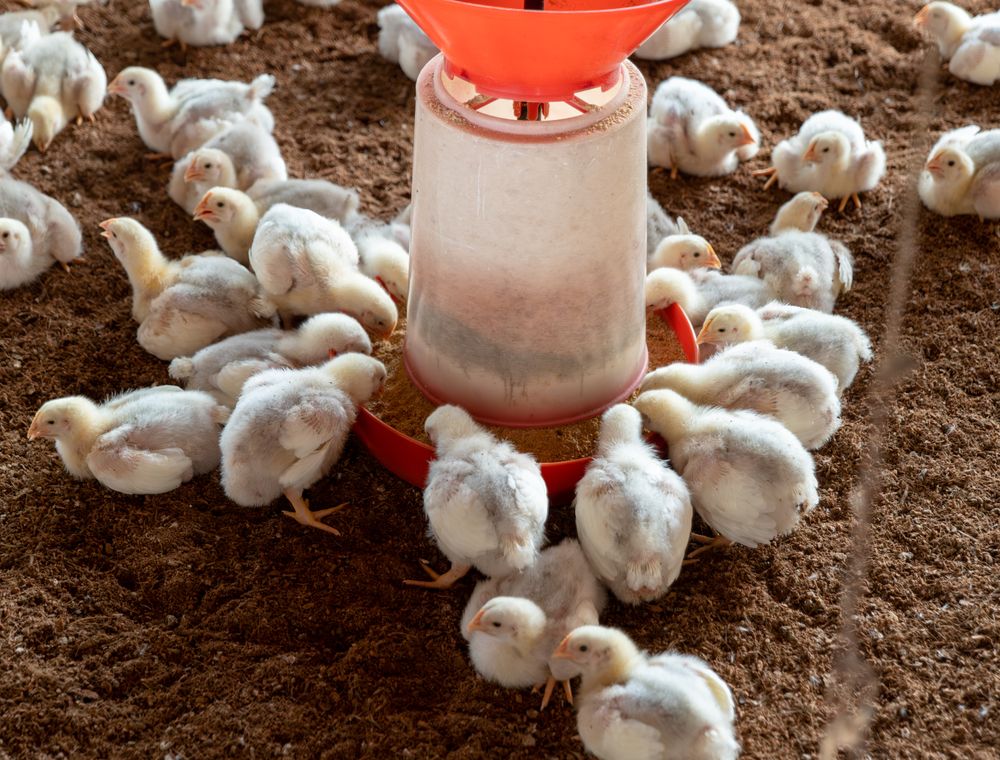
Short answer: The Ross 308 is a fast-growing white broiler that, with sound feed, water and temperature control, reaches about 2.2 to 2.5 kg live at around six weeks in Ghana. Its appeal is steady early growth and good feed conversion, but those traits only pay off when brooding, stocking density and feed phases are handled properly. Halaal Farms supplies Ross 308 day-old chicks from GH₵20 each, or GH₵1,000 for a box of 50.
Key takeaways
- Plan for about 2.2 to 2.5 kg live at six weeks, not the best-case figure on a breeder chart.
- Switch feed phases on weight and appetite, with the calendar as a guide rather than a rule.
- Aim for a feed conversion ratio near 1.8 to 1.9 across the grow-out, because FCR drives margin as much as weight does.
- Heat, wet litter and crowding cause most of the problems we see in Ross 308 flocks.
- Weigh a sample every week; the scale reveals problems that the feed bag never will.
- Start with vaccinated day-old chicks and a brooder that is ready before they arrive.
What the Ross 308 is and where it comes from
The Ross 308 is a commercial meat-type broiler, the white-feathered bird most Ghanaian farmers mean when they say "broiler". It is developed and bred by Aviagen, which maintains carefully selected parent stock. What reaches a farm as a day-old chick is the commercial cross, not the parent birds, and that is why a Ross 308 flock is usually very uniform when the chicks are hatched and handled well.
Our hatchery in Kasoa runs a local hatch on European parent stock, and we also import day-old chicks from the Netherlands, Belgium and Germany. We can supply Ross 308 chicks at the starting price on our list. Whichever route a batch takes, the questions that decide its performance are the same: how the chicks were hatched, how long they travelled, and whether they were vaccinated before they reached your farm. You can read more about our hatchery on our about page, or browse the full breed overview to compare the other lines we supply.
Farmers choose the Ross 308 for three reasons. It puts on weight quickly in the first weeks, it converts feed efficiently, and it reaches a size that suits both live-bird and dressed-bird markets within about six weeks. None of those advantages is automatic. The bird is demanding, and it rewards the farmer who keeps it warm, dry, well fed and calm.
The growth curve: what to expect week by week
Growth targets are the quickest way to find out whether a flock is on track. The table gives planning figures for Ross 308 chicks in Ghanaian conditions with good management. Treat them as a guide rather than a guarantee, and weigh a random sample of 10 to 20 birds every week so you can compare your own flock against them.
| Age (end of week) | Average live weight (kg) | What should be happening |
|---|---|---|
| Week 1 | 0.16 | Chicks eating and drinking within hours of arrival, spread evenly under a warm brooder. |
| Week 2 | 0.45 | Feathering well, no crowding at the edges, and feed moved to the grower phase on day 15. |
| Week 3 | 0.90 | Grower feed in use, with feeders and drinkers raised as the birds get bigger. |
| Week 4 | 1.40 | Heat becomes a real factor, so check ventilation on warm afternoons. |
| Week 5 | 1.90 | Appetite at its peak; litter and water flow need daily attention. |
| Week 6 | 2.35 | Market window for most growers; arrange transport and buyers before the birds reach this weight. |
Two details matter when you read this table. First, the averages assume a mixed flock. Males grow faster than females, so a straight-run flock will average below a flock of males alone. Second, the figures assume clean water, dry litter and a steady house temperature. A flock that misses a weekly target by a small margin can usually catch up. A flock that falls behind for two weeks in a row is much harder to recover, and by then the lost weight is expensive to buy back in feed.
Feed conversion: why FCR matters more than weight
Feed conversion ratio, or FCR, is the number of kilograms of feed a flock eats for each kilogram of live weight it puts on. A flock that eats 4.36 kg of feed per bird to reach 2.35 kg has an FCR of about 1.86. For the Ross 308 in good conditions, an FCR somewhere around 1.8 to 1.9 over the grow-out is a sensible target. Lower is better, and the gap between 1.85 and 1.95 is worth more to your margin than most people expect.
Consider a 50-bird batch. At an FCR of 1.86 and an average weight of 2.35 kg, the flock produces about 117.5 kg of live meat from roughly 218 kg of feed. If heat, wet litter or wasted feed push the FCR to 2.0, the same birds need about 235 kg of feed. That is 17 kg more for the same meat, and multiplying it by your local feed price per kilogram shows how quickly a bad week becomes an expensive one.
Feed is usually the largest running cost on a broiler farm, so the most useful habits are the unglamorous ones. Keep feed clean and dry, adjust feeder height as the birds grow, avoid long periods with an empty feeder, and do not overfill it so that feed is trampled into the litter where birds cannot eat it and it turns damp.
Feed phases: starter, grower and finisher
Ross 308 chicks need protein and energy in the right balance at each stage. The starter diet supplies the amino acids and vitamins a chick needs for rapid early development. The grower diet supports the fast skeletal and muscle growth of weeks two and three. The finisher diet is built for weeks five and six, when the birds eat the most, and it usually comes as larger pellets that waste less than fine mash.
Move between phases according to the flock rather than the calendar alone. A slow-growing flock should not be pushed onto a lower-protein finisher simply because the date says so, and a flock that is already heavy and eating well may be ready for the next phase a little early. Your weekly weigh-in tells you which situation you are in. Our week-by-week feeding schedule gives the amounts for each phase in detail.
Where possible, buy the full batch of feed from one mill. Changing brands mid-batch changes the nutrient profile and makes it hard to tell whether a drop in growth came from the bird, the house or the feed. If a change is unavoidable, make it gradually over three to four days.
Brooding and temperature for Ross 308 in Ghana
Brooding sets up the whole grow-out. In the first week the temperature at chick level under the brooder should be warm, around 32 to 35 °C, and then reduced gradually by about 2 to 3 °C each week until the house is close to outside conditions. In Kasoa's warm climate many growers can stop supplementary heat well before the textbook end point. The real test is behaviour. Chicks that crowd under the heat are cold, and chicks that spread out and pant near the walls are too hot.
A Ross 308 chick grows so quickly that a cold first week shows up later as poor uniformity and weak legs. A warm, dry brooder with clean litter and even light makes a visible difference by week three. Our guide to setting up a brooder walks through the preparation step by step, so the house is ready the moment the box arrives.
Heat becomes the bigger threat from week four. A Ross 308 at 1.5 kg produces far more body heat than a chick, and a house that was comfortable at week two can turn dangerous on a hot afternoon in the months before the rains. Our guide to getting heavier broilers goes deeper on temperature management through the hot season.
Housing, ventilation and stocking density
A Ross 308 house has to move air without creating draughts at bird level. Open sides with adjustable curtains suit most Ghanaian conditions, provided you can close the curtains on cold harmattan nights and open them fully on hot days. Roof height and ridge ventilation help hot air escape upwards and keep the litter from staying damp.
Stocking density is the decision most farmers underestimate. As a planning figure, many tropical growers work with about 10 to 12 birds per square metre at market weight, and they reduce that number when the weather is hot or when they want heavier birds. Crowding raises ammonia, increases footpad problems, and makes it harder for every bird to reach feed and water at the same time.
Use this checklist before the chicks arrive:
- Litter: dry wood shavings or rice husk, spread evenly to a depth of about 5 to 8 cm.
- Feeders and drinkers: enough of each for every bird to reach them without a queue, and set to a height you can adjust as the birds grow.
- Curtains and fans: tested and ready, so you can manage both cold nights and hot afternoons without scrambling.
- Lights: even coverage across the house, with a dimmer setting for the first few days.
- Records: a sheet for daily mortality, feed used, water checks and weekly weights, ready on day one.
Pros and cons of the Ross 308 for Ghanaian farms
Where the Ross 308 performs well
- Fast early growth that brings birds to market weight in about six weeks.
- Good feed efficiency when the flock is managed well.
- Uniform flocks, which make it easier to sell in lots and to plan weights for a buyer.
- A large body of grower experience and feed mills that formulate for this type of bird.
Where it asks more of you
- Fast growth leaves less tolerance for heat, crowding and damp litter.
- Legs and heart carry a heavy load in the last two weeks, so lameness is a real risk.
- Feed spend rises sharply in weeks five and six, which makes late losses expensive.
- It is not the right bird for slow-growing or free-range systems.
Common problems in Ross 308 flocks and how to prevent them
Most problems in a Ross 308 flock are management problems in disguise. These are the ones growers describe most often when a flock starts to fall behind, along with what to do before they become expensive.
- Leg problems and lameness. Usually a mix of fast growth, wet litter and poor grip on the floor. Keep the litter dry, check feeder height, and watch the birds walk rather than only eat.
- Footpad burns. Wet, caked litter around drinkers is the usual cause. Fix leaking nipples and drainage before you blame the feed.
- Sudden deaths in heavier birds. Often linked to rapid growth, heat stress or an abrupt feed change. Keep feed changes gradual and avoid crowding at the feeder during hot spells.
- Ammonia and eye irritation. A sign of poor ventilation and damp litter rather than a disease on its own.
- An uneven flock. Usually a brooding or feed-access problem in the first two weeks, and very hard to correct later.
If mortality rises above what your vet considers normal, call your vet early rather than waiting for the market date to reveal the problem.
Need chicks for your next batch?
Send breed, number and town. We reply with price, hatch date and delivery cost in writing.
Health and vaccination: what we do before the chicks leave us
Every batch of chicks from Halaal Farms is vaccinated at the hatchery against Marek's disease, Newcastle disease (NCD), Gumboro (IBD), infectious bronchitis and coccidiosis. You receive a batch record with the delivery, and it is worth filing it with your other farm records, because your vet will ask for it when planning the next steps.
Hatchery vaccination does not replace good husbandry on the farm. Booster timings, the route used and any extra protection depend on your region, your flock's history and your vet's advice. As a typical example only, many growers schedule a Newcastle and Gumboro booster in the second or third week, but your vet sets the calendar for your own farm.
Biosecurity is the second layer of protection. Restrict visitors, keep a footbath or clean boots at the house door, use a separate set of tools for each house, and remove dead birds promptly. Our biosecurity checklist covers the details for a small or medium farm.
Buying Ross 308 day-old chicks from Halaal Farms
Ross 308 day-old chicks start at GH₵20 each. A box of 50 costs GH₵1,000, and that is the minimum order. For orders of 1,000 chicks or more, tell us the number you need and we will prepare an individual quote, confirmed in writing before you pay. We accept mobile money, bank transfer and cash. We do not take payment online.
Chicks leave the hatchery on the day they hatch, packed in ventilated boxes of 50. We deliver to all 16 regions, and you can also collect from the farm in Opeikuma, Kasoa. The delivery cost is confirmed before payment, so it never comes as a surprise on the day. Count the birds as soon as the box is opened. If any chicks are dead on arrival, send a photo on WhatsApp the same day, and we replace them free in the next hatch.
Ready to order, or want a quote for a larger flock? WhatsApp us on +233 24 915 1503, email support@halaalfarms.com, or use the order form on our homepage. Our current price list shows the starting prices for every line we supply, and the delivery page explains how transport works. For bigger plans, see our bulk day-old chicks page. Farm visits are by appointment.
A simple profit check for a 50-bird batch
The table below shows how quickly mortality changes the picture. It uses the chick price from our list and the live-bird price of GH₵110 for a bird of about 2.5 kg. Feed and other running costs are left out, because they depend on your local feed price and your house. Subtract them from the last column to see your real position.
| Birds surviving to sale | Sales at GH₵110 per bird (GH₵) | Chick cost, 50 at GH₵20 (GH₵) | Left before feed and running costs (GH₵) |
|---|---|---|---|
| 48 | 5,280 | 1,000 | 4,280 |
| 46 | 5,060 | 1,000 | 4,060 |
| 44 | 4,840 | 1,000 | 3,840 |
The gap between 48 and 44 birds is GH₵440 before a single bag of feed has been bought. That is why mortality control and early vaccination pay off. Birds that reach market weight in good health also tend to sell more easily than underweight or bruised birds, which protects the price you were counting on.
Ross 308 or another breed? How to decide
If you are not yet sure the Ross 308 suits your market, read our Cobb 500 guide and our side-by-side comparison of the two. If you are aiming at a particular festive season, our article on timing chicks for Christmas broilers lays out the sums. And if you are still deciding between a broiler and a layer, the broiler versus layer comparison explains what each asks of your house and your capital.
Our broiler day-old chicks page has the full range we supply for meat production, and if you have a question that is not covered here, the FAQ is a good next stop before you message us.
Questions farmers ask
How heavy should a Ross 308 be at six weeks?
Under good management in Ghana, a planning target is about 2.2 to 2.5 kg live at six weeks. Males usually weigh more than females, so a mixed flock averages lower than a flock of males. If your birds sit well below that range, check water, temperature and litter first, then review feed intake and health with your vet. Weighing a sample each week shows the trend early.
What is a good FCR for Ross 308?
In good conditions, a feed conversion ratio of about 1.8 to 1.9 across the grow-out is a sensible target. Heat, wet litter, crowding and wasted feed all push it upward. Track the feed used per batch and divide it by the total live weight you sell. Your own FCR, worked out this way, is more useful than any published figure.
Can I keep Ross 308 chickens past six weeks?
You can, but the economics change. Feed intake rises in the final weeks while daily weight gain slows, so each extra kilogram costs more. Most growers sell somewhere between five and seven weeks, depending on market demand and the condition of the birds. If you are considering a longer grow-out for a specific buyer, ask your vet first, especially if heat or leg problems are already showing.
Is the Ross 308 suitable for Ghana's heat?
The Ross 308 can be raised successfully in Ghana, but it is more sensitive to heat than slower-growing birds, particularly from week four onwards. Success depends on ventilation, lower stocking density in the hot season, clean water at all times and feeding during cooler hours. It is a bird that needs managing, not one you can leave to run itself.
Do you sell Ross 308 chicks in small numbers?
Our minimum order is one box of 50, which costs GH₵1,000 at the starting price. Larger orders, from 1,000 chicks, get an individual quote. Each box leaves the hatchery on hatch day in ventilated packaging. You can collect at the farm in Opeikuma, Kasoa, or have them delivered to any of the 16 regions, with the delivery cost confirmed before you pay.
How do I pay for Ross 308 chicks?
We accept mobile money, bank transfer and cash. We do not take online payment. The price and the delivery cost are confirmed in writing before you pay, so you know the full amount in advance. To start an order, WhatsApp us on +233 24 915 1503 or use the order form on our homepage.
What happens if some chicks die on arrival?
Count the chicks as soon as the box is opened and send a photo to our WhatsApp the same day. Dead-on-arrival birds are replaced free in the next hatch. Write down the arrival time and the condition of the box in your batch record, because that information helps you and us trace any problem quickly.


