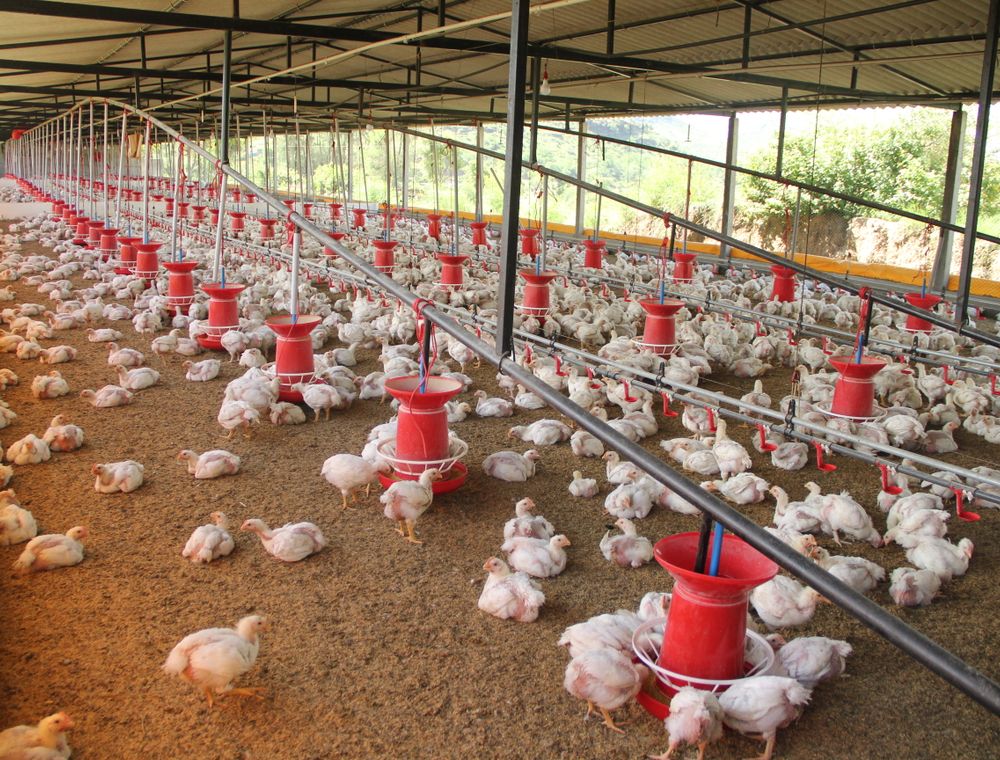
Short answer: The Cobb 500 is a white meat-type broiler developed by Cobb-Vantress and known for strong breast yield and efficient feed use. In Ghana it can reach a practical market weight in roughly six weeks, but its real value depends on how you sell: whole live birds, dressed birds or breast-led sales to processors. Halaal Farms supplies Cobb 500 day-old chicks from GH₵20 each, with a box of 50 at GH₵1,000.
Key takeaways
- Breast yield is the Cobb 500's headline trait, and it only pays if your buyer values the carcass.
- Choose your market age on purpose: five, six or seven weeks each carry a different feed bill and weight.
- Target a feed conversion ratio near 1.8 to 1.9 and track it batch by batch.
- Heavier breast meat raises the stakes on litter quality, leg health and stocking density.
- Keep litter dry and the house cool in the hot season to protect breast quality.
- Order from a hatchery that vaccinates before dispatch and records every batch.
What the Cobb 500 is and who breeds it
The Cobb 500 is a commercial broiler developed by Cobb-Vantress, a breeding company whose lines are used in many countries. Like the Ross 308, it is a white-feathered meat bird that grows quickly on a standard feed programme. Growers who choose it are usually looking for a bird that combines good growth with a well-fleshed breast, which is the part of the carcass most buyers ask for by name.
On our hatchery floor, the question Cobb 500 buyers ask most is not "how fast does it grow?" but "what will my buyer pay for?" That is the right question to start with. The answer decides how heavy you should grow the bird and whether you should sell it live, dressed or in pieces. Our breed overview places the Cobb 500 alongside the other broiler and layer lines we supply.
Our starting price for Cobb 500 chicks is GH₵20 each, the same as our Ross 308 price, and the same box-of-50 and minimum-order rules apply. The breeds differ in emphasis rather than in basic management, so a farmer who knows how to run one can usually run the other with only small changes to the routine.
Breast yield: what it means and why it matters
Breast yield is the weight of breast meat as a share of the carcass. A bird with a higher breast yield gives more saleable meat from the same live weight. That difference is most visible to processors, restaurants and butchers who buy by the cut, and far less visible to a trader who buys whole live birds by weight.
Genetics sets the potential, but the farmer decides how much of it reaches the market. Three things matter most. A bird that is not stressed by heat keeps its muscle development. A bird with sound legs moves and eats normally. And a clean, dry house prevents breast blisters, which are skin lesions caused by birds lying on wet or hard litter. Blisters are a quality defect a buyer can spot at a glance, and they are almost always a management issue.
| Factor | What it affects | What you can do |
|---|---|---|
| Heat stress | Feed intake and muscle development | Lower stocking density, ventilate well, feed in cooler hours |
| Wet litter | Breast blisters and hock burns | Fix drinker leaks, keep litter dry and loose, remove wet patches |
| Lameness | Movement, feed intake and uniformity | Set feeder height correctly, improve grip, call your vet early |
| Excess fat in the finisher | Carcass shape and dressing yield | Choose the right market age and use a balanced finisher |
Woody breast is a separate quality problem linked to very fast growth and to the genetics of heavy-breasted birds. It is largely a breeding and processing issue rather than one you can fix in the house, but it is worth discussing with a processor if you sell into that channel.
Choosing your market age: five, six or seven weeks
Market age is the most important decision a Cobb 500 grower makes, because every extra week changes both the weight you sell and the feed you pay for. The table gives planning figures for a well-managed flock in Ghana. They are illustrations to help you think, and your own birds will vary.
| Market age | Approx. live weight (kg) | Cumulative feed per bird (kg) | Where it fits |
|---|---|---|---|
| 5 weeks | 1.9 | 3.0 | Faster cash flow and a lower feed bill, with a lighter carcass |
| 6 weeks | 2.3 | 4.4 | The standard point for live-bird and dressed-bird sales |
| 7 weeks | 2.7 | 6.0 | Heavier birds for specific buyers, but the last week is costly |
The seventh week is where the arithmetic gets harsh. Moving from six to seven weeks in this example adds about 0.4 kg of live weight for roughly 1.6 kg of feed, a marginal feed conversion of about 4. The whole flock's FCR rises to about 2.2 by then. Unless your buyer pays a clear premium for the extra kilograms, six weeks is usually the most sensible compromise.
Five weeks has its own appeal. It shortens the time the house is occupied and brings cash in sooner, which matters when you are stocking the next batch. The trade-off is a lighter bird, so check that the buyers you sell to will pay a fair price per kilogram at that weight before you commit.
Feed efficiency: how the Cobb 500 turns feed into meat
A good Cobb 500 flock in Ghana should land near an FCR of 1.8 to 1.9 across the grow-out, which is in line with the planning range for most modern broilers. Efficiency is at its best in the middle weeks and worsens in the last one. That is why market age matters so much: the cheapest kilogram of meat is usually the one produced between weeks three and five, when the birds are growing fast and eating well.
Take a 50-bird flock sold at about 2.3 kg per bird, which is 115 kg of live meat. At an FCR of 1.9 that flock eats about 219 kg of feed. If heat stress and wet litter push the FCR to 2.1, it eats about 242 kg for the same live weight, which is more than 20 kg of extra feed. Heat is therefore a feed problem as much as a welfare problem, and every cool-season or shade improvement you make in the house shows up in your feed sheet.
Keep a feed log for each batch: bags opened, feed weighed into each phase, and the date each bag was used. Without that log you cannot separate a breed effect from a management effect when you review the batch at the end.
How the Cobb 500 differs from the Ross 308
Both birds are white meat-type broilers with similar market ages and similar feed phases, so the basic rules of management carry across. The differences show up in the emphasis of the genetics and in the details of the carcass, not in the core routine of brooding, feeding, watering and ventilating.
Cobb 500 growers tend to talk about breast yield and carcass conformation. Ross 308 growers tend to talk about early growth and feed conversion. In practice the two are close enough that the decision is usually about price, the chicks available on the date you need them, and what your buyer prefers. Our side-by-side comparison sets out the differences in a single table.
Two practical points stand out. Cobb 500 growers often report a broader, deeper breast at the same live weight, which buyers notice if you sell dressed. And if you sell whole birds to traders who judge by appearance, the shape of the carcass can matter as much as the live weight on the scale. Check with your buyers before you decide that either difference is worth paying for.
Feeding the Cobb 500: phases, protein and timing
The feeding programme for a Cobb 500 follows the same three-phase logic as other fast-growing broilers. Switch phases on weight and appetite as well as on the calendar.
- Starter, days 1 to 14. Crumble, offered freely. Fill feeders often in the first days, and place extra feed on paper trays so that no chick has to search for food.
- Grower, days 15 to 28. Pellets or a coarse crumble, introduced on schedule and checked against the weekly sample weight.
- Finisher, day 29 to market. Larger pellets, with energy and protein set by the mill's finisher formula.
Do not push extra protein into the finisher in an attempt to build breast size. Protein the bird cannot use is excreted as nitrogen, which raises ammonia in a warm house, damages the litter and increases the risk of breast blisters and footpad problems. A balanced finisher from a reputable mill is a better investment than a richer diet that makes the house harder to run.
Feed timing matters in Ghana. If the feeder is filled late in the afternoon and the birds eat heavily through the night, they carry a full crop into the hottest part of the next day, which adds to the heat load. Where you can, keep feed topped up in the early morning and evening, and avoid refilling large amounts at the hottest time of day.
Housing, density and litter for heavier breasts
A Cobb 500 flock benefits from a little more space in its final two weeks. Lower density protects breast skin, gives the birds room to move, and keeps them eating, which is the best protection for both weight and carcass quality. In the hot season, consider reducing the number of birds per square metre below the ten to twelve you might use in cooler months.

Litter is where breast quality is decided day by day. Keep it dry and loose to a depth of about 5 to 8 cm, and turn or top up the wet patches around drinkers every day rather than waiting for a weekly clean-out. In the rainy season, ventilation at night matters as much as ventilation by day, because damp air keeps the litter wet.
- Check nipple drinkers for leaks every morning, and adjust their height as the birds grow.
- Keep curtains and fans working through the night in the rainy months.
- Remove any caked or wet litter promptly rather than covering it with fresh shavings.
- Watch the birds' feet at the feeder line, since early lameness often shows there first.
A daily routine for Cobb 500 growers
A consistent routine catches problems while they are still small. The list below is one we would use for a Cobb 500 house, adjusted for your own team and layout.
- Dawn walk-through. Check for dead birds, lame birds, birds away from the group, and any sign of respiratory noise.
- Water. Confirm drinkers are flowing, clean and at the correct height, and that no tank has run low.
- Feed. Check the amount left in each feeder, top up as needed, and confirm the feed is dry and free of mould.
- Litter. Look for wet patches around drinkers and deal with them at once.
- Midday temperature. Note the reading in the house and the state of the birds: spread out and panting, or settled.
- Evening record. Write down mortality, feed used, water notes, and anything unusual before you leave.
Need chicks for your next batch?
Send breed, number and town. We reply with price, hatch date and delivery cost in writing.
Health checks that protect carcass quality
The chicks from Halaal Farms are vaccinated at the hatchery against Marek's disease, Newcastle disease, Gumboro, infectious bronchitis and coccidiosis, and each batch comes with a record. Vaccination protects the flock against several common diseases, but it does not cover everything, and the timing of any further vaccination on your farm should follow your vet's schedule.
The most useful health habit is early observation. Birds that are quiet, hunched, lame or reluctant to feed are telling you something before the mortality figure moves. Call your vet when a pattern appears rather than when the losses are already large. A wet or dirty house is itself a health risk, and it shows up later as breast and leg defects.
- Restrict visitors and keep a record of everyone who enters the house.
- Use clean boots or a footbath at the door and a separate tool set for each house.
- Remove and dispose of dead birds promptly and according to your vet's advice.
- Note any change in droppings, breathing or drinking and report it the same day.
Timing your sale around festive demand
Demand for live and dressed chicken in Ghana rises around Christmas, Easter and Eid, and a Cobb 500 flock is well suited to hitting those windows if you plan backwards from the date. Count six weeks back from the day you want to sell, then allow time for the house to be ready, and set the arrival date for the chicks from there.
Plan for a little slack in that calendar. A delayed delivery, a hot spell or a short bout of illness can push a flock a few days past its target, and a bird that is ready after the festive peak sells for much less. Our article on Christmas broilers works through the timing in more detail, including the buying window for the chicks themselves.
Questions to ask a hatchery before you order
Chicks are the foundation of the whole batch, so it pays to ask the right questions before you pay. A good hatchery will answer them plainly. Use this list when you compare suppliers, including us.
- Which vaccines were given at the hatchery, and is there a batch record I can keep?
- How many hours will the chicks spend in transit, and in what kind of box?
- What is the procedure if chicks are dead on arrival, and how quickly is it resolved?
- What is the total price, including delivery, and is it confirmed in writing before I pay?
- What is the minimum order, and how are larger orders quoted?
- Can I visit or collect the chicks myself, and do I need an appointment?
Ordering Cobb 500 chicks from Halaal Farms
Cobb 500 day-old chicks start at GH₵20 each. A box of 50 is GH₵1,000, and one box is the minimum order. Bigger orders, from 1,000 chicks, are priced one at a time. We accept mobile money, bank transfer and cash, and we do not take online payment.
The chicks are dispatched the day they hatch, in ventilated boxes of 50. We deliver to all 16 regions, and collection from the farm is also possible. Delivery cost is confirmed before you pay. When a box arrives, count the birds, look for any that are dead or obviously weak, and message us a photo that day if anything is wrong. Dead-on-arrival chicks are replaced free in the next hatch.
To place an order, WhatsApp +233 24 915 1503 or use the order form. If you want a Cobb 500 batch as part of a wider plan, our broiler chicks page and Kasoa delivery page explain the options. For questions about the hatchery itself, visit our about page or read the FAQ.
Questions farmers ask
Is the Cobb 500 better than the Ross 308 for breast meat?
The Cobb 500 is marketed around breast yield, and many buyers who sell cut-up or dressed chicken prefer it for that reason. Whether it is better for you depends on your buyer. Whole-bird sales to households may not reward the difference. Run a small comparison batch and weigh the dressed carcasses to see what your own market pays for.
What weight should a Cobb 500 reach at six weeks?
A planning target for Ghana is around 2.2 to 2.4 kg live at six weeks under good management. Heat, poor litter and disease can pull the figure down, and extra feed will not always pull it up. Weigh a random sample every week and compare it with the target, rather than relying on a single weigh-in.
Should I sell Cobb 500 at five or seven weeks?
Five weeks gives faster cash flow and less feed, while seven weeks gives heavier birds at a much higher feed cost for the last kilograms. Six weeks is the usual middle ground. Choose according to your buyer's weight preference and the price per kilogram, then check the numbers against your own batch records.
Does the Cobb 500 need a different feed programme?
The phases are essentially the same as for other fast-growing broilers: starter, grower and finisher, switched by weight and behaviour. Use formulations from a reputable mill and avoid pushing extra protein into the finisher. Surplus protein adds ammonia and litter problems without a matching gain in breast yield.
How do I prevent breast blisters?
Breast blisters come from birds lying on wet or hard litter. Keep the litter dry and loose, fix leaking drinkers quickly, keep stocking density sensible, and maintain ventilation so the litter does not stay damp. Blisters are usually a management issue rather than a disease, but if they appear in many birds, ask your vet to look at the house with you.
Can Halaal Farms supply Cobb 500 chicks in bulk?
Yes. The minimum is one box of 50 at GH₵1,000, and anything from 1,000 chicks upward gets its own quote. WhatsApp us on +233 24 915 1503 with the number you need, the date you want the chicks and your delivery town, and we will confirm the price in writing before you pay.
What should I check when Cobb 500 chicks arrive?
Count the birds in each box, look for any that are dead or weak, and check their activity, eyes and navels. Message us a photo on WhatsApp that day if anything looks off. Dead-on-arrival chicks are replaced free in the next hatch. Record the arrival time and the temperature of the house in your batch notes, since they help you trace any problem later.


