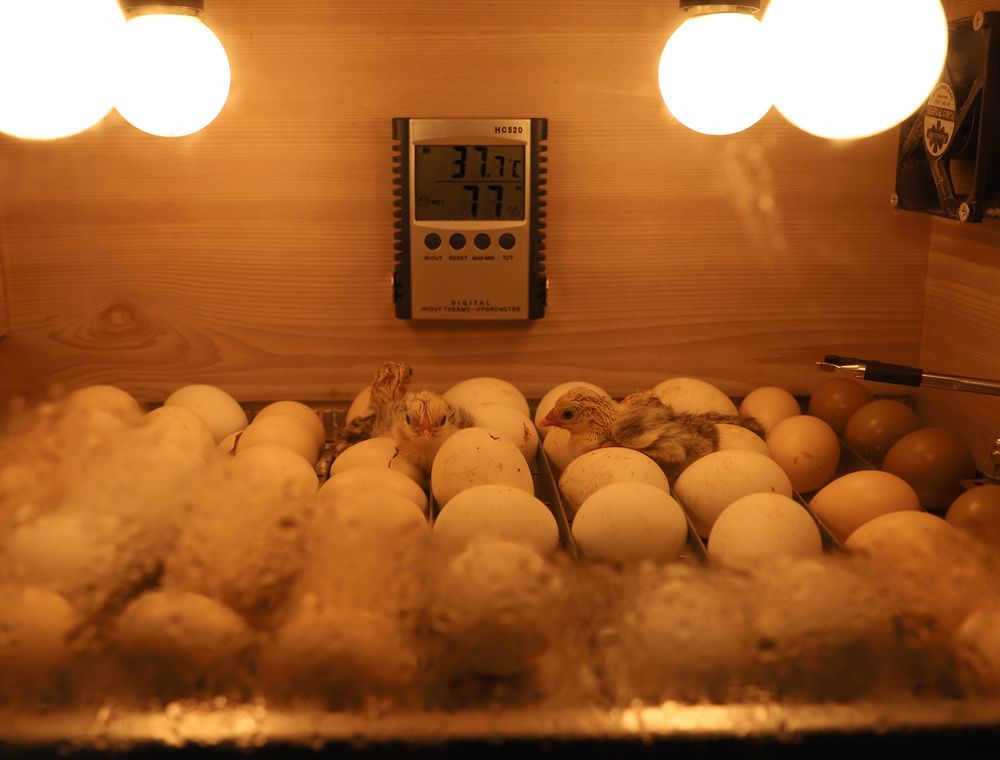
Short answer: A goose egg needs 28 to 30 days in the machine, about 37.5 °C at egg level and a humidity 5 to 10 points above your chicken setting. Aim to lose 14 to 15 percent of the egg weight by lockdown, which for a 180 gram egg means 25 to 27 grams gone. From about day 20 the embryo makes enough heat to need a short daily cool-down in a hot Ghana room, and a light mist at lockdown helps only when the air is dry.
Key takeaways
- Count 28 to 30 days from the set day, and plan lockdown for day 25 or 26.
- Hold 37.5 °C at egg level, and do not chase a higher number because the egg is big.
- Run humidity 5 to 10 points above your chicken setting: about 50 to 55 percent, then 65 to 70 at lockdown.
- Target 14 to 15 percent weight loss by lockdown. Weigh a sample of eggs on day 0, day 14 and day 25.
- Cool the trays for 10 to 15 minutes once a day from about day 20 when the room is hot, then mist lightly only if the air is dry.
A goose egg weighs as much as three chicken eggs
Put a goose egg on a kitchen scale next to a chicken egg and the difference surprises people. A goose egg of 170 to 200 grams is roughly three chicken eggs in one shell. The shell is thicker, the white is deeper and the embryo that grows inside has a lot more tissue to build. Every part of the set plan follows from that single fact.
The pattern is familiar to anyone who has set chicken eggs, but the timings and the margins are tighter. A goose embryo needs more time, more moisture and more care with heat than a chicken embryo, and it can cause trouble in a machine that was tuned for chicks. This guide is written for the keeper who sets their own goose eggs. Goose eggs are not on our price list, so this is written for the keeper who sets their own, drawing on the same hatchery routine we use for poultry.
If you are still working out whether the goose side is worth the time, our guide to raising geese in Ghana covers the breeds and the markets. If you are setting goose eggs for the first time, read our breeding and gosling guide alongside this one, because it covers the gander, the flock ratios and the brooding side that this article leaves out.
The calendar, counted from the set day
Goose eggs take 28 to 30 days, and the breed and the machine both move that number a little. Most keepers set the clock by the longer end of the range and then plan lockdown from the first pip, not from the calendar alone. Write the set date on the tray card and on the wall of the room in large figures. A date you can read from the door saves a lot of arguments later.
| Day from set | What you do | Why it matters for a goose |
|---|---|---|
| Day 0 | Set the eggs, weigh the sample, record machine and room readings | Gives you the baseline for every later weight check |
| Day 1 to 24 | Turn three to five times a day, and check temperature and humidity twice daily | Keeps the embryo off the shell and the readings honest |
| Day 7 | First candle, remove clear and dead eggs | A clear egg in a goose set is usually infertile, not just slow |
| Day 14 | Second candle, second weigh of the sample | The weight loss tells you whether humidity is right |
| Day 20 onward | Start the daily cool-down if the room is hot | The embryo now makes heat faster than the air can take it away |
| Day 25 or 26 | Lockdown: stop turning, raise humidity, final candle | The gosling settles into position for the hatch |
| Day 28 to 30 | Hatch window. Keep the lid shut. | Each opening drops humidity and temperature for the whole tray |
The day-25 lockdown is a guide, not a law. If the eggs were laid early in a cold week, or the machine ran cool for a day, hold lockdown until day 26. A late lockdown is a smaller risk than a rushed one, because the gosling still has a few hours of work to do before it will need the drier air.
Temperature at egg level, and why a bigger egg does not need a hotter machine
Set the machine to 37.5 °C at egg level, the same figure you use for chicken eggs in a forced-air cabinet. People new to geese often push the setting up because the eggs are big, and that is a mistake. The size of the egg does not change the temperature the embryo needs. What changes is the heat it makes once it is large enough, and that heat builds in the last third of the set.
The thermometer is the first thing to check. Most cabinets have a display near the top, and the air at the top of the cabinet can run half a degree or more above the air where the eggs sit. Put a calibrated probe on the tray, at the height of the eggs, and read it at the same time each morning and evening. Our guide to calibrating an incubator thermometer shows how to check the probe against a known reference before you trust it.
A reading that drifts above 38 °C for more than an hour is a problem, and a reading that drops below 36.5 °C for a long time is a problem too. Both will slow or stop the embryo. If the room is hot in April, move the machine away from the window and out of the afternoon sun before you change any setting on the cabinet.
Humidity five to ten points above your chicken setting
Goose eggs have thicker shells and lose water more slowly than chicken eggs, so they need a humid machine to keep the balance right. The working rule is simple: run five to ten points above the humidity you would use for chicken eggs. For most forced-air cabinets that means about 50 to 55 percent relative humidity during the set, then 65 to 70 percent from lockdown.
Measure the humidity with a hygrometer you trust. Check it against a salt test before the first set, because a cheap gauge can read ten points out and still look confident. Our guide to fixing humidity problems sets out the salt test and the wet-bulb check step by step.
Water is the lever you control. Use a wide, shallow pan rather than a small bowl, so the water surface is large and the air above it picks up moisture evenly. Top up the pan with warm water rather than cold, so the machine does not dip while you fill it. If the reading is high, reduce the water surface first before you touch the vents.
Ghana's seasons change the job. In the dry harmattan, from roughly December to February, the air can drop well below your target inside a cabinet that is not sealed, and dust gets into vents. In the wet months the reverse happens, and a goose set can run too wet if the pan is full and the room is closed. Check the reading every morning in both seasons, not just when the eggs are candled.
Weight loss by lockdown: a worked example on a 180 gram egg
Weight loss is the number that tells you whether the air cell is growing at the right speed. Water leaves the egg through the shell over the whole set. By lockdown the goose should have lost 14 to 15 percent of its starting weight, leaving an air cell big enough for the gosling to breathe while it pips and zips.
Take a 180 gram egg from your sample. Fourteen to fifteen percent of 180 grams is 25.2 to 27 grams. The egg should weigh about 153 to 155 grams at lockdown. By day 14, a steady set should be about 7 percent down, which is around 13 grams gone, leaving the egg at about 167 grams.
| Checkpoint | Target loss | Egg weight for a 180 gram start | What a miss tells you |
|---|---|---|---|
| Day 0 | None | 180 g | Baseline. Weigh a sample of three. |
| Day 14 | About 7 percent, about 13 g | About 167 g | Under 160 g: too dry. Over 170 g: too wet, so check the pan and the vents. |
| Day 25 or 26 | 14 to 15 percent, 25 to 27 g | 153 to 155 g | Under 151 g: air cell too big, raise humidity now. Over 158 g: the hatch will be weak. |
The figures here are for a 180 gram egg. A smaller egg loses the same percentage in fewer grams, so do the sum with your own average. The percentage is the target, and the grams are the check. A goose egg that weighs 200 grams has a different target than one that weighs 170, and treating them the same is a common error.
When the day-14 weight is behind, do not panic and do not drown the machine. Raise the humidity by a few points over the next three days, keep the pan topped, and weigh again on lockdown. A small correction in the second half of the set is a much better fix than a large change on day 25.
Turning a thick shell: how often, and when to stop
A goose egg needs turning to stop the embryo sticking to one side of the shell. Turn the tray three to five times a day until lockdown, and keep the interval as even as you can. A turner does this for you, but check it, because a turner that has stopped will leave the eggs lying the same way for days without any warning.
Mark one egg on the tray with a pencil cross, and check each morning that the cross has moved. If the cross sits in the same position for a day, the turner is not doing its job, and the eggs have been lying still. For hand-turned sets, a fixed time for each turn is better than a vague sense that you have turned them recently.
- Turn the eggs the same number of times every day, at the same hours where you can.
- Stop turning at lockdown on day 25 or 26, with the eggs lying flat on their side.
- Do not turn the eggs during the candling session, because the handling adds risk to the embryo.
- If the machine has a stop-turn switch, check it before lockdown and not on the morning the eggs are due to stop.
If you have a large set and the turner is failing, do not move the eggs by hand every few hours. Repair or replace the turner. A few days of hand turning from a broken machine is a better fix than a few hours of ignoring the eggs while you wait for parts.
Candling a dark, thick shell
A goose shell blocks more light than a chicken shell, and some goose eggs are darker in colour as well. A torch that shows a clear chicken egg well may leave a goose egg looking like a brown stone. Use a stronger torch, work in a dark room, and hold the egg against the light for longer than you would for a chicken egg. Move the egg slowly in front of the beam.
The first candle is on day 7. A fertile goose egg shows a network of blood vessels spreading from a dark centre. A clear egg with no network is infertile, and it should be removed, because a rotting infertile egg can burst and foul the tray. On day 14 the embryo fills more of the egg and the shadow is larger. At lockdown, a healthy gosling should show movement when you hold the torch to the egg, and the air cell should be visible at the blunt end.
Remove any egg that goes still, or that shows a dark ring of dead embryo with no movement. Put it in a sealed bag, not on the floor, and clean the tray before you return the others. Write the count of removed eggs on the card at each candle. The numbers become the record that tells you what went wrong, if something does.
If the shell is too dark to read, do not guess. Hold the egg for a longer count, or rotate it slowly. If you still cannot see, weigh the egg at lockdown and use the weight as the second check. Our day-by-day guide explains the chicken timings, and the same logic applies to the goose with the longer count.
Cooling the eggs in a hot Ghana room, from about day 20
Late in the set a goose embryo makes more heat than a chicken embryo of the same age, because it is larger and it is busier. The machine can handle that heat for most of the set. In the last week, in a room above 32 °C, the cabinet may climb past its setting even though the thermostat looks fine. That is the situation where a short daily cool-down helps.
What we would do in your machine is simple. From about day 20, on any afternoon when the room is hot or the cabinet reading rises above the set point, open the machine and take the tray out. Let the eggs rest at room air for 10 to 15 minutes, then return them and close the lid. Check that the cabinet has come back to 37.5 °C within about 30 minutes. If it has not, the cabinet is overloaded or the room is too hot, and you need to change one of those, not add more cool-downs.
Do not cool more than once a day unless the room is very hot and you have checked the reading every hour. Do not cool at night, when the room is cold, and do not put the tray on a cold floor. Cool the eggs gently, and keep the air moving with a fan on the room rather than a draught on the tray.
The cool-down is a safety valve, not a method. If the cabinet runs hot every day, the fix is the room. Move the machine out of the sun, open a window on the cool side, and put a fan in the room. Our guide to cooling a poultry house covers the same airflow ideas for a building, and they apply to a room that holds a machine.
Need chicks for your next batch?
Send breed, number and town. We reply with price, hatch date and delivery cost in writing.
Misting at lockdown: a light mist, not a bath
Some keepers mist goose eggs at lockdown to soften the membrane and help the gosling get out. The method works only in dry air, and it does harm when the cabinet is already humid. A goose egg is not a dry egg you need to wet. It is an egg that has lost the water it needs to lose, and the mist should only top up what the air is short of.
Use lukewarm water, about 35 °C, in a clean spray bottle. Give the eggs one light mist a day from lockdown until the first pip, aiming the spray at the shell rather than into the cabinet. Stop if the reading is already at 70 percent or above, or if the eggs look wet for more than a few minutes. A soaked shell can carry bacteria in through the pores, and a wet tray on a warm floor is a bad place for a gosling to be born.
- Mist only when the reading is below your lockdown target.
- Use clean, lukewarm water, never cold water straight from the tap.
- Mist the shell lightly, never the cabinet floor or the lid of the machine.
- Stop misting once the first pip is seen. From then on the air should stay steady.
Misting is a small tool in a bigger job. The weight check on day 25 tells you more about the moisture than any spray, and the spray is only needed if the weight is behind. Our guide to why eggs fail to hatch lists the other causes to rule out before you blame the humidity.
The hatch: leave goslings alone until they are dry
The first sign of a hatch is a small crack or pip in the shell, usually around day 27 or 28. The gosling then works its way round the shell, zipping as it goes. Expect the hatch to take a day or more, and expect the first goslings to look tired and wet. Those first hours are the most dangerous time to open the machine, because each opening drops the humidity that the rest of the eggs still need.
Leave the goslings in the cabinet until they are dry and fluffy, which usually takes 12 to 24 hours after they first come out. Do not pull a gosling out of its shell, even if the shell looks stuck. A gosling that is still working at the membrane is doing its own job, and a helping hand can tear the blood vessels and kill it.

Once the goslings are dry, move them to a brooder with a warm, dry floor and clean water they can dip their bills in without drowning. Our gosling guide covers the brooder and the first week of feeding, and the water rules matter more for geese than for chicks.
Keep a note of the hatch time and the number of eggs that did not hatch. Those are the last figures on the record, and they tell you whether the set went wrong in the first half or the second.
Harmattan, the rains and a power cut on day 22
A goose set does not stop for the weather, and it does not stop for a power cut. Ghana gives you three problems that a chicken set also faces, but a goose set stays in the machine longer and so has more time to go wrong. Plan for each one before the eggs go in.
In the harmattan, the air is dry and dusty, the cabinet loses moisture faster, and the weight checks run ahead of target. Raise the humidity earlier and keep the pan full. In the rains, the air is damp, the room holds heat and the cabinet runs wet. Open a window on the cool side, cut the water surface and watch the reading for a week after each heavy shower. In the hot months, from about March to April in the Central Region, the room can push the cabinet hot, and the cool-down routine matters more.
| Ghana season | Usual risk for a goose set | First response |
|---|---|---|
| Harmattan, dry and dusty | Weight loss runs ahead of target, membrane sticks | Raise humidity early, keep the pan full, clean vents |
| Rains, damp and cool | Cabinet runs wet, weight lags, slower hatch | Reduce the water surface, ventilate, check the hygrometer |
| Hot spell, late set | Cabinet overheats from the embryo's own heat | Daily cool-down, move the machine out of the sun |
The power cut is the one that catches people out. If the cabinet loses power for an hour on day 22, the embryo is not harmed in most cases, because the eggs cool slowly. A longer outage is different. Keep a backup supply for the machine, such as an inverter or a solar set-up sized for the cabinet, and test it before the set. Our guide to incubating through power cuts explains the sizing and the backup routine.
After any outage, weigh a sample, check the temperature history if the machine logs it, and write the time and length of the cut on the card. Those notes help you decide what to do next, and they help you explain the result if the hatch is poor.
Mistakes that cost a goose set its hatch
These are the errors we hear about most from keepers who set their own eggs. None of them is rare, and each one is cheap to avoid if you catch it on the card before it reaches the hatch.
- Setting goose eggs at the chicken temperature in a cabinet that reads high at the top, so the eggs sit at 38 °C for days.
- Trusting a hygrometer that was never checked, and running the set ten points too dry for a whole week.
- Letting the pan dry out in the harmattan and then topping it with cold water, which drops the cabinet for an hour.
- Candling too often with a weak torch, then opening the lid repeatedly and dropping the humidity each time.
- Leaving infertile or dead eggs in the tray, where they burst and foul the rest of the set.
- Helping a gosling out of the shell on the first day of the hatch.
- Skipping the day-14 weight check because the eggs look fine.
- Setting goose eggs that were stored too long, or that were dirty and never cleaned at collection.
Each mistake on this list is a case where the card would have told you the problem sooner. Keep the card, and read it before the next set rather than after the next failure.
A checklist for your goose set
Print this list, tape it to the cabinet and tick each line on the day it is done. A goose set is long, and the checklist keeps the routine steady across the four weeks.
- Set date written on the tray card and on the wall of the room.
- Thermometer probe at egg level, checked against a reference before the set.
- Hygrometer checked against a salt test, with the pan sized for the cabinet.
- Three sample eggs weighed on day 0, with the weights written down.
- Turner checked each morning, with a marked egg to show it is moving.
- First candle on day 7 with a strong torch, clear and dead eggs removed.
- Weight check on day 14, with humidity adjusted if the eggs are behind.
- Daily cool-down ready from day 20, if the room is hot.
- Lockdown on day 25 or 26, turning stopped, humidity raised and misting only if dry.
- Hatch window with the lid shut, and goslings left in the cabinet until dry.
- Power backup tested and the outage log kept.
If you want to hand the setting to a hatchery that already runs the timings, our egg hatching service explains what we can do for the eggs we handle, and the fertile eggs page shows the poultry eggs we can offer. Goose eggs are not on our price list, so ask us before you bring any in. If your goose plans sit beside a poultry flock, the poultry side is what we can stock: start with the order form, or put your question to us on WhatsApp, +233 24 915 1503.
Questions farmers ask
Can I set goose eggs in a chicken incubator?
Yes, many keepers do in their first season, provided the cabinet is checked. Set at the chicken temperature, measured at egg level, and run the humidity 5 to 10 points higher than for chicken eggs. Turn the eggs three to five times a day, and check the weight on day 14 and at lockdown, because a chicken machine rarely holds the goose humidity without help.
How long do goose eggs take to hatch?
Most goose eggs hatch in 28 to 30 days from the set day, and the breed and the machine both shift that a little. Plan lockdown for day 25 or 26, and keep the lid shut from about day 27 until the hatch is finished.
What humidity do goose eggs need?
Run about 5 to 10 points above your chicken setting. For most forced-air cabinets that is about 50 to 55 percent during the set, then 65 to 70 percent from lockdown. Check the reading with a hygrometer tested against salt, not one you have never checked.
Should I cool goose eggs in the machine?
Only if the room is hot or the cabinet climbs above its set point late in the set. From about day 20, a 10 to 15 minute rest at room air once a day is a sensible safety valve. Check that the cabinet returns to 37.5 °C within about 30 minutes. If it does not, fix the room or the load, rather than adding more cool-downs.
Do goose eggs need misting?
Not always. Mist only when the reading at lockdown is below your target and the air is dry. Use lukewarm water at about 35 °C, a light mist once a day, and stop once the first pip is seen. A wet shell can carry bacteria in, so a soaked egg is worse than a dry one.
How do I know a goose egg is fertile?
Candle it on day 7 with a strong torch in a dark room. A fertile egg shows a network of blood vessels spreading from a dark centre. A clear egg with no network is infertile and should be removed, because it can burst and foul the tray.
Does Halaal Farms sell goose eggs or goslings?
No. We sell poultry chicks and fertile eggs for poultry, and we do not sell goose eggs or goslings. Our hatchery works with chicken, guinea fowl and turkey lines, among other poultry. If you are planning a goose side alongside a poultry operation, we can help with the poultry part on WhatsApp at +233 24 915 1503.


