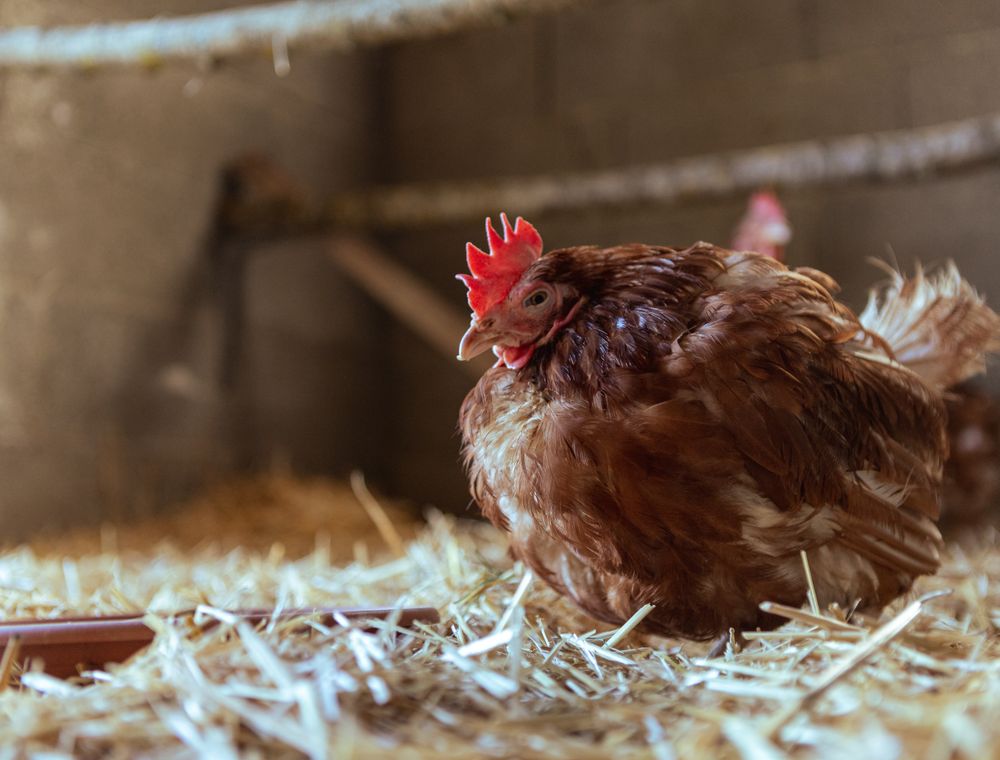
Short answer: An egg-bound hen has an egg stuck in her oviduct and cannot pass it. She strains, sits hunched or keeps going back to the nest with nothing to show for it, and she often stops eating. Keep her warm, quiet and apart from the flock, and call your vet the same day, because a stuck egg can break inside her and become fatal within a day or two. Follow your vet's advice on any treatment.
Key takeaways
- Egg-bound means an egg is stuck. It is an emergency, not a wait-and-see problem.
- Straining, long nest visits and hunched sitting are the signs to act on, especially if she has stopped eating.
- Never squeeze the belly or pull at the egg. You can break the shell inside her and make things far worse.
- Soft shells, short calcium, extra weight and a first egg are the usual background causes.
- Call early. A vet has far more options with a hen who is still bright than with one who has been down all night.
She has been in the nest since breakfast
Every layer house has a hen like this. She goes into a nest box in the morning, sits, stands, sits again, and comes out an hour later with nothing. By noon she is on the floor under the nest boxes with her feathers fluffed and her tail up. Most farmers assume she is broody. Some are right. Others have a hen with an egg stuck in her, and that hen needs you within the hour.
The difference matters more than the label. A broody hen wants to sit on eggs, puffs up and growls when you reach for her, and eats and drinks when she gets off. An egg-bound hen is in pain. She strains with visible effort and usually stops eating. If you are not sure which one you have, look at her again that morning rather than the next.
How an egg gets stuck
A hen forms an egg roughly once a day. The yolk is released, the white and membranes build up in the oviduct, and then the shell is laid down in the last section before the egg passes out through the cloaca and the vent. The whole trip takes many hours. The muscles of the oviduct squeeze the egg along in waves, and a healthy hen barely notices.
An egg gets stuck when that squeezing fails or the way out is too small. The shell may be soft or wrinkled, which makes the egg grip the passage. The egg may be unusually large, or a double yolk may travel together. The muscles may be weak in a hen that is run down, overweight, short of calcium or simply laying for the first time. Less often, an infection or a broken egg inside the tract blocks the route. Each of these ends in the same place: the egg stops moving, and the hen cannot push it out alone.
Reading the signs
Egg-bound hens show a set of signs that repeat from bird to bird. Look for several at once rather than one alone.
- Repeated visits to the nest box with no egg, sometimes for an hour or more.
- Standing hunched with feathers fluffed, tail held down, or tail pumping up and down.
- A lower belly that feels full or firm.
- Refusing feed, drinking less and standing apart from the flock.
- Visible straining with the vent open, sometimes with a little blood on the feathers.
Count the signs. One of them on its own could be a broody hen, a bad morning or a fright. Three or four together means you act now.

Broody, prolapsed or stuck: how to tell them apart
Several conditions look alike from across the house. Use this table before you decide.
| Condition | What you see | What separates it |
|---|---|---|
| Egg-bound | Straining, long nest visits, hunched, not eating | Hard egg sometimes felt low in the belly; no egg after hours of effort |
| Prolapse | Wet pink or red tissue outside the vent | Soft, moist tissue that bleeds when touched, with no shell |
| Broody hen | Sits on the nest, puffs up and growls | Eats and drinks when she gets off, returns to the flock, does not strain |
| Internal laying or yolk peritonitis | Swollen belly, weight loss, dull and sleepy | The whole belly is swollen and heavy, not only the lower part |
The belly tells you the most. A stuck egg makes the lower belly feel full. A broken egg or a yolk problem makes the whole abdomen swell over days, and the hen gets duller rather than more distressed.
If what you are looking at is tissue rather than a shell, read our guide to prolapse in laying hens, because the first steps are different.
What usually sits behind a stuck egg
Calcium comes first. In the hot months many hens eat less, and the calcium they miss in the ration is the calcium their shells lack. Soft shells are the easiest egg to get stuck. A layer ration with proper calcium, plus oyster shell in its own container, lets a hen top up when she needs it. We explain the numbers in the calcium and oyster shell guide. The ration side is in our layer feeding guide.
Weight is second. A hen who has grown fat in the house has less room for the egg to pass, and fat around the oviduct narrows the way out. A pullet who comes into lay heavy is at risk in her first months. Our point-of-lay pullets guide sets out what a good pullet should look like before she starts.
The first egg is a third cause. A pullet lays her first egg through a passage that has never been used before, and some of them struggle. Most manage, but a pullet still standing in the nest after several long sessions needs a check that day.
Finally there is the house. Where water runs short in a hot spell, or where cold, damp nights leave birds huddled, egg movement slows. Water and temperature matter more than most farmers expect. In the hot months the same pattern shows up in our guide to keeping layers laying through the heat.
The first hour, step by step
You have a hen who is probably in pain and may be in danger. In the first hour, aim for calm, warmth and a clear decision with your vet.
- Lift her gently and move her out of the flock into a quiet, dim pen.
- Keep her warm, not hot. A box with soft litter, out of draughts, works well.
- Look at the vent. Is an egg showing? Is it moving? Is there any bleeding?
- Note the time you first saw her straining and the time you isolated her.
- Give her clean water in a shallow dish. Do not force feed.
- Call your vet now, while she can still be helped, and follow your vet's advice on what to do next.
Some farmers try a warm bath or a little lubricant on the outside of the vent to help the egg slip. Some vets advise it and others do not, so ask first. Never press or squeeze the belly, and never pull at the egg. A broken shell inside her is far worse than a delayed egg.
Three mistakes that kill hens
The first mistake is waiting until morning. A hen who has been straining all night has used up a great deal of her strength, and the vet has less to work with by the time you call.
The second is squeezing. Pressing the belly to force the egg out can rupture the oviduct or break the shell inside her. The third is giving her anything from a shelf without a vet, including human painkillers and leftover medicines from another flock. Ask your vet what, if anything, is right for her.
A fourth mistake is leaving her in the flock. Other hens peck at a bird that sits hunched and quiet, and a straining bird can have her vent torn by a pecking neighbour. Separation is part of the treatment, even before the vet arrives.
Need chicks for your next batch?
Send breed, number and town. We reply with price, hatch date and delivery cost in writing.
When to call the vet, and what to have ready
Call the same day every time you see straining with no egg after an hour or two. Call at once if the hen is weak, if the vent is bleeding, or if you can see tissue or shell at the opening that will not move.
When you phone, have these ready: the age and breed of the hen, how long she has been straining, whether she has laid today, what she has eaten, whether other birds show signs, and her weight if you have a scale. Photographs of the vent and the belly help as well. A good vet can often decide quickly whether she needs to be seen or can be managed by you under instruction.
Some vets give an injection to help the uterus contract and move the egg along. Others decide that a hen is too far gone, and that a quick, humane end is the kinder choice. Whatever the decision, follow your vet's advice, and ask what to watch for that evening, because she may need checking again.
If she is weak but still alive while you wait, our guide to what to do with a sick chicken covers isolation and observation.
The egg that breaks inside her
Some egg-bound hens die even after help, because the egg broke inside her. Yolk and shell fragments set off inflammation in the belly, and the hen can go down over the next day or two, often with a swollen abdomen and no obvious straining. Vets call this egg yolk peritonitis. It is one of the main reasons a hen that seemed to be coping suddenly gets worse.
You cannot see it from outside, which is why her belly and her behaviour matter. If she appears to recover from straining but then sits hunched, swollen and weak, go back to your vet. Keep her apart and warm, and keep water within reach.
When a hen dies this way, the vet may want to look at her body. That is useful. It tells you whether she had a stuck egg, a broken egg, an infection or a bigger problem for the flock. Ask your vet whether a post-mortem is worth the cost in your case.
Keeping the nest room safe
You cannot stop every hen from having a difficult egg, but you can lower the number a great deal by getting the basics right in the lay house.
- Keep layer ration in front of the hens at all times, with oyster shell in a separate container.
- Check the water lines every morning, and top up the drinkers again on hot afternoons.
- Weigh a sample of hens weekly, so a flock that is getting fat shows on paper before it shows in the nests.
- Watch pullets closely in their first two weeks of lay, especially in the morning.
- Keep nest boxes clean, dry and dim enough that a hen feels private enough to settle.
- Remove broken eggs and any eggs with soft or wrinkled shells from the nests each time you collect.
Hot spells need the most care. Hens drink less and eat less calcium when it is hot. In the harmattan, dust builds up on drinkers and feeders, so wipe them down and check that every bird can reach water. Our record keeping guide shows how to log weights and lay so the trends show up early.
The cost of a stuck egg, in numbers
Put a number on it. Say you keep 500 hens and lose two of them a month to egg binding. A hen that dies at 30 weeks has eaten far more feed than the chick she came from cost you. A Hy-Line Brown chick from us starts at GH₵23, and sold in a box of 50 the box is GH₵1,150. Two hens a month for a year is 24 birds, which is a lot of feed and a lot of lost lay.
The lost eggs add up too. A hen in peak lay gives around 0.85 eggs a day. Losing two hens a month costs about 51 eggs a month, which is 1.7 crates of 30. At GH₵50 a crate that is roughly GH₵85 a month, or about GH₵1,000 a year, before feed and replacements. Set that against a weekly weigh-in, a calcium routine and a few minutes of morning checking, and the sums are not close.
If you are restocking after losses, our layer chicks page has the current prices, and you can place an order on the order form. For questions about a batch, WhatsApp +233 24 915 1503.
Questions farmers ask
How long can an egg-bound hen live?
It depends on whether the egg is simply stuck or has broken inside her. A stuck egg caught early can often be freed within a few hours with vet help. A hen with a broken egg can decline over a day or two. Without help, many do not survive a full day of straining. That is why same-day calls matter, and why waiting until the next morning is a real risk.
Can I break the egg to get it out?
No. Breaking the shell inside the hen spreads sharp fragments and yolk through the body cavity and can kill her faster. Do not poke or pull at the vent. Leave a stuck egg to your vet. If the egg is partly out with the shell intact, your vet will tell you whether to help it along and how.
Will she lay again?
Often, yes, if she is treated early and nothing is broken inside. Give her a few days of rest, clean water and soft feed, and watch her lay pattern. A hen who has been egg-bound once is more likely to have it again, so look at her weight and her calcium intake first.
Is oil the answer?
Some vets suggest a little lubricant on the outside of the vent to help the egg slide. It can help a little, but it is not a cure, and it makes a mess. Ask your vet before you use anything. Never put anything inside the vent yourself, and never use a product your vet has not approved.
Can pullets get egg-bound on their first egg?
Yes. The first egg is the most common time for a young hen to struggle, because her passage is new and her first eggs can be large. Check any pullet who stays in the nest after several sessions. Keep feed and water near the nest room, and make sure older birds are not crowding the nest boxes she needs.
Does bad feed cause egg binding?
Feed contributes, mostly through calcium. A ration short of calcium, or a flock that eats too little of it in the heat, makes soft-shelled eggs that stick. Too much energy makes hens fat, which narrows the passage. Check the date on every bag, store feed dry, and keep calcium available at all times.
Should I cull an egg-bound hen?
Not automatically. A hen who is freed and recovers can keep laying. A hen with repeated egg binding, or one who is weak and not improving with vet care, is often better culled humanely. Your vet will help you decide, and you should not leave her to suffer while you wait.


