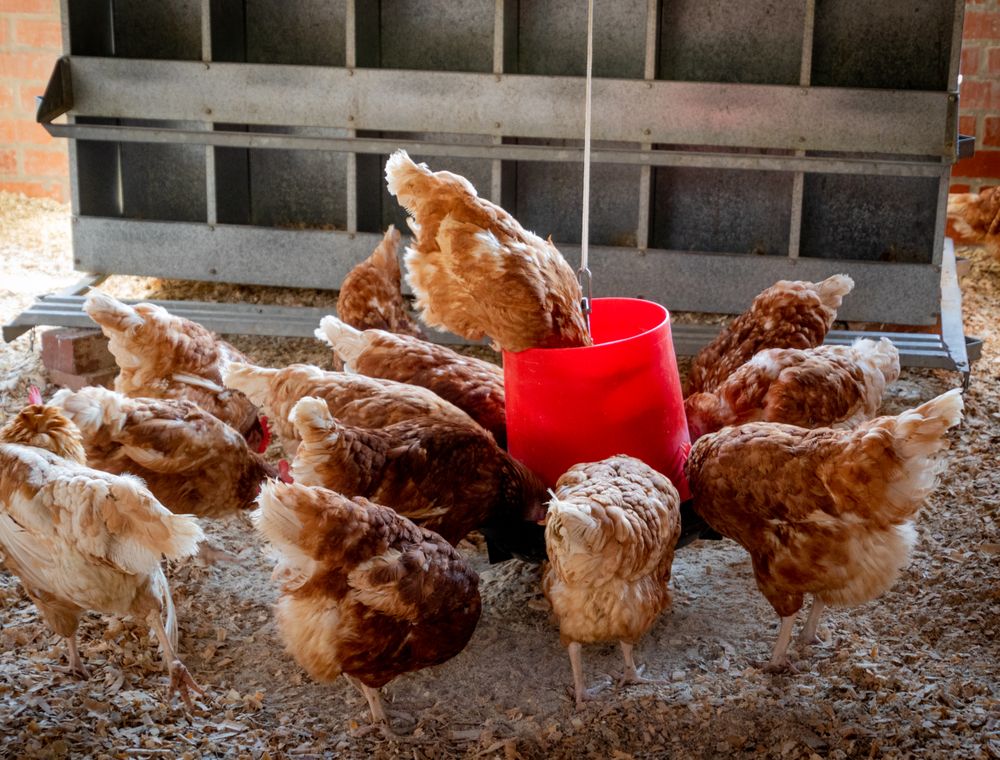
Short answer: Feed wastage shows up on the floor under the feeders, in bags that split in the store, and in the rats that live off both. Measure it with a simple sweep test, then fix feeder height first, fill pans part way, and store feed sealed and off the floor. A weekly check stops the leak coming back.
Key takeaways
- Measure your spill with a sweep test before you spend anything on new equipment.
- Set the feeder rim at the back height of your birds, and raise it as they grow.
- Fill pans part way and top them up often, so the feed stays fresh and birds cannot throw it out.
- Keep bags and bins sealed, off the floor and away from rats.
- Keep drinkers from dripping onto the feed, and keep feeders out of the wet.
Start with the floor under the feeder
Walk the house at seven in the morning, before the birds have settled. Look at the litter under and around the feeders. A light fan of feed around the pan is normal. A thick crust of mash on the floor, a line of spilt pellets along the wall, or birds that have clearly been picking at the litter for an hour is money on the ground.
Spilt feed is not a theory. It is a bill you have already paid. Every kilo a bird scratches out, every bag a rat chews through and every wet clump a drinker drips onto is feed you bought and will never see again. The good news is that most of it can be fixed with a tape measure, a few hours of work and a habit of checking the house every day.
Measure the leak before you change anything
Before you buy a new feeder or move anything, measure what you are losing. Guessing leads to the wrong fix. The method needs only a bucket, a scale, and a notebook.
- Record the weight of feed in the bins on the day of delivery, so you know your starting figure.
- Pick a set length of feeder line, say five metres, and mark it out.
- Each morning for a week, collect every bit of spilt feed from the floor under that section, and weigh it.
- Scale the weekly total up to the full length of feeder line to get the spill for the house.
- At the end of the cycle, weigh what is left in the bins and compare it with the feed in and the intake you would expect from the birds.
The gap between feed in and feed eaten is your total loss. Spill under the feeders is one part of it. Rats, damp, dust and bag handling make up the rest. Splitting the loss into those parts tells you where to start.
Feeder height is the fault most farms have
Most of the feed we see scattered on the floor comes from feeders set at the wrong height for the birds using them. A feeder set too low lets birds stand in the pan, scratch the feed out and drop droppings into it. A feeder set too high makes birds reach up, and what they pull out falls on the floor. Both are wasteful, and both are easy to correct.
The working rule is to set the rim of the feeder at about the level of the bird's back. For layers, that puts the rim level with the back of the hen, so she can reach in with her head but cannot step inside the pan. For broilers and young birds, set the feeder low enough to reach, then raise it as the birds grow, so the rim keeps pace with the backs of the flock. Check the height every few days, and raise the feeder when you see birds stretching up or standing in the pan.

Chicks need something different. In the first days, use flat trays or paper on the floor under the feed, with chick-sized feed on it, and remove the paper once the birds can reach a proper feeder. Chicks that wade in the feed scatter more than they eat. Our chick starter guide covers what goes in those first trays.
Feeder types and where each one leaks
Every feeder type has its own leak. Know which one you have, and you will know where to look first. Our guide to feeders and drinkers covers how many of each you need, and this table covers where they lose feed.
| Feeder type | Where it leaks | Simple fix |
|---|---|---|
| Round or long pan feeder | Birds scratch over the rim, stand in the pan and kick feed out | Fit a grill or lip over the pan, fill part way, and set the rim at back height |
| Hanging tube feeder | Overfilled tubes spill at the base, and swinging feeders throw feed sideways | Keep the tube filled only to the cone, and hang it level at the birds' back |
| Long open trough | Scratching throws feed out of the sides, and rain or drinkers wet it | Wire the trough with a grill, and keep it under cover away from the drinker line |
| Chain or auger line | Overfilled hoppers, jammed chains, and feed thrown out at the turns | Set the fill by timer, check the line at each turn, and keep the hopper dry |
| Improvised floor tray or sack | Wet, trampled, dusty and easy for rats to reach | Replace it with a proper feeder as soon as the budget allows |
How full to fill, and how often
Full feeders are not full feeders. A pan piled to the brim lets birds throw the top layer out before they have eaten it, and the feed at the bottom goes stale because the birds never reach it. A pan filled to about a third or half, and topped up often, keeps the feed fresh and the waste down.
Fill twice a day, or more often in the heat. Small, regular fills mean every bird has fresh feed in front of it, and nothing sits long enough to damp, heat or draw insects. Empty feeders at night are normal. What you want to avoid is a pan still full at dusk, because that feed has been sitting for hours.
Check for feed clinging to the bottom of the pan at the end of each day. If there is a layer of old mash on the base, scrape it out and throw it away rather than piling fresh feed on top.
Bags, bins and the trip from store to shed
Some of your loss happens before the feed reaches the house. Bags tear when they are dragged across the yard, and sacks split when they are stacked too high or thrown off a truck. Bins leak when the lid does not close, and a scoop left on the ground collects a little from every visit.
- Lift bags, do not drag them, and keep the stack no higher than the bags below can carry.
- Put bags on pallets or bricks, off the floor, against a wall where you can walk round them.
- Keep a lidded bin in the house, and fill it from the bag in one go rather than scooping at the feeder.
- Keep one scoop per bin, kept inside the bin, so nobody leaves it on the ground.
- Check each bag on arrival for tears, damp patches and a sweet, musty smell.
Track bag weights when they come in. If your 50-kilogram bags regularly weigh a little under, the loss is happening between the truck and the store, and the supplier should hear about it. Our feed storage guide covers how to keep bags dry and mould-free once they are through the door.
Pests: rats, mice, birds and ants
Rats follow spilt feed, and they will chew through a bag with a corner open. A rat in the store does more harm than a bucket of spill, because it wastes feed and leaves droppings in what is left. Mice get into bins through gaps the size of a pencil. Weaver birds and pigeons pick at open bags and spilt grain. Ants and cockroaches gather in damp corners and along feeder lines.
The fix is a mix of habits. Keep feed in lidded bins, keep bags off the floor, clear spill from under feeders each morning, and seal the gaps around the store. Sweep the store floor and the wall edges weekly, and keep weeds and rubbish cleared from around the buildings. Talk to your vet or a pest control supplier about rodent control, and use only the methods they recommend. Keep any bait well away from feed and birds, and check bait points regularly.
A rat seen once in daylight means there are more. Do not wait for the feed bill to tell you so.
Wet feed from drinkers, rain and condensation
Wet feed is wasted feed, even when the birds still eat it. A drinker that drips onto a feeder turns the top layer into a crust, and birds will not eat that part. In the rains, wind-blown rain gets under sidewalls and into open troughs. In cold weather, condensation on the roof drips onto feeders in poorly ventilated houses.
Walk the drinker line every morning and look for drips, leaks and overflow. Raise feeders away from the drip line, and check that nipple or bell drinkers are set at the right height for the birds. Keep feeders under cover, and clear out any feed that has gone damp. Damp feed does not just waste money. It goes mouldy, and the mould can put toxins into the birds. Our water management guide covers the drinker side, and it is worth reading alongside this one.
Need chicks for your next batch?
Send breed, number and town. We reply with price, hatch date and delivery cost in writing.
Scratching birds and free range
A bird that scratches for food throws it out of a feeder faster than any other fault. Scratching hens and local birds do it on purpose, and they do it well. If your flock runs outside, give them feed at fixed times, in a covered feeder or a trough with a lid, and pick up what is left before dusk. Feeding in the same spot each day trains the birds to come to the trough, rather than scratch the whole run for their meal.
Birds fed on open ground spread mash over a wide area, and some of it is lost to rain and ants before it is eaten. Feed in shelter where you can, and do not scatter a day's ration in one go. A few small feedings cost less than one big scatter. Our deep litter guide explains how to keep spilt feed from building up in the house bedding, which is the other place it hides.
A worked example: a 500-bird house
Say a house of 500 broilers uses about 1,000 kilograms of feed in a week in the middle of the cycle. The house has 40 metres of pan feeder. The farmer sweeps the floor under five metres of it every morning for a week and collects 1.2 kilograms of spilt feed. Scaled across the full 40 metres, that comes to about 9.6 kilograms in a week.
That is roughly one per cent of the week's feed. For a house in good order, that is a fair figure, and there is no need to panic. Now suppose the same farmer finds 3 kilograms of spill along the same five metres in a week. Scaled to the house, that is about 24 kilograms, or 2.4 per cent. That is a fault worth fixing this week.
The fault is usually feeder height. In this house, the pan rim was set about a hand's width too low for the older birds, so they stood in it and kicked feed out. Raising the rim and fitting a grill brought the sweep back to about 1.5 kilograms the following week. The fix cost an afternoon and a few metres of wire, and the sum behind it cost nothing but a bucket and a scale.
Mistakes that cost more than the fix
The first mistake is cutting the feed to stop the waste. Underfed birds grow slowly, and the feed you saved comes back to you as lost weight. Fix the feeder, not the ration.
The second is overfilling feeders because the birds look hungry. Birds look hungry when a feeder has just been emptied, and they scratch harder when a pan is dusty and bare. Fill small and often rather than piling the pan.
The third is buying a cheap feeder without checking its height and fill. A new pan in the wrong place still wastes feed, and it can waste more, because the birds have more room to kick it out.
The fourth is ignoring the bag on arrival. A torn or damp bag at the door is loss you can prove, and the supplier can replace it. A bag you find three weeks later under a stack is loss you cannot claim back. Keeping a simple record of feed in and feed out, as our record-keeping guide suggests, is how you catch these problems early.
A weekly wastage checklist
Do this once a week, and write the numbers down.
- Feeder rims are set at back height, and raised as the birds grow.
- Pans are filled part way, and topped up at least twice a day.
- The floor under the feeders is swept, and the spill weighed for a set length.
- Bags are stored off the floor, sealed, and checked for damp and tears.
- Bins are lidded, the scoop is kept inside the bin, and there is no feed on the ground.
- The drinker line is checked for drips, and feeders are kept out of the wet.
- Rat signs are checked, bait points are checked, and gaps in the store are sealed.
- Feed in, feed out and spill are recorded, and the weekly wastage figure is worked out.
If your numbers still do not add up after a month of this, our questions page covers the usual causes, or you can WhatsApp us on +233 24 915 1503 and describe the house.
Questions farmers ask
How much feed wastage is normal?
We would not quote a figure for everyone, because it depends on the house and the feeder. On a well-set house, around one per cent of the feed a week is a fair target. Several per cent points to a fault worth finding this week. Track your own figure for two or three cycles and compare it with your last cycle, because that tells you more than any rule of thumb.
Should I feed less to stop the waste?
No. Cutting the feed slows growth and moves the cost from the floor onto the birds. Fix the feeder height, the fill and the store first. If you are short of feed money, talk to your supplier about a plan that fits your budget. Reducing the ration to save on waste is the most expensive way to fix a cheap problem.
Are pellets or crumbles better for wastage?
Usually, yes. Pellets and crumbles are harder for birds to throw out and pick through, so they spill less than mash. The trade-off is price per kilo, and the risk of crumbling and dust in a damp or rough store. Compare the cost of the feed the birds actually eat, not the cost of the feed you buy, and our <a href="/blog/layer-feeding-guide-ghana/">layer feeding guide</a> looks at the mash-versus-pellet question in more depth.
How do I stop chicks scratching the feed out?
Use a shallow tray or paper under the feed at first, with a small amount of chick feed on it, and refill it often. Keep the feeder low enough for chicks to reach without standing in it. Remove the tray once the chicks are using a proper feeder, and check the litter around the brooder for scattered feed each morning.
Do rats cause much harm on a farm?
Yes. Rats eat feed, contaminate what they do not eat, carry disease and chew through bags. Signs include droppings near the store, gnawed bag corners and runs in the litter or along walls. Keep spill cleared, bags off the floor and gaps sealed. Ask your vet or a pest control supplier which rodent control methods they recommend, and keep bait away from feed and birds.
Can I reuse feed the birds have scratched out?
Not as feed for the same flock. Feed that has been on the litter is mixed with droppings, dust and bedding, and it may carry disease or mould. Sweeping it up and throwing it away is the right call. Clean, dry spill from a clean tray can go back into the feed if it is checked first, but when in doubt, throw it out.
What is the quickest fix I can make this week?
Check the feeder height against the backs of your birds, and raise or lower the rims to match. Fill the pans part way and top them up twice a day. Then sweep under one feeder, weigh what you collect, and compare it with the same section next week. In a house that has been running with feeders too low, the height change alone can cut spill a great deal.
Do chain feeders waste more than pan feeders?
Not inherently. A chain feeder set up well and kept filled to its design level can waste very little. The trouble starts when the chain is overfilled, the turns throw feed out, or the line runs with nobody checking it. Walk the line, check the fill, and watch the first few metres at each turn. Our <a href="/blog/choosing-feeders-drinkers-ghana/">feeder and drinker guide</a> compares the types in more detail.


