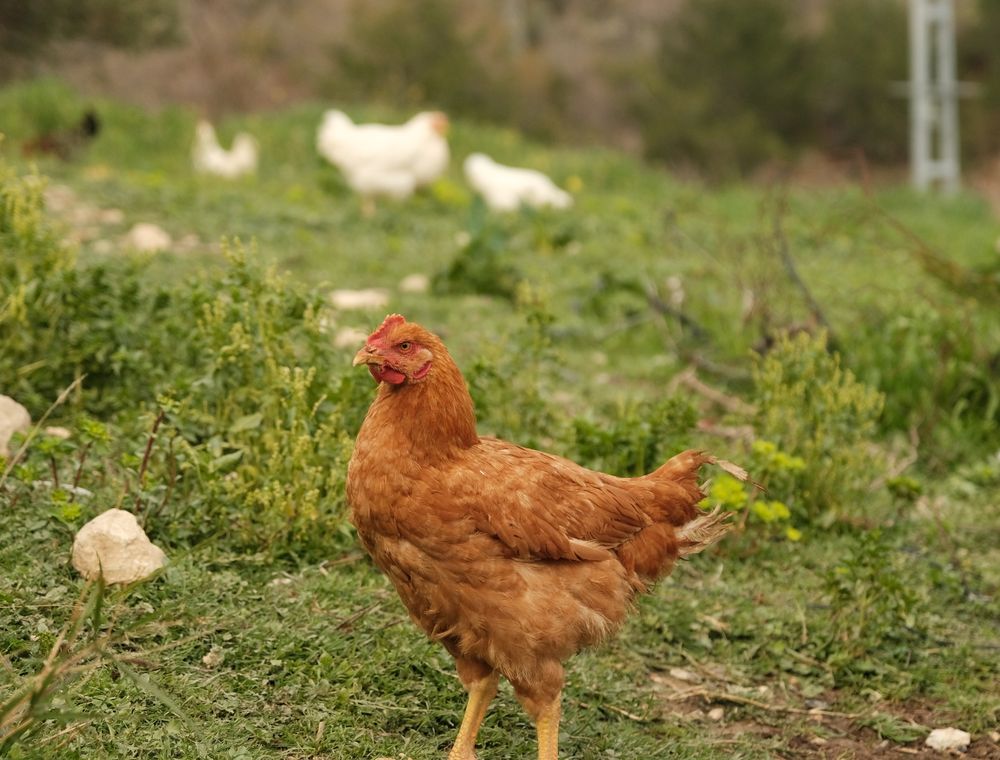
Short answer: The naked neck chicken carries a dominant gene that thins the feathers on its neck and upper body, so it sheds heat faster than a fully feathered bird. A well-kept hen typically lays around 150 to 180 brown eggs a year and weighs about 2.5 kg, while a cock reaches about 3.5 kg. In Ghana it suits free-range compound flocks, but it still needs shade, clean water and protection from sunburn and predators.
Key takeaways
- The bare neck sheds heat only when the bird can also reach shade.
- Expect roughly 150 to 180 brown eggs a year from a well-kept hen, and fewer from a hot or underfed flock.
- Mature hens weigh about 2.5 kg and cocks about 3.5 kg, so this is a dual-purpose bird, not a broiler.
- Bare skin burns. Check necks and backs after every dry spell.
- Build the coop for airflow and a cool roof before the birds arrive.
- Naked neck chicks are not on our standard price list, so ask us on WhatsApp before you plan around them.
Why a bare neck helps on a Kasoa afternoon
Put a fully feathered hen and a naked neck hen side by side in a yard at noon in March and watch what happens. The feathered bird finds the one patch of shade under the mango tree and stays there with its wings held a little out from its body. The naked neck bird keeps scratching in the sun as if nothing is wrong.
The reason is simple. Feathers trap warm air against the skin. That is exactly what you want on a cool harmattan morning, and exactly what you do not want when the air in a Kasoa compound climbs past 33 degrees. The naked neck gene is dominant, and it thins the feathering on the neck and upper body. The result is a patch of bare skin that lets heat leave the body faster. It is not a cooling system. It is simply less coat.
We tell farmers two things about this trait. First, the bare neck only helps if the bird can also get out of the sun. A naked neck hen standing in full noon sun on a bare tin roof is hotter than a feathered hen resting in a dark shed. Second, the trait pays off most for birds that spend the day outdoors, which is why it is common in the village flocks of hot parts of the country.
Bare skin is a double-edged tool. It sheds heat, and it also burns. We come back to sunburn later, but if you remember one thing from this section, remember that shade is the partner of the bare neck, not an optional extra.
Where the naked neck came from, and why nobody agrees
Ask three poultry people where the naked neck originated and you will get three answers. The most common account places the best-known line, the Transylvanian Naked Neck, in the Carpathian region of Romania, with close ties to Hungary. Breeders there kept birds with the bare neck and a sturdy, dual-purpose body, and the birds travelled widely from that region over the following decades.
The trait itself is older than any named breed. Naked neck birds turn up in village flocks across Asia, the Middle East and Africa, and farmers in hot climates often kept them without ever hearing a breed name. The gene gave the bird its look, and generations of selection for heat tolerance and for hardiness on scraps did the rest.
For a Ghanaian farmer the history matters less than the outcome. The naked neck you see in a compound may be a pure line, a village cross, or a bird with only a little naked neck blood in it. Our local chicken ecotypes guide covers the village types in more detail, and it is worth reading if your flock is already mixed.
What this means in practice is that a bird which looks like the picture in a book is not guaranteed to behave like one. Buy from a source that can tell you what the parent stock is, and expect some variation in size and colour from one bird to the next.
What a naked neck hen lays and weighs
A naked neck is a dual-purpose bird. It will not match a commercial layer or a broiler, and it was never meant to. These are the figures most breeders quote for a well-kept bird. A hot, underfed or poorly housed flock will fall short of them.
| Measure | Naked neck hen | Naked neck cock |
|---|---|---|
| Mature live weight | About 2.5 kg | About 3.5 kg |
| Eggs per year, good management | About 150 to 180 | Not applicable |
| Egg colour | Brown | Not applicable |
| Age at first egg | Around 5 to 6 months | Not applicable |
Two things about those numbers. The egg count assumes the hen is getting enough protein during the rains and is not spending her day in full sun. Take away shade and water and the count slips, usually well before you see any disease. Second, the weight matters more to a family than to a hatchery. A 2.5 kg hen cooked slowly for a Sunday pot is a proper meal, but she is not a fast cash crop.
Feed intake is about what you would expect for a medium bird. A laying hen eats roughly 100 to 120 grams a day in mild weather and more when the heat is on, because the body burns energy to keep itself cool. Plan your feed bill around the hot months, not the cool ones.
Temperament: alert, bold and not a lap bird
Naked neck hens are alert. They spot a hawk or a stray dog before most birds notice the shadow, and they run for cover quickly. They forage well, working through leaf litter and turning over the insects in dung, which is useful in a yard where you are not buying much feed.
Do not expect a pet. Most naked neck birds tolerate you walking past with a bucket, but they will not sit in your lap. Cocks can be firm with each other, and with children who chase them, so keep the flock calm. Keeping one cock with a small group of hens usually works better than a crowded pen of cocks, because rival cocks spend the day fighting instead of feeding.
Hens are steady layers rather than dedicated sitters. A naked neck hen will sometimes go broody, but she is not a reliable hatcher, and you should not plan a hatch around her mood. More on that in the breeding section below.
A coop that breathes: shade, airflow and the tin roof problem
Most Ghanaian backyard coops fail on heat before anything else. A single sheet of tin with no ceiling turns the house into an oven by mid-morning. A closed plywood box traps the ammonia from wet litter overnight, and by dawn the birds are breathing it in.
For naked neck birds we want three things. The roof should stay cooler than the sky. The sides should be open enough to move air across the perch. And the run needs shade that every bird can reach at noon without crowding. Thatch, palm, or a shade cloth over a metal frame all do the job. A double roof, with a gap between the sheet and a ceiling, beats a single sheet every time.
At night the harmattan brings cool, dusty air, and many farmers shut everything tight to keep out the chill. Do not. A bird roosting in a sealed box breathes its own damp air all night, and that is how respiratory trouble starts in the dry season. Close the lower part of the wall on the side facing the wind, and leave the top open.
- Roof: double or shaded, never bare tin over the roost.
- Walls: half open, with the closed side facing the prevailing wind.
- Roost: about 20 cm of perch per bird, raised above the litter.
- Run: enough shade that every bird can stand in it at noon.
Sunburn, mites and the skin you can actually see
Bare skin changes the list of things you have to check. A common problem in naked neck flocks is pink, peeling skin on the neck and back after a dry, bright spell. That is sunburn, and it hurts. A hen with sore skin stops eating properly, and her egg count drops before you notice the cause.
The fix is shade and a dust bath in a shaded spot. Keep the dusty patch out of direct sun. In harmattan the fine dust is everywhere, and a naked neck bird with dust settled into its bare skin looks grubby, but the real concern is parasites hiding in the bald patches.
Mites and lice are easier to spot on a naked neck than on a feathered bird. Look under the wings and around the vent in the evening, when the birds are on the roost. If you see crawling dots or grey crusts on the skin, call your vet and follow their advice on treatment. Do not improvise with household sprays on live birds. Your vet's schedule for worming and external parasite control belongs in the same notebook as your vaccination dates. Our worming guide covers the internal side of the same routine.
A weekly check takes about ten minutes:
- Look at the neck and back for pink, peeling or scabbed skin.
- Lift each wing and check the armpit for moving parasites.
- Check the vent for dirt, droppings or swelling.
- Confirm the dust bath is in shade and filled with dry, loose soil.
- Note any bird that stands apart from the flock.
Feeding a compound flock without wasting feed
Most naked neck flocks in Ghana scavenge a good part of their diet: kitchen scraps, insects, weed seed and the grain spilled from a market basket. That helps. But scavenging is unreliable in the rains, and a hen that has spent the afternoon in the sun will not find enough food by herself.
A practical plan is to put layer mash or a balanced feed in a covered feeder each morning and let the birds scavenge the rest of the day. Keep oyster shell or crushed shell in a separate dish. Layers need calcium for strong shells, and they will eat the shell when they need it. Put clean water within a few steps of the feeder. Water is the one input you cannot skip.
Here is a worked example for a family flock of twelve hens. At 110 grams a hen a day, that is 1.32 kg a day, or about 40 kg over a 30-day month. If the hens scavenge a third of their diet, you buy roughly 26 kg of mash a month instead. The figure moves with the weather. A hot fortnight pushes intake up, and a wet fortnight pushes scavenging down, so weigh a week of feed and adjust.
Feed formulation is a deeper subject, and our feed formulation basics guide covers it. If you buy ready mash, check the protein and calcium on the bag before you buy in bulk, and keep the bag off the damp floor.
Predators around a Ghanaian compound
A naked neck hen is not more vulnerable to predators than any other village bird. She is simply more exposed, because she spends her day on open ground in the sun. That is the trade. The shade you give her in the day is also the cover a predator uses to approach.
The usual suspects around our area are stray dogs, cats, rats, mongooses and the occasional hawk. Snakes take chicks and young birds, and a flock that roosts low is an easy meal for a snake or a rat. Raise the roost, close the coop at dusk, and check the walls for gaps wide enough for a rat to slip through.
Most flock losses at night come down to one gap or one door left open. Walk the perimeter every evening before you lock up. It takes five minutes, and it saves more birds than any expensive coop feature.
Need chicks for your next batch?
Send breed, number and town. We reply with price, hatch date and delivery cost in writing.
Breeding and crosses: what the chicks look like
If you are thinking of hatching your own naked neck chicks, two facts matter before you start. The first is that the trait is dominant, so about half of the chicks from a naked neck by normal feathered cross will show the bare neck. The second is that broodiness is not reliable, so plan on an incubator, or on a broody bird of another breed, for the hatch.
Crossing a naked neck hen with a local feathered cock can give you birds that keep some heat tolerance and gain a little size. That is a fair village strategy, and many compound flocks already carry the cross. It is not a purebred line, though. Keep records of which cock sired which chicks, or you will not know what you are breeding for by the second generation.
Incubation follows the usual pattern of 21 days, with turning and humidity managed as your incubator manual says. Chicks from a naked neck parent can look different from each other in the first week, so do not panic when a few of them have more down than the rest. Sort out the feathering over the first few weeks.
Mistakes that cost naked neck flocks their weight
Most problems with naked neck birds are husbandry problems, not breed problems. These are the ones that come up most often.
- Shutting the coop tight at night in the cool months and ignoring the ammonia smell by morning.
- Keeping the birds in full sun all afternoon with no shade in the run.
- Putting the only water container in the far corner of the yard.
- Feeding the same ration in March and August, when intake and heat stress differ a lot.
- Ignoring a bird with pink, peeling skin for a week because she still eats.
- Keeping several cocks together in one small pen.
Every item on that list is cheap to fix. Most of them cost nothing more than a second water container and a bit of shade cloth.
How a naked neck compares with a commercial layer
A naked neck is not a commercial layer, and it should not be judged as one. A Hy-Line Brown from a commercial hatch will lay far more eggs in a year, and she needs a feed plan and housing built around her. The naked neck earns its place on heat tolerance, scavenging and low-input keeping.
Here is the cost comparison in its simplest form. Our listed price for Hy-Line Brown chicks starts at GH₵23 each, so a box of 50 is GH₵1,150 before delivery. Sasso chicks start at GH₵13 each, so a box of 50 is GH₵650. A naked neck is not on our standard price list, so ask us directly if you want one. Every price is confirmed in writing before you pay, and you can see the full range on our day-old chick prices page. Delivery terms are set out on our delivery page.
The question to ask is what you want the birds to do. If you want the most eggs per bag of feed, a commercial layer is the right tool, and you can see our layer chick range. If you want a hen that copes with a bad harmattan week and a long rainy season on scraps and a shady run, a naked neck is worth the slower laying.
For a breed that sits between those two ends, our Sasso chicks are a useful reference point. Read our Sasso chick page before you decide. If the curly-feathered look interests you more, our frizzle guide covers a different kind of heat-shedding bird, and our breeds overview sets out the lines we work with.
Before you buy naked neck birds: a checklist
Work through this list before you order, and keep the answers in writing. It saves most of the regret we hear about from farmers who started a flock in a hurry. Our FAQ page answers the questions that come up most often.
- Decide whether you want eggs, meat, or a flock to hatch from, and write it down.
- Measure your shade. If the birds cannot all stand in shade at noon, build the shade before they arrive.
- Set out at least two water points, so one spill or one dirty bowl does not leave the flock thirsty.
- Build a roost with about 20 cm of perch per bird, raised off the floor.
- Ask the source what the parent stock is, and whether the birds are pure or crossed.
- Agree the vaccination and worming plan with your vet before the first bird arrives.
- Keep a notebook for egg counts, weights and any bird that looks off colour.
If you are ready to start, WhatsApp us on +233 24 915 1503 with your location and the number of birds you have in mind. We will tell you what we can source, and you can place your order through our order form.
Questions farmers ask
Is the naked neck a separate breed or a type of local chicken?
It is both, depending on who you ask. The naked neck is a gene that appears in many breeds and village populations, and there are named breeds such as the Transylvanian Naked Neck built around it. Most naked neck birds you see in Ghana are village birds that carry the trait. If the breed matters to you, ask the seller what the parent stock is, and expect some variation in size and colour.
How many eggs does a naked neck hen lay in a year?
A well-kept naked neck hen commonly lays around 150 to 180 brown eggs a year, according to figures quoted by breeders. A hen on poor feed, with no shade and constant heat stress, will lay fewer. A first-season hen can take a few months to settle into a steady rhythm. Track the count for a few weeks so you have your own baseline to work from.
Do naked neck chickens get sunburnt?
Yes. The bare neck and back can burn in direct midday sun, especially after a dry spell when the birds spend the day in the open. Shade in the run, a shaded dust bath and a weekly skin check solve most of the problem. Pink or peeling skin means you should move the birds into shade at once, and call your vet if the skin does not improve.
Are naked neck chickens good for meat?
They are a dual-purpose bird, so they give a reasonable carcass at the end of their laying life or at a suitable slaughter age. Cocks reach about 3.5 kg and hens about 2.5 kg when mature. They grow much more slowly than a commercial broiler, so do not expect a fast meat crop from a naked neck flock.
Can I cross a naked neck hen with my local cock?
You can, and many village flocks already carry the cross. The naked neck gene is dominant, so about half of the chicks from a naked neck by feathered cross will show the bare neck. Keep records of parentage so you know what you are breeding, and expect some variation in size and colour from one generation to the next.
Do naked neck hens go broody?
Occasionally, but not reliably. If you plan to hatch naked neck chicks, use an incubator or a broody bird of a different breed. Do not build a hatch around a hen's mood, because she may stop sitting halfway through the 21 days.
Where can I buy naked neck chicks in Ghana?
Naked neck birds are not on our standard price list, so we cannot promise a box of them. WhatsApp us on +233 24 915 1503 and we will tell you honestly whether we can source them. Our listed layer and Sasso chicks come with delivery to all 16 regions, and you can see the details on our delivery page.


