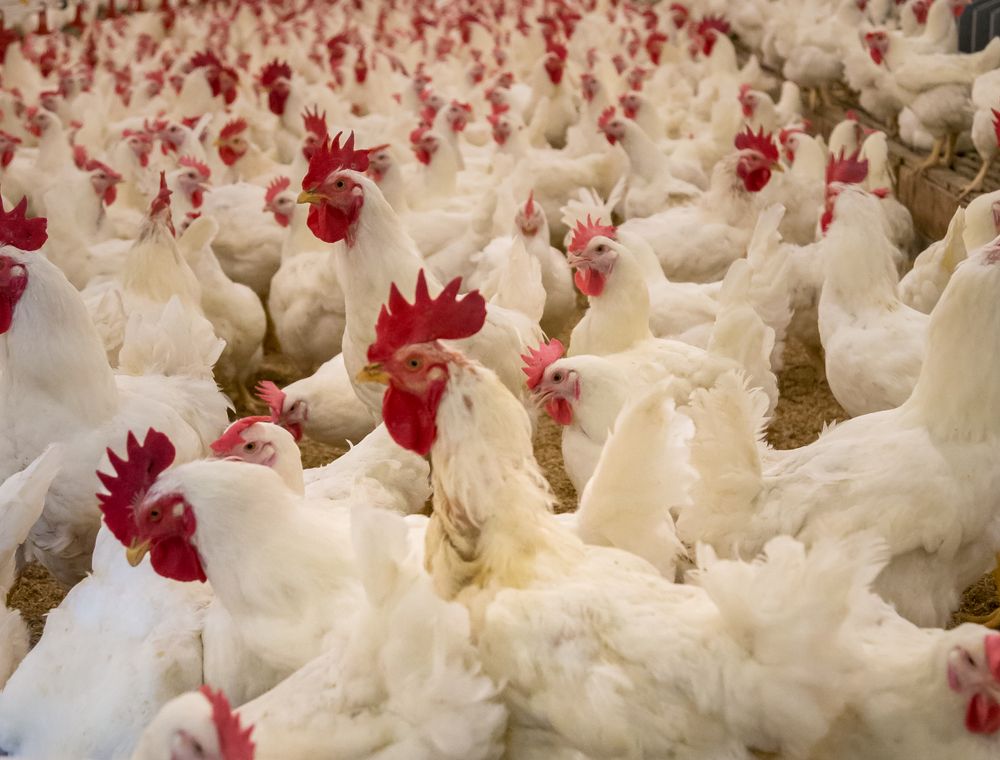
Short answer: In Ghana a fast white broiler house is usually planned at about 10 to 12 birds per square metre for a 2.3 kg sale, and fewer in the hot months. Plan by kilograms of live bird per square metre rather than by head count, because a 2.3 kg bird loads the floor with far more weight than a day-old chick. Measure the usable floor by pacing it out, then divide it by the density you chose for the season.
Key takeaways
- Measure the usable floor with a tape, not from memory. Take off the store, the passages and any corner you cannot stock.
- Plan by kilograms per square metre at sale. A flock of 2.3 kg birds at 12 per square metre carries about 28 kg of live bird on every square metre.
- Reduce the birds per square metre in the hot months. A house that carried 12 birds per square metre in the cool season may only carry 10 in the heat.
- If you can smell ammonia when you bend to bird height, the density, the litter or the ventilation is already wrong.
- Count feeders and drinkers against the final weight of the flock, not the number of chicks on arrival day.
- Stock from the house you have. A batch that is too big for the floor costs more than the chicks you had to leave out.
Density is a weight question, not a head count
Stocking density is how many birds share each square metre of floor. Farmers quote it in birds because birds are easy to count. The load on the house, though, is weight. The heat, the droppings and the ammonia all come from kilograms of live bird, and a kilogram of chick produces very little of any of them.
A day-old chick weighs about 40 grams. A broiler at 2.3 kg weighs more than fifty times as much. Put 12 chicks on a square metre and you have roughly half a kilogram of bird on the floor. Put 12 market-weight birds on the same square metre and you have about 28 kilograms. The house does not see the first as the same problem as the second, and neither does the fan.
That is why we talk about density in two numbers at once: birds per square metre to plan the chicks, and kilograms per square metre to judge whether the house can carry them at sale.
The planning table: birds per square metre by sale weight and season
The table gives planning figures for open-sided, curtained houses in Ghana with working fans. Treat the cool column as the months when the nights drop and the wind is steady. Treat the hot column as the dry spell before the rains and any stretch when the wind goes still. A house with a closed roof, a low ceiling or no fans needs fewer birds than these figures suggest.
| Sale weight (kg) | Birds per m², cool season | Birds per m², hot season | kg per m² at sale, cool | kg per m² at sale, hot |
|---|---|---|---|---|
| 1.6 | 14 | 12 | 22.4 | 19.2 |
| 2.0 | 13 | 11 | 26.0 | 22.0 |
| 2.3 | 12 | 10 | 27.6 | 23.0 |
| 2.5 | 11 | 9 | 27.5 | 22.5 |
Look at the last two columns before you decide. The kilograms per square metre stay within a narrow band across the rows, which is the point. The house has a load it can carry, and the birds per square metre simply shift to keep the load inside it. If your plan pushes the last column above 28 kg in the cool season, you are asking the house to carry more than most open-sided houses can carry in the hot months.
Working out the floor you need, step by step
Most density mistakes start with the floor measurement. A house that is 6 metres wide and 8 metres long sounds simple until you take off the parts birds cannot use. Work through it in this order.
- Pace or tape the inside of the house, from wall to wall, and write down the length and width.
- Take off the areas birds do not use: the feed store, the office corner, the entrance passage and any section you have walled off.
- Take off a strip along the walls if the curtains are open on a windy site and the birds crowd the edges. Only do this if you see crowding. Otherwise leave it.
- Divide the usable area by the birds per square metre you chose from the table.
Here is the sum on a real-sized house. A 6 by 8 metre shed gives 48 square metres. Take off a 4 square metre store and passage, and 44 square metres is usable. At 12 birds per square metre for a cool-season batch sold at 2.3 kg, the house holds 528 birds. In the hot season, at 10 per square metre, the same house holds 440. The difference of 88 birds is the number you must plan for, not the number you wish you could fit.
For a planned batch of 500 birds at 2.3 kg, the floor you need is 42 square metres in the cool season and 50 square metres in the hot season. A 5 by 10 metre house gives exactly 50, and that is the one to build or rent if the batch will run through the hot months.
Why a heavy flock turns the house into a heat source
Birds make heat in proportion to their body mass and how much they are eating. A broiler in week five produces many times the heat of a chick, and that heat has to leave the house through the curtains, the fans and the roof. The ventilation was sized for one load. Pack in more kilograms and the house does not get bigger.

Midday in the dry season adds the rest. Corrugated iron roofs soak up the sun and radiate it down, and a dark roof on a still afternoon can push the air at bird level well past the comfort range. That is when a flock that was fine at 12 birds per square metre in the cool season starts panting at 11. You do not need a thermometer to see it. Watch the birds spread to the walls and stand with their beaks open, and you are already past the point where density is the cause.
Our heat stress guide covers the signs in more detail and the fixes that do not cost much. The lesson here is simpler: density decides how much heat the house has to move, so the number on the planning sheet is also a cooling decision.
Ammonia: the density signal you can smell
Ammonia comes from wet droppings and urine breaking down in the litter. Density raises the output, and a wet corner under a drinker raises it further. Many guidelines put the ceiling at about 25 parts per million. That is a level you will not reliably notice as a smell, which is why the warning signs are the eyes and the airways rather than the nose.
Walk the house and bend down to bird height, the level where the birds breathe. If your eyes sting, if birds are blinking or watery-eyed in a row, or if the air catches in your throat, the house is over its limit whatever the table says. Cheap ammonia meters are worth owning if you are stocking heavy, and the reading belongs at bird height, not at the door.
Fix the source before you buy ventilation. Lower the drinker lines, repair the leaks, turn or replace the wettest litter and keep the curtains open enough to move the air. More fans on a wet floor just blow the ammonia around.
Feeders and drinkers have to match the final flock
A house can carry the right number of birds on paper and still be too tight once the birds are heavy. The reason is the equipment. Feeders and drinkers are counted against birds that are eating and drinking, and a heavy bird needs more access than a chick does. Count your equipment against the final number of birds you will sell, not the chicks on arrival day.
The broiler house setup guide sets out the equipment counts we use as a starting point, and it covers the transition from chick trays to the permanent feeders. For density planning the rule is the same. If the house is planned for 528 birds at market weight, the feeders and drinkers must serve 528 birds at market weight, even if the first week looks roomy.
Our broiler house setup guide is the place to check the equipment counts, and the poultry housing designs guide looks at the layout of the house itself, which matters as much as the number.
Mixed sexes and uneven flocks: count kilograms, not birds
A straight-run flock is a mix of males and females, and the males get heavier. That means two flocks of the same head count can carry very different loads. Five hundred birds that average 2.3 kg is a total of 1,150 kg. If the flock is 250 males at 2.6 kg and 250 females at 2.0 kg, the total is still 1,150 kg, so the house sees the same load. The difference shows up in the feeders, in the corners and in the sale, because the heavier males crowd the feed and the lighter females lose out.
If the flock is sexed, you can plan the males and the females separately, and the females can sometimes carry a higher count. If it is not, plan on the average and watch the spread. A flock that runs wide will feel crowded at the light end even when the house is within its figure.
Need chicks for your next batch?
Send breed, number and town. We reply with price, hatch date and delivery cost in writing.
Ways to cut density without losing the batch
Once the table says the house is over, you have four realistic options. None of them is free, but each costs less than the alternative, which is to pack the house and watch the mortality climb.
- Stock to the hot-season number from the start if the batch will run through the dry months. You will sell fewer birds at a time, but the flock will grow evenly.
- Sell a week earlier. This cuts the kilograms per square metre at the end of the batch, and it is often the cheapest fix once the flock is in the house.
- Take out the heaviest birds early, if a buyer will take them. Partial sales lighten the house, but they need a buyer lined up before the birds reach the weight.
- Use a second house or a partition for a second batch rather than squeezing one house. Two houses with separate airspace are safer than one house with a wall down the middle.
Here is the cost of ignoring the table. Say you plan 500 birds at 12 per square metre in the cool season, which needs 42 square metres. The batch then runs into the hot months, and the same 42 square metres at 10 per square metre holds only 420 birds. The other 80 chicks need a home. If you have no second house, the cost of those 80 chicks at GH₵20 each is GH₵1,600 in chicks alone, and that is before the feed. Packing the 80 in anyway does not save the money. It moves the loss into the mortality column and the feed conversion.
Signs the house is too full, and what to try first
The birds will tell you before the numbers do. Use this table on your walk-round, and change one thing at a time so you know what worked.
| What you see | What it usually means | First thing to try |
|---|---|---|
| Birds crowding the walls and corners on warm afternoons | Not enough airflow for the heat load, or too many birds for the floor | Open the curtains on the windward side, check the fans, and move birds out if the heat stays high |
| Wet litter around drinkers and in corners | Drinker overflow, poor drinker height or too many birds for the litter to absorb | Raise and level drinkers, fix leaks, and dry or replace the wettest litter |
| Footpad or hock sores spreading | Wet litter and ammonia, usually with crowding | Improve litter and ventilation first, then review the density against the planned figure |
| Coughing, sneezing or sore eyes | Ammonia above the level the birds can handle | Measure at bird height, fix the litter source and increase air movement |
| A heavy top end and a light tail in the weights | Feeders and drinkers queued, or a mixed flock in a tight house | Count the equipment, check the sex mix, and look at the spread on your weigh-in sheet |
| Deaths rising in the afternoon | Heat load beyond what the ventilation can move | Cut the density for the rest of the batch if you can, and move feeding and handling to cooler hours |
Deaths rising in the afternoon are the sign we take most seriously, because they cost money fast and they rarely fix themselves. If the deaths are not heat-related, or you see other signs such as coughing or diarrhoea, call your vet. Do not assume it is the density.
A checklist before you stock a house
- Pace and measure the usable floor. Write the figure on paper and keep it with the house plan.
- Decide the sale weight and the months the batch will spend at each weight.
- Choose birds per square metre from the planning table for the hottest month the batch will see.
- Multiply the usable floor by the birds per square metre to get the number of birds for the house.
- Count feeders and drinkers for that number at market weight.
- Check the fans and curtains can move air for that load in the hottest month, not in the cool weeks.
- Confirm the litter is dry, deep enough and free of old caked material before the chicks arrive.
- Place a thermometer and an ammonia meter at bird height and read them at the hottest time of the day.
- Write the stocking figure on the house door so the whole team can see it.
The last item sounds fussy. In practice it stops a well-meaning helper from adding an extra fifty birds in week three because the house looked empty.
Matching the batch to the house you have
Your house sets the number, and the number sets the order. If the house holds 528 birds in the cool season, order 528 chicks plus a small allowance for the losses you expect in transit and early weeks, rather than ordering a round number that looks good on paper. Our broiler chicks page shows the fast-growing breeds, and the bulk day-old chicks page explains how larger orders are quoted, since orders of 1,000 or more are priced individually.
Every box leaves the hatchery on the day the chicks hatch, packed in ventilated boxes of 50. Our delivery page covers the routes, and the order form lets you confirm the quantity before payment. If you want to talk through the house, WhatsApp +233 24 915 1503. Farm visits are by appointment.
If the house is still on the drawing board, the guide on how many chicks to start with and the broiler weight chart will help you work back from the sale weight to the number of birds.
Questions farmers ask
How many broilers can I put in one square metre in Ghana?
For birds sold at about 2.3 kg in an open-sided, curtained house, a planning figure of around 12 per square metre in the cool months and 10 in the hot months is a sound starting point. Heavier sale weights and closed houses need fewer birds. Use the kilograms per square metre at sale as the check, not the head count alone.
Why do I need to plan density in kilograms as well as birds?
Because the house responds to weight. Heat, droppings and ammonia all rise with the kilograms of live bird on the floor. Two houses with the same number of birds can carry very different loads if the birds sold at different weights, so the kilogram figure tells you whether the house is really over capacity.
Does density change in the rainy season?
It can. Cooler, wetter weeks let you keep the cool-season figure as long as the litter stays dry and the air moves. Wet litter during rains raises ammonia, so the density you can carry depends on the floor as much as the weather. Check the litter before you raise the number.
Can I fit more birds if I sell them younger?
Yes, and that is one of the simplest ways to manage density. A 1.6 kg bird takes less floor than a 2.5 kg bird, so a younger sale lets you stock more. The trade-off is a lower price per bird and a shorter time in the house for the next batch. Check the price before you choose.
What are the signs my broilers have too little space?
Birds crowd into corners and along the walls, they stand panting on warm afternoons, the litter goes wet near the drinkers, footpad sores increase and the weights show a wide spread. Coughing, sore eyes and afternoon deaths point to ammonia or heat. Walk the house, change one thing, and watch the next weigh-in.
Is it better to overstock and sell early?
Only if the market and the buyer are ready for the lighter birds. Early sales often mean a lower price per kilogram and a lower total. Overstocking also raises the risk of mortality, which costs more than the extra birds earn. Plan the batch for the weight you can sell, and treat the early sale as a fallback.
How do I measure ammonia on my farm?
A simple ammonia meter read at bird height is the most useful tool. Read it in the morning and at the hottest hour, in several places in the house, especially near drinkers. If the reading is high or your eyes sting while you walk the house, fix the litter and ventilation first. Keep a note of each reading next to your weigh-in record.


