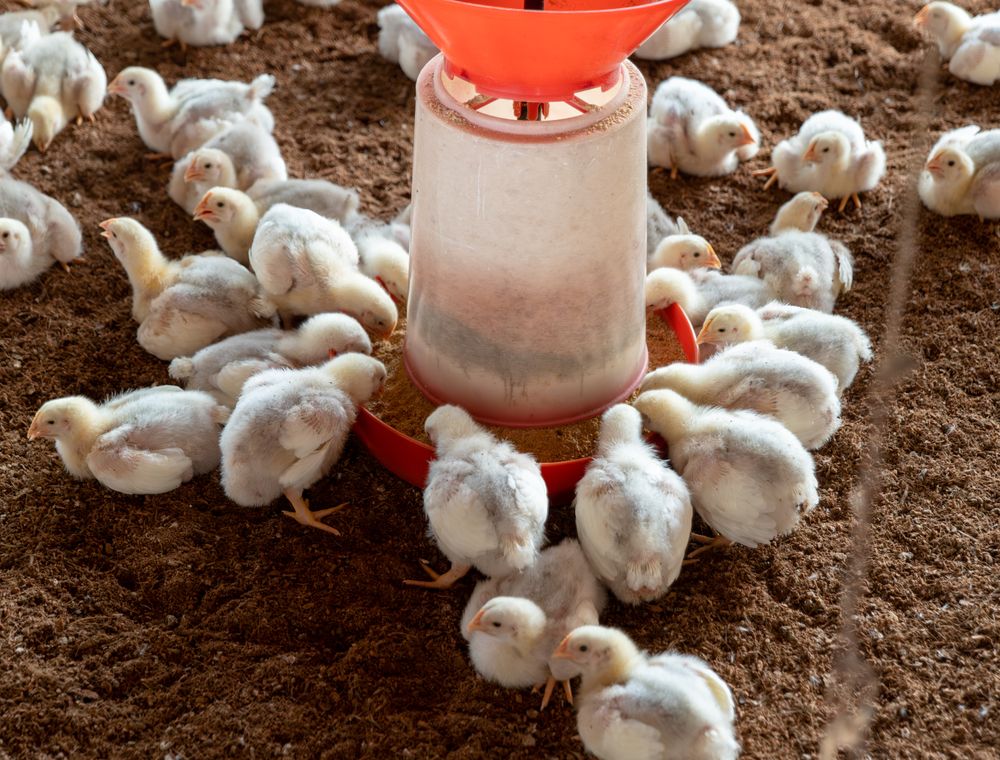
Short answer: Break-even is the point where the sales of a batch cover every cost of that batch, shown either as a number of birds or as a price per bird. In our 500-bird Cobb 500 example, the batch breaks even at 385 birds sold at GH₵110 live, or at GH₵88 a bird if 480 survive. Work it out before you order chicks, and rerun it whenever feed, mortality or price moves.
Key takeaways
- Break-even is the point where batch sales cover every cost, including the cost of birds that died.
- Load the full cost of each chick and feed bag onto the birds placed. Deaths raise the price you need.
- At GH₵110 a bird and 4 per cent mortality, the 500-bird example breaks even at 385 birds sold.
- Price per bird is the number to watch. A GH₵11 drop in the live price moves break-even by about 43 birds.
- Redo the sheet before every batch, then check it against actual mortality and price afterwards.
Break-even is the finish line, not the target
A break-even figure is only as honest as the deaths you put into it. Leave out the chicks that died in week two, and the feed they ate before they died, and the sum will tell you a batch pays off sooner than it really does. Get that part right and the rest of the sum is simple.
Break-even is the point where the sales from a batch equal every cost of that batch. Below it, the batch loses money. Above it, the batch makes a profit. You can express it two ways: as the number of birds you must sell at a given price, or as the price per bird you need from a given number of sales. Both answers come from the same figures, and you should work out both.
Break-even tells you whether one batch can pay its own way. It does not tell you what the money you tied up is earning over time. The ROI guide on this blog answers that second question, and the two figures together give a fuller picture than either one alone.
Costs that follow the birds, and costs that sit still
Before any arithmetic, split every cost into two groups. The first group is paid for each bird you place. The second is paid once per batch, whatever the bird count. The table uses a 500-bird Cobb 500 batch, with the figures we use in this article.
| Cost | Does it follow the birds? | Figure for the 500-bird batch (GH₵) |
|---|---|---|
| Day-old chicks | Yes, paid for every chick placed | 10,000 (500 at 20 each) |
| Feed | Yes, every bird placed eats until it leaves | 23,000 (about 46 a bird) |
| Medicines and additives | Yes | 1,000 (assumed 2 a bird) |
| Litter and bedding | No, per batch | 1,500 |
| Power and brooding fuel | No, per batch | 2,000 |
| Casual labour | No, per batch | 1,800 |
| Transport to market | No, per batch | 1,000 |
| Packing and sundries | No, per batch | 500 |
| Overheads share (house, phone, licence) | No, per batch | 1,500 |
| Total cost of the batch | 42,300 |
The costs that follow the birds are the ones that catch people out. They are owed for every chick you place, whether that chick lives or dies. The costs that sit still are the same whether you place 500 birds or 400, provided the house holds them. Keep the two groups on separate lines in your sheet, so you can see which one moves when something changes.
The chicks you place carry the cost, and the birds you sell carry the income
Here is the part that trips people up. You pay for 500 chicks, so you carry the cost of 500 chicks. You sell 480 of them, so you earn from 480. Dead birds do not reduce the cost. They reduce the income. A break-even calculation has to load the full cost onto the birds placed, and the revenue onto the birds sold.
Look at what happens when the sum is done the other way. Take the live price of GH₵110, subtract the chick, feed and medicine cost of GH₵68 per bird, and you get a margin of GH₵42 a bird. Divide the GH₵8,300 of per-batch costs by GH₵42 and you get about 198 birds. That answer is wrong. It assumes every chick you paid for becomes a sale, and it leaves out the feed the dead birds ate. The honest answer is 385 birds, almost twice as many. It is an easy mistake to make in a spreadsheet, which is why we spell it out.
The worked batch: 500 Cobb 500 chicks, one cycle
The example is one batch of 500 Cobb 500 chicks, bought at our from-price of GH₵20 each, reared to market weight and sold live at GH₵110 per bird of about 2.5 kg. The chick price is the one we quote. The feed, medicine and per-batch figures are assumptions made for the arithmetic, so replace them with your own quotes before you rely on the result. For the feed, we assume about 4.2 kg per bird at GH₵11 a kilogram, which rounds to GH₵46 a bird. Check that against your feed merchant's price this week.
Cobb 500 chicks are on our broiler day-old chicks page, and the chick price list shows the current from-prices. If you want the breed background first, the Cobb 500 guide covers how the bird grows and what it eats.

On the sales side, we assume 4 per cent mortality over the cycle. That leaves 480 birds to sell. At GH₵110 each, the batch brings in GH₵52,800. Against total costs of GH₵42,300, that is a profit of GH₵10,500 for the cycle. Those are the numbers the rest of this article works from.
How many birds you must sell to break even
The formula is short. Break-even birds sold equals total cost divided by the price per bird sold. With total cost of GH₵42,300 and a live price of GH₵110, the sum is 42,300 divided by 110, which gives 384.5. Round up, and you need 385 birds sold.
That is 77 per cent of the 500 placed. Put the other way round, you can afford to lose 115 birds, or 23 per cent of the batch, before it stops paying. At 4 per cent mortality you sell 480, which leaves 95 birds of room above break-even. That is a real margin, but a thin one. A bad week of heat, a vaccine reaction on day 18 or a night when 40 birds are taken would consume much of it.
Work the figure through for your own batch, using your own cost total. The number of birds you need to sell is the number to pin to the wall of the house, because it is the one you can count on the morning of the sale.
The price you need per bird at the gate
Now turn the question around. Given the birds you expect to sell, what price per bird covers the costs? At 4 per cent mortality and 480 birds sold, the sum is GH₵42,300 divided by 480, which gives GH₵88.13 per bird. Every cedi above that is profit. At GH₵110 you clear about GH₵22 a bird, and across 480 birds that is the GH₵10,500 shown above.
Price per bird is the number to ask every buyer and every trader for. If a buyer offers GH₵95 at the farm gate, the margin falls to about GH₵7 a bird. A few more deaths than planned would then take the batch under water, and the sale would look fine on the day and hurt at the bank a week later.
Write the break-even price next to the price you have been quoted, and do not sell below it without knowing why. Sometimes it makes sense to sell a batch below break-even, for example to clear a house before a disease reaches it, but that should be a decision you make on purpose, with the loss written down.
Mortality against price: the grid to print and pin up
The table below holds the same 500-bird batch and the same GH₵42,300 of costs. Only mortality and price change. The last two columns show profit at GH₵110 and at GH₵100, the second being a plausible price in a flat week.
| Mortality | Birds sold of 500 | Break-even price per bird sold (GH₵) | Profit at GH₵110 (GH₵) | Profit at GH₵100 (GH₵) |
|---|---|---|---|---|
| 2% | 490 | 86.33 | 11,600 | 6,700 |
| 4% | 480 | 88.13 | 10,500 | 5,700 |
| 8% | 460 | 91.96 | 8,300 | 3,700 |
| 12% | 440 | 96.14 | 6,100 | 1,700 |
| 15% | 425 | 99.53 | 4,450 | 200 |
Read across any row and the outcome moves quickly. A farm that rises from 2 to 8 per cent mortality loses about GH₵3,300 of profit at GH₵110, and about GH₵3,000 at GH₵100. At GH₵100 the batch only just breaks even at around 15 per cent mortality, which is about 77 birds lost out of 500. That is why a farm with weak vaccination or poor litter management feels the price so sharply.
Need chicks for your next batch?
Send breed, number and town. We reply with price, hatch date and delivery cost in writing.
Price is the lever you do not control
Mortality is partly yours to manage. Price is not. A fall of GH₵11 a bird, which is 10 per cent off the live price, moves break-even from 385 birds to 428. That is 43 more birds to sell from the same batch, and it leaves only 72 birds of room.
Seasonal demand matters here. The festive weeks at Christmas, Easter and Eid can lift the price for a few weeks, and the weeks either side can be flat. Plan the batch so its sale week falls inside demand you can count on, and line up a second buyer before the birds reach weight. Our guide to when to sell broilers goes through the timing in more detail.
Dressed or live: the same bird, a different break-even
Selling dressed changes the sum. Our dressed broiler price of GH₵120 is GH₵10 above the live price, but dressing, packing and the time you spend on them cost money. In this example we assume GH₵6 a bird for dressing and packing, which leaves GH₵114 a bird. Break-even then falls to 372 birds sold, from 385.
The gain is only GH₵4 a bird, so the dressed route pays only if your dressing is clean and quick and does not cost you a day's labour. Weigh a sample of dressed birds before you agree a price. A dressed price per bird that assumes a heavier bird than you have actually produced is no price at all. Chick delivery is a per-delivery cost, and the delivery page explains how it is confirmed before payment, so it belongs in the costs that sit still.
What the break-even leaves out, and why it still matters
Break-even does not include your own time, the cost of the capital you tied up, depreciation beyond the overhead share, or the loss from a disease outbreak. It is also a single-batch figure. It tells you whether this batch can pay its own way, not whether the farm makes sense over a year.
For the return on the money you tie up, use the ROI guide. For the cash you need before the first sale, the business plan guide is the right place to start. Break-even's job is narrower: it tells you whether the batch you are about to buy has a chance of covering its own costs.
Running the break-even for each batch, with a checklist
- Write down the cost of every chick, feed bag and medicine you expect to use, with the date you priced it.
- Split each cost into the part that follows the birds and the part that sits still.
- Divide the total cost by the price per bird you can realistically get, not the best price you have heard of.
- Use a realistic mortality figure, based on your last two batches, and divide the total cost by the number of birds you expect to sell.
- Write the break-even count and the break-even price on the sheet, and the margin beside them.
- After the batch, put the actual mortality, the actual feed used and the price achieved beside the forecast.
- Redo the sum before every new order, because one change in feed or price moves the answer.
A small change in an input moves the answer more than most farmers expect. A rise of GH₵1 a kilogram in feed adds GH₵2,100 to this batch and pushes break-even up by about 19 birds. When the feed merchant changes the price, update the sheet before you pay the next bill. If you are ready to order, the order form is the next step, and WhatsApp +233 24 915 1503 will confirm the chick price in writing before any money moves. Questions about batch timing are answered on our FAQ page.
Questions farmers ask
What is break-even in simple terms?
Break-even is the number of birds you must sell, or the price you must get per bird, for sales to equal every cost of a batch. Below it, the batch loses money. Above it, the batch makes a profit. It is a finish line rather than a target, and it works best when you calculate it before you order the chicks, not after the lorry has left.
Is break-even the same as profit?
No. Break-even is the point where profit is zero. Anything you sell above it is profit, and the gap between break-even and your actual sales shows how much room you have. In the 500-bird example, selling 480 birds at GH₵110 gives GH₵10,500, while break-even is 385 birds. The profit is the gap, not the break-even figure.
Why do I include the chicks that died?
Because you paid for them. Dead chicks do not reduce your costs, they reduce your income. If you leave them out and divide the costs by the birds you sold, you get a break-even that is too low, sometimes by a wide margin. Put the full cost on the birds you placed and the income on the birds you sold.
How often should I recalculate break-even?
Before every batch, and again whenever feed, chick or sale prices move noticeably. A rise of GH₵1 a kilogram in feed on a 500-bird batch moves break-even by about 19 birds. It takes a few minutes to rework, and it is the difference between spotting a problem early and finding it at the market.
Can I use break-even for a laying flock?
Yes, but the sum is different. Eggs are sold by the crate, and a laying flock produces over many months rather than one cycle. Our egg business guide works through break-even per crate for a laying flock, which is a separate calculation from the broiler example here.
Does break-even include my own labour?
Not unless you put it in. If you work on the farm and do not pay yourself, your break-even figure will look kinder than your real cost. Decide whether to include a labour line and stay consistent. A farm that cannot cover a wage for its owner is not earning what the batch figure suggests.
Do chick delivery costs go into the break-even?
Yes, if you pay them. Delivery cost is confirmed before you pay, so you can put the actual figure in the sheet before you commit. It is charged per delivery rather than per bird, so it belongs with the costs that sit still, but it still has to appear in the total.
What if I sell some birds dressed and some live?
Split the sales by route and calculate break-even on the blended price per bird. Track which route each bird went through, because the dressed route brings extra labour and cost. A blended figure is only as good as the counts behind it, so note how many birds left the farm on each route on the day they went.


