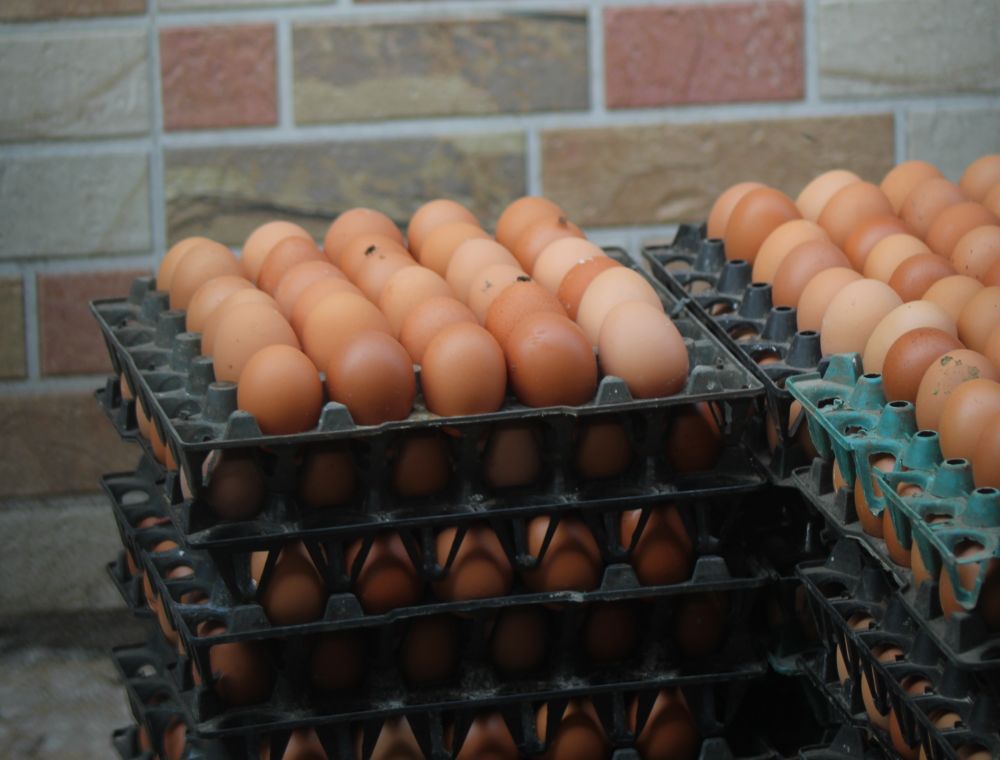
Short answer: To choose fertile eggs for hatching in Ghana, start with the flock they came from, then check size, shape, shell quality and storage age. Good hatching eggs are clean, uncracked, of normal oval shape, close to the typical weight for their breed, and no more than about seven days old when they go into the incubator. Ask the seller for the flock's age, vaccination history and the date the eggs were collected before you pay.
Key takeaways
- The flock behind the egg matters more than the egg's size or colour.
- Choose medium-to-large eggs with a normal oval shape, and reject very small, very large, round or pointed ones.
- Shells should be clean, smooth and unbroken. Never wash hatching eggs.
- Eggs older than about seven days hatch noticeably worse, so ask for the collection date.
- Inspect every tray on arrival and write down what you find before you set the eggs.
Why the egg you choose decides the hatch
Most people think of incubation as the hard part, and it is important. But at our hatchery in Kasoa we have learned that a large share of disappointing hatches begin in the nest box, long before the egg reaches a machine. An incubator can only do so much with an egg that was weak, dirty or old when it was laid. Temperature and humidity can support a good embryo, but they cannot rescue an egg that was never capable of developing properly.
Choosing fertile eggs is therefore a selection job. You are looking for eggs that have the best chance of containing a live, healthy embryo and that have kept that chance intact on the journey from the nest to your setter. Each of the checks in this article is a way of narrowing the field. None of them guarantees a result on its own, but together they tell you whether the eggs deserve a place in your incubator.
It also helps to be realistic about fertility. Not every egg from a breeding flock will be fertile, and a flock that is healthy and well managed still produces some eggs that will not develop. The aim is to start with the best eggs you can source, handle them carefully, and set enough of them to meet your target number of chicks.
Start with the source: the flock behind the egg
The single most useful question you can ask is where the eggs came from. A fertile egg is only as good as the breeding flock that laid it. A well-managed parent flock, kept in clean conditions, vaccinated on schedule and fed a balanced ration, produces eggs with much better hatching potential than a flock kept in a crowded or dirty yard with no records.
Before you buy, ask the seller these questions and write down the answers:
- What breed is the parent flock, and is it a layer or a dual-purpose line?
- How old are the hens and the cockerels? Eggs from very young or very old breeders often hatch less well.
- What is the male-to-female ratio in the pen?
- Which diseases are the parent birds vaccinated against, and when was the last round given?
- On what date were these particular eggs collected, and how have they been stored since?
- Has the flock had any disease outbreak in the past few months?
A reputable seller will answer these questions without fuss. If a seller cannot say how old the flock is or when the eggs were laid, treat that as a warning. For readers who want to understand how breed choice shapes the rest of the operation, our breeds page sets out the main lines we work with and how they differ.
Size and weight: what a good hatching egg looks like
Egg size is one of the first things growers look at, and it is worth understanding why. Within a flock, eggs of a consistent medium-to-large size tend to carry enough yolk and albumen to support a full-term embryo. Very small eggs often carry too little reserve, and the chick that emerges can be weak or undersized. Very large eggs can be a sign of a young hen still settling into lay, or of a double yolk, and both tend to hatch poorly.
Breed matters here. Heavy breeds lay bigger eggs than light breeds, so the right weight depends on what you are hatching. The table below gives general guidance you can use when you hold an egg in your hand and compare it with what the seller says the flock produces.
| Egg size class | Typical weight (approximate) | What it means for the hatch |
|---|---|---|
| Small | Under about 50 g | Often a small yolk reserve. Usually a weaker chick. Set only if nothing else is available. |
| Medium | About 50 to 55 g | Acceptable for light breeds. Look for uniform weight across the tray. |
| Standard | About 55 to 65 g | The normal range for most commercial layer and dual-purpose hatching eggs. |
| Large or oversize | Above about 65 g | Check for double yolks and young-hen eggs. Hatch often drops, so set with caution. |
The most important point is uniformity. A tray where the eggs are all close in weight usually reflects a healthy, mature flock. A tray with wide variation suggests a mixed flock or a flock with management problems. Weigh a sample of five or six eggs on a kitchen scale if you have one. Record the average, because it becomes a reference when you later compare hatch results across different suppliers.
Shape: why normal oval beats round and pointed
A normal hatching egg is a smooth oval with one end slightly broader than the other. The shape is not cosmetic. The air cell, which the chick uses for its first breaths before it pips the shell, sits in the broad end, and the embryo is positioned to use that space. Eggs that deviate strongly from the oval often have an uneven distribution of contents or a shell that is not formed correctly.
Here is what to set aside when you sort a tray:
- Round eggs that look almost spherical. They often have a thin or irregular shell and can hatch poorly.
- Pointed or elongated eggs that taper strongly at one end. These can indicate a problem in the laying hen's oviduct and are best left out.
- Wrinkled or ridged eggs. Surface ridges usually point to a shell-forming problem, sometimes linked to stress, feed imbalance or disease.
- Eggs with a visible waist or bulge. Double-yolkers and eggs with two shell membranes do not hatch reliably.
Shape problems are sometimes seasonal. In the hot, dry part of the year, when temperatures in the poultry house climb, you will see more soft or misshapen eggs in some flocks. If you buy during a hot spell, look more closely at shape than you would in the cooler months, and ask the seller how the house is being managed.
Shell quality: clean, smooth and unbroken
The shell is the egg's first line of defence. It is porous enough to let the embryo breathe during incubation, but it also has to keep out bacteria, and a healthy shell does both jobs. When you inspect a tray, look at the surface under good light, ideally with a torch held behind the egg. You are checking for hairline cracks, thin patches, chalky spots and rough texture.
Cracks are the most serious shell fault. A crack lets bacteria in and lets moisture out, and it can kill the embryo long before you open the incubator. Reject every cracked egg, even if the crack looks small. Thin or chalky shells are less obvious, but a shell that feels light or powdery on the surface usually means a weaker barrier against infection.
Dirt on the shell needs careful handling. Many growers instinctively wash eggs, but this is one of the most common mistakes. Hatching eggs have a natural protective coating, sometimes called the bloom, and washing removes it and can drive bacteria through the pores. The usual practice is to leave clean eggs alone and to remove only light dust or straw particles with a dry cloth. Heavily soiled eggs are generally better left out than cleaned, because the contamination may already be inside the pores.
- Reject all cracked eggs, including hairline cracks.
- Reject eggs with heavy, wet or smeared dirt.
- Do not wash eggs before setting.
- Keep eggs with a rough, chalky or unusually thin shell out of your setter.
Storage age: how old is too old
Storage age is the factor growers most often underestimate. An egg begins to age the moment it is laid. Its moisture escapes slowly, the albumen thins, and the yolk drifts toward the shell. Each day the egg spends outside a suitable environment, its chance of hatching falls. The effect is gradual, which is why many people do not notice it until the hatch disappoints.
As a general rule used across the poultry industry, the freshest eggs hatch best, and the hatch declines as storage time increases. The table below is a planning guide, not a promise. Your own results will depend on how the eggs were stored, the breed, and the health of the flock.
| Days since collection | Expected hatch potential | Hatchery advice |
|---|---|---|
| 1 to 3 | Best | Ideal for setting. Plan your hatch around these eggs where possible. |
| 4 to 7 | Good | Acceptable. Store them correctly and set them on schedule. |
| 8 to 10 | Reduced | Usable if nothing fresher is available. Expect fewer chicks and set extra. |
| 11 to 14 | Poor | Only use if you have no alternative, and treat the result as a learning exercise. |
| Over 14 | Very poor | Avoid. The cost of incubator time is usually better spent on fresher eggs. |
When you buy, ask for the collection date and calculate the age yourself. Do not rely on the seller saying the eggs are fresh. Write the collection date on the tray and the date of arrival on the box, so there is no confusion later. For the storage conditions that keep eggs in good shape between collection and setting, read our guide on how to store fertile eggs before incubation.
Inspect the eggs on arrival, before you pay in full
The inspection does not end when the eggs are in your hands. Transport is hard on eggs. A bumpy journey in the back of a car, a long wait in the sun, or a box left in a hot room can crack shells, shift air cells and speed up ageing. A careful buyer inspects the eggs at the point of handover, and asks to see them before the money changes hands.
Use this checklist each time you receive a batch:
- Open the box in shade, not in direct sun.
- Count the eggs against the number you ordered and note any shortfall.
- Look at every egg for cracks, dirt, damp patches and leaking.
- Smell the box. A sulphur or rotten smell means a broken egg has leaked inside.
- Feel the eggs. They should be cool, not hot, and not wet.
- Note the number of eggs that look unsuitable and keep them separate from the rest.
- Take a photo of the tray before you put anything in the incubator, so you have a record.
If many eggs fail this check, raise it with the seller straight away and agree what happens next. Good suppliers take a fair view of transport losses and make the matter right. If the eggs are sound, place them in a cool, clean, stable spot and set them as soon as you can.
Need chicks for your next batch?
Send breed, number and town. We reply with price, hatch date and delivery cost in writing.
Local or imported parent stock: what changes for the buyer
Growers often ask whether they should buy eggs from local parent flocks or from imported lines. The honest answer is that the source matters more than the label. A local flock that is well kept, vaccinated and recorded can produce excellent hatching eggs. An imported flock that arrives stressed, is poorly managed on the farm, or is bred for a specific market can produce disappointing eggs. The questions in the earlier section apply in both cases.
At Halaal Farms we hatch locally using European parent stock and also import from the Netherlands, Belgium and Germany. The breed you want depends on your goal, whether that is meat, eggs or a dual-purpose bird. If you are still deciding, our comparison of imported and local day-old chicks explains the trade-offs in more detail, and the imported chicks page describes the supply side.
Whatever source you choose, keep the paperwork. Record the supplier, the breed, the collection date and the quantity. When you later compare hatch results across batches, these records tell you which source gave you better eggs, and that is far more useful than memory.
How many eggs to buy: a worked planning example
Growers rarely plan for the eggs that will not hatch, and then they are short of chicks on the day they need them. A simple calculation avoids this. Suppose you want 200 healthy chicks for a broiler cycle. You will not set exactly 200 eggs, because some will be infertile, some will die during incubation, and some will hatch weak. You need a planning margin.
Here is a worked example. You decide to set 240 eggs, which gives you a margin of 40 extra eggs above your target of 200. You expect the hatch to be uneven, so you plan the setting in two batches of 120 and leave yourself the option of topping up if the first candling shows a large number of clear eggs. Note that this is planning arithmetic, not a promise about your results. Your actual margin depends on the flock, the storage age and how well the incubator is managed.
- Set your target number of chicks.
- Add a margin for infertile eggs and early losses.
- Check how many eggs you can fit in your setter at once.
- Confirm the date the eggs will be ready, and make sure you have room in the hatcher.
If you are not sure how many chicks you need, our guide on how many chicks to start with helps you size the first batch. Once you know your target, you can order eggs or chicks with confidence, and call us on WhatsApp at +233 24 915 1503 if you want help working through the numbers.
Questions to ask before you pay
A short conversation with the seller before payment can save you a great deal of trouble. Use the list below as a script. You do not need to ask all of these in one message, but you should have answers to all of them before the eggs leave the farm.
- What is the exact collection date for this tray, and how many days have passed?
- How were the eggs stored between collection and today?
- Are the eggs from the same flock and the same day, or are they mixed?
- Can you show me the tray before I pay?
- What happens if many of the eggs are cracked or infertile when I open the box?
- Do you have a record of the flock's vaccinations and recent health?
Ask for the price in writing and confirm payment method before you transfer anything. Halaal Farms gives the price in writing before payment and accepts mobile money, bank transfer or cash. If you are buying fertile eggs from us, you can see what is available on the fertile eggs page, or place a request through the order form. For farms that want the hatching step done for them, our egg hatching service page explains how that works.
Common mistakes growers make when choosing eggs
In our hatchery we see the same mistakes repeated by growers who are otherwise careful. Most are easy to avoid once you know them, and each one is worth checking against your own buying habits.
- Buying on price alone. The cheapest tray is often the oldest or the least well documented. Compare the cost per chick you expect to hatch, not the cost per egg.
- Choosing by colour. Shell colour is breed-dependent and tells you little about fertility or quality. A brown egg is not better than a white one just because it is brown.
- Setting eggs straight from a hot car. Eggs that have been baking in transport need time to return to a stable temperature. Rushing them into the setter can stress the embryo.
- Ignoring the first candling. Skipping the early check means you may keep infertile or dead eggs in the setter until the late stages, wasting heat and incubator space.
- Failing to record anything. Without records you cannot tell whether a poor hatch came from the egg, the incubator or the handling.
When in doubt, ask for help. Our team answers questions on WhatsApp, and farm visits are available by appointment for growers who want to see the flock and the eggs before they buy.
Questions farmers ask
How do I know if a fertile egg is good for hatching?
Check the source first, then look at size, shape and shell. A good hatching egg comes from a healthy, recorded flock, has a normal oval shape, is clean and uncracked, and is close in weight to the rest of the tray. Storage age matters too. Eggs that are only a few days old usually hatch better than eggs that have waited a week or more.
Should I wash fertile eggs before setting them?
No. Hatching eggs have a natural protective coating that washing removes, and washing can drive bacteria into the pores of the shell. Remove light dust with a dry cloth and leave clean eggs alone. Heavily soiled eggs are usually better left out of the setter altogether.
What size of fertile egg hatches best?
Medium-to-large eggs with a standard weight for the breed usually give the best results. Very small eggs often carry too little yolk reserve, and very large eggs can be double yolks or come from young hens. Breed matters, so compare the eggs against what the flock normally produces.
How old can fertile eggs be before I set them?
As a general guide, eggs from one to seven days old give the best hatch. Eggs of eight to ten days can still be used if nothing fresher is available, but you should expect fewer chicks and plan to set extra eggs. Eggs older than about two weeks are best avoided.
Are cracked eggs ever worth setting?
Generally no. A crack allows bacteria in and moisture out, and it can kill the embryo well before the hatch. Even a small hairline crack is a reason to reject the egg. Remove cracked eggs from the tray on arrival so they do not contaminate the rest of the batch.
Does it matter whether the parent flock is local or imported?
The source matters more than the label. A well-managed local flock can produce excellent eggs, and an imported flock can disappoint if it is poorly handled. Ask about the flock's age, vaccination history and collection practice whatever the origin, and keep records so you can compare results across suppliers.
What should I ask a seller before buying fertile eggs?
Ask for the exact collection date, how the eggs have been stored, whether the tray is from one flock and one day, the flock's vaccination record, and what happens if many eggs are cracked or infertile when you open the box. Get the price in writing before you pay, and inspect the tray before the money changes hands.

